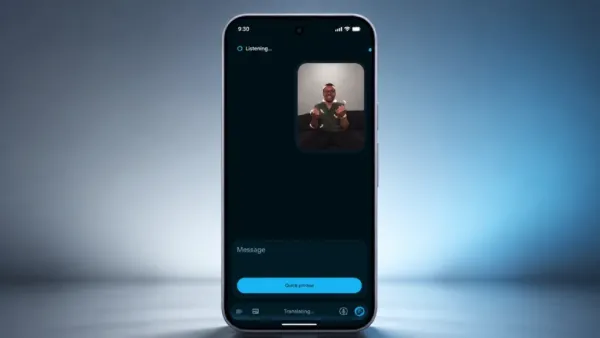
Sign-to-text is Google’s new accessibility feature that allows Deaf and hard-of-hearing users to sign to their phone and have their signing translated into text. Google DeepMind announced the technology on August 12, 2026, introducing its new sign-language-to-text (SL2T) model for consumer products. The feature powers sign-to-text dictation in Gboard and Live Transcribe on Pixel 11, initially supporting American Sign Language (ASL) to English. Google says more devices are coming soon, with additional languages to follow.
Google developed the technology with input from the Deaf community, with Deaf perspectives involved throughout the project, including data collection, evaluation and impact assessment. Google says the goal is to make sign-language communication more accessible through everyday smartphone technology.
How sign-to-text works
The technology works similarly to voice dictation, except that users sign in front of their smartphone camera. The input method on Gboard allows users to sign wherever they would normally type. This means users can sign messages, search the web, draft documents, or ask Gemini to answer questions or perform tasks.
This innovation gives sign-language users another input method without requiring them to type everything manually. Google says the feature is designed to work in places where users would normally use dictation, making sign language a more direct way to interact with supported Android experiences.
Google’s technology is not simply looking for individual hand gestures. Sign languages are independent natural languages with their own grammars and vocabularies. They also communicate meaning through simultaneous movements of the hands, arms, torso, head and face. That makes sign-language translation a complex computer-vision and machine-translation challenge.
Google says SL2T processes sign language as a sequence of pose landmarks rather than using the raw camera feed directly for translation. An on-device MediaPipe Holistic model tracks points on the signer, and only the resulting geometric coordinates are sent to the server for translation. Google says the original video can then be discarded immediately.
Live Transcribe
When used with Live Transcribe, the technology provides another way for users to participate in conversations. Live Transcribe was originally developed as an accessibility tool that converts spoken words into written text in real time for people who are Deaf or hard of hearing. Google has continued developing the service with accessibility and community feedback in mind.
The new sign-to-text capability allows users to make responses by signing. Instead of typing an answer, the person can sign toward the phone and have the message translated into text. This can reduce the need to type responses back and forth during conversations.
Google says testers found that signing in ASL could be faster and more natural than typing in English. The company is using this feedback alongside technical testing to improve the real-world usability of the system.
Pixel 11 Series Receives First Technology
Google is bringing the new technology to consumers through the Pixel 11 series. SL2T powers sign-to-text dictation in Gboard and Live Transcribe on Pixel 11, making the new Pixel generation the first consumer-device platform to receive the technology. Google says more devices will be supported in the future.
The technology is also designed to address situations where users may need to hold their phones while signing. Google says it has worked on improving performance for one-handed signing, which can be particularly useful when a person is holding a smartphone in the other hand.
The technology can also process two-handed signing. This is important because sign languages use more than isolated hand movements, with information also communicated through facial expressions, body position, and other movements.
Google says the initial rollout supports ASL-to-English translation. Additional devices are coming soon, while more sign languages will follow as Google expands the technology.
Leverage Sign-Language AI
The innovation is based on Google DeepMind’s sign-language-to-text (SL2T) model. Google says the model was trained on more than 100,000 hours of data covering more than 50 sign languages, with roughly one-quarter of the data consisting of ASL.
The model was designed to learn shared structures across different sign languages, dialects, and proficiency levels. Google says this multilingual training approach helps SL2T perform better than models trained on individual languages in its experiments.
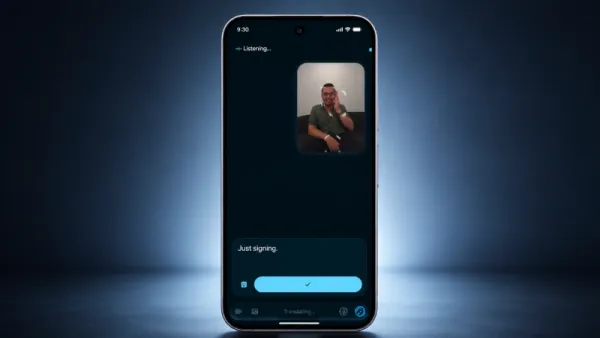
Sign language is much more complex than simply mapping hand movements to individual words. Movement, timing, spatial relationships, facial expressions and body position can all contribute to meaning. Google’s system therefore uses pose information to translate signing directly into text rather than relying on intermediate “glosses,” which can fail to represent some of the richer characteristics of sign languages.
Google also says it worked with the Deaf community throughout development. Deaf experts and organizations participated in testing, evaluation, and governance through the AI Sign Language Advisory Committee, helping shape the technology and its deployment.
Final Thoughts
The new sign-to-text feature from Google demonstrates how AI can be used to improve Android accessibility. By allowing users to sign to their phones instead of relying only on traditional typing, the technology creates another communication option for people who use sign language.
The initial implementation brings ASL-to-English sign-to-text dictation to Gboard and Live Transcribe on Pixel 11. Google says more devices and additional sign languages will follow, making the current launch an initial step toward broader sign-language support.
The technology also highlights the complexity of applying AI to sign languages. Rather than treating signing as a collection of simple hand gestures, SL2T analyzes broader body movements and translates landmark sequences into text. Google’s approach shows how advances in computer vision and multilingual AI could help make everyday digital communication more accessible.
-
UK MP Dhesi urges reopening of Kartarpur Sahib corridor in Amritsar
-
CII’s SME-to-MNC programme to create 25 new multinational firms
-
Karnataka cabinet approves bill to regulate use of public property
-
Fighting a bunch of jokers, no reason to fear RSS: Rahul Gandhi
-
Indian High Commissioner inaugurates India Corner at Kenya School