Pooch Ke Toh Dekho: When Gen Alpha Put India’s Biggest Brands On The Spot
Samira Vishwas | August 14, 2026 6:24 AM CST
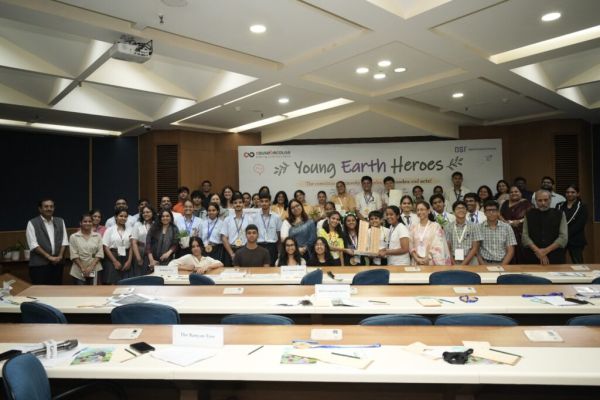
At around 11:40 on a humid August morning in New Delhi, the familiar choreography of a students’ event began to disappear. The speeches were over. Across a room at the India Habitat Centre, school students were sitting opposite representatives of companies whose products are part of their everyday lives. And they had questions.
An executive from one of the leading automobile companies of the country was asked a deceptively simple one: How much carbon dioxide does a car emit over its entire life cycle?
Not just from the factory or its tailpipe, but from the extraction of raw materials and manufacturing to transportation, years on the road and eventual disposal. What, ultimately, does one car cost the planet?
There was no hostility in the question. The student simply wanted an answer.
The representative explained why arriving at a precise figure was difficult, given that a manufacturer cannot control how much a car is driven, how long it remains on the road or how it is eventually discarded. The discussion, however, led somewhere more useful. The automobile brand here was Hyundai Motor India, which apparently has reported achieving RE100, with renewable-energy coverage across its offices and manufacturing facilities in India. Its latest Business Responsibility and Sustainability Report also acknowledges that it has not yet conducted a formal life-cycle assessment of its complete vehicles, although assessments have been facilitated for parts supplied by 40 key vendors.
The students applauded the renewable-energy achievement, then moved to the next question.
That exchange captured the spirit of “Pooch Ke Toh Dekho”, one of the central ideas at the fourth meetup of the Young Earth Heroes community. The proposition was simple: why don’t you just ask?
And so they did.
When Gen Alpha Puts Consumption On Trial
The programme gave students an hour to question representatives of a leading automobile brand, a popular bottled water company and a beverage packaging giant under the deliberately direct proposition: “Dear Brand, How Responsible Are You?”
It is a question that has become increasingly difficult to avoid.
For decades, prosperity has been closely associated with accumulation: more clothes, more cars, newer phones, more packaging, greater convenience and shorter cycles between wanting something and replacing it.
The ecological arithmetic is becoming harder to ignore.
The United Nations estimates that the global material footprint — the raw materials extracted to satisfy final consumption — grew from 57.4 billion metric tonnes in 2000 to 98 billion tonnes in 2022, a 71 per cent increase. The UN Environment Programme has warned that, without significant changes, resource extraction could rise another 60 per cent by 2060 compared with 2020 levels.
These numbers are usually discussed in policy rooms and climate conferences. But every billion tonnes eventually becomes something intimate: a bottle on a desk, a pair of shoes, a carton in a bin, a phone replaced before it stops working.
That makes consumption an uncomfortable conversation, particularly in relatively affluent urban communities.
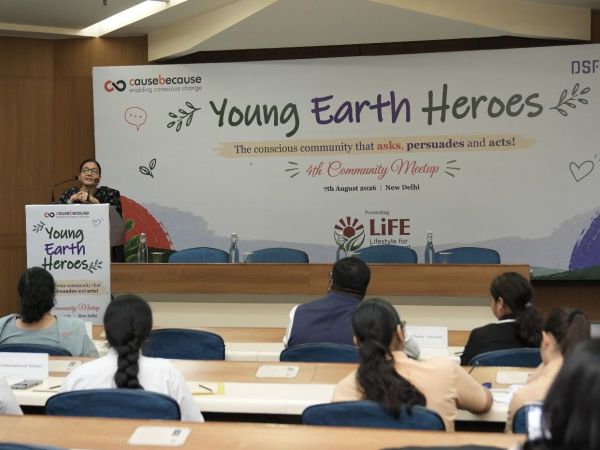
Student captain Siyona Munjal acknowledged as much in her welcome address, pointing out that many members of the community, herself included, come from comparatively privileged backgrounds with greater access to private transport, air-conditioning, electronics, packaged products and travel.
Greater consumption, she argued, also creates greater responsibility.
That raises a question beyond individual behaviour: how much responsibility should consumers, particularly young ones, place on the companies producing what they consume?
A Jacket That Had Survived 47 Years
Earlier that morning, K. J. Alphons, former Union Minister and IAS officer, had offered the room a sustainability lesson without a chart.
He was wearing it.
Alphons told the students that his jacket was 47 years old — the same one he had worn when he entered the IAS academy nearly half a century ago.
There are sophisticated theories of circularity, product longevity and resource efficiency. The jacket reduced them to a simpler question: why replace something that still works?
For a generation growing up in an economy organised around upgrades, seasons and planned desire, the jacket made a surprisingly radical argument.
The programme had titled Alphons’ address “Sustainable consumption, the way of life.” His jacket supplied the footnote.
Divya Datt, Deputy Country Head of UNEP in India, approached the question from another angle. Adults, she told the students, had made many of the mistakes that produced the environmental predicament they were inheriting. Yet children are often the ones now being asked to conserve resources and save the planet.
Then she invoked Spider-Man.
“With great power comes…” she began.
“Great responsibility,” the students finished.
The laughter loosened the room, but the argument remained. Responsibility is not the same as blame. A generation can inherit a problem without having created it. The question is what it does once it understands the problem.
Siyona put the idea more sharply: young people, she said, should not merely be asked to learn about sustainability. “They should also be given the opportunity to influence the behaviour of grown-ups.”
That inversion ran through the day. Adults were no longer simply teaching students. Students were beginning to question adults.
Building A Community Beyond The Screen
The Young Earth Heroes meetups are part of CauseBecause’s effort to bring students, teachers, experts, businesses and environmental organisations into the same physical space. The format is deliberately more interactive than a conventional awareness programme, with students taking on roles in sessions and questioning speakers directly.
The emphasis on physical interaction is significant at a time when much of young people’s social and environmental engagement takes place online.
Ranjan Rayna, co-founder and chief strategist of CauseBecause, said the initiative is intended to give young people reasons to step away from screens and engage directly with the world around them.
“At a moment when narratives, identities, friendships and even outrage are increasingly manufactured through screens,” he said, “I believe Gen Z and Gen Alpha need reasons to physically enter the world — to meet, to disagree, to sit across a table from a corporation, to visit communities whose lives bear little resemblance to their own, to understand where things come from and where they go.”
For students from relatively privileged households, those encounters can also expose them to how differently environmental problems are experienced.
Kamala Menon of the Delhi Science Forum pointed to the contrast between a child who can escape extreme heat by moving into an air-conditioned room and a worker who may have to spend eight more hours delivering food, laying bricks, pulling a rickshaw or cleaning a street because not working means not being paid.
“There is an ethical seriousness in that,” Menon said. “Climate change is universal, but its suffering is not. An environmental education that never crosses that boundary risks becoming merely aesthetic.”
The Consumer Is Changing
Perhaps the most significant shift is not happening in the companies being questioned, but in the consumers asking the questions.
Gen Alpha is growing up with an awareness of climate, waste, inequality and corporate responsibility that previous generations often acquired much later. Labels and slogans may no longer be enough. They are likely to ask where products come from, what they cost the planet and what happens after they are discarded.
That does not automatically make them more sustainable consumers. But it does make them more questioning ones.
And perhaps that is where the significance of gatherings like this lies. Not in whether a single student can force a corporation to provide every answer, but in creating a generation willing to ask for those answers in the first place.
Sometimes, change begins with something as simple as asking a question. look at the pooch.
With a decade of experience in journalism, Rituparna began her career covering politics before expanding into video storytelling, and eventually specialising in entertainment and lifestyle. A Kolkata soul with a boarding pass always ready, she reports, travels, and tastes her way through culture — one headline at a time.
The post Pooch Ke Toh Dekho: When Gen Alpha Put India’s Biggest Brands On The Spot appeared first on NewsX.
READ NEXT
-
Aston Villa may already have found a Morgan Rogers replacement without spending anything

-
Has the glow on the face disappeared? Use these products to clean the face, tanning will be destroyed

-
Simple ways to bring back the aroma of old spices

-
Should you be doing ‘reverse Kegels’ instead of regular ones?

-
Gal Gadot says motherhood turned her into a ‘lioness’