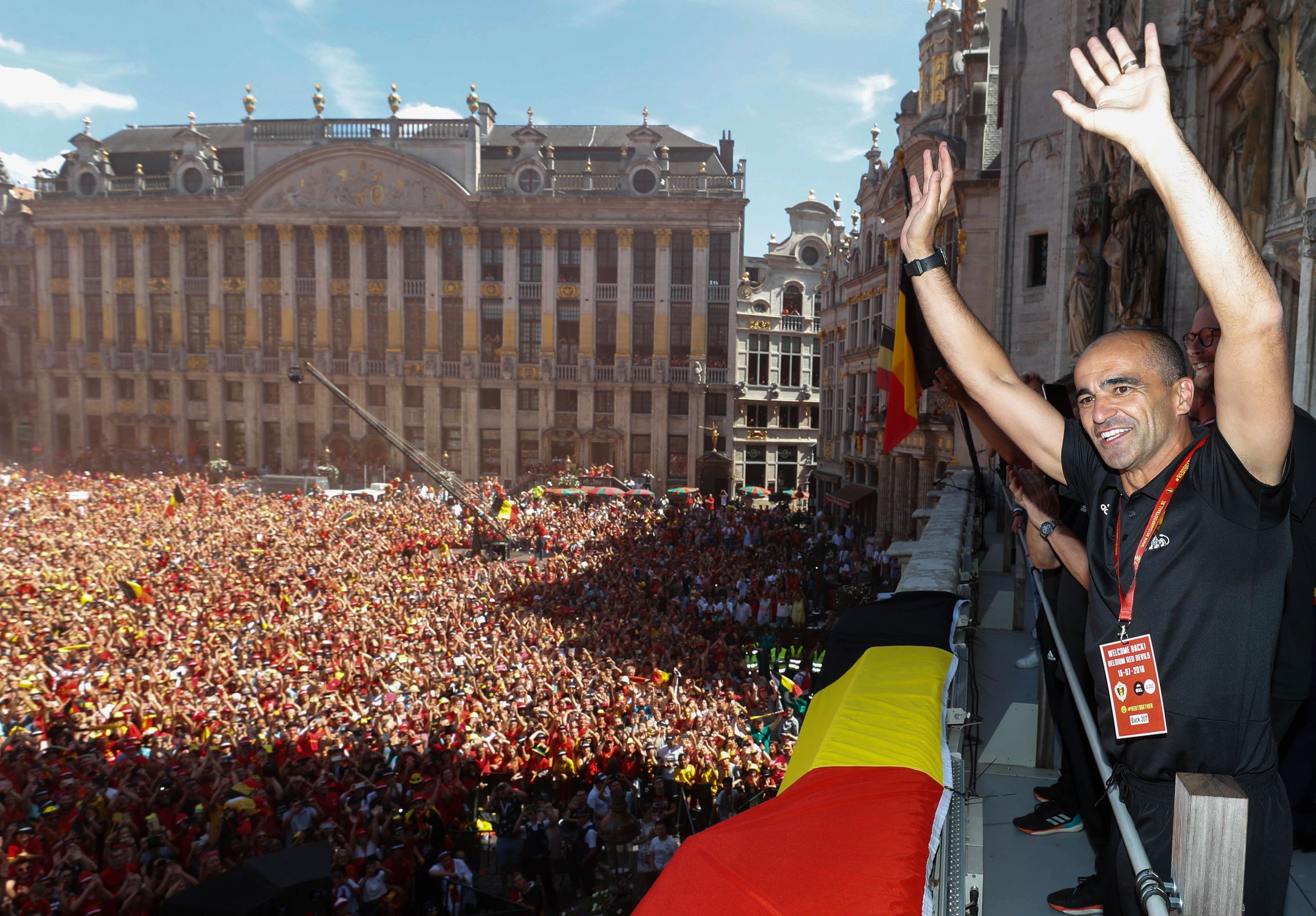
Did Roberto Martinez truly let down Belgium’s golden generation? Or did everyone simply expect far too much from a badly unbalanced squad packed with stars?
Poor Roberto Martinez. Wigan Athletic’s finest now appears to be in the frame for yet another of European football’s biggest international jobs, and there is hardly any excitement online about it. Instead, the reaction is full of claims that he squandered Belgium’s greatest-ever group of players, suggestions that he must know something sensitive about powerful figures at some of world football’s leading federations, and jokes that if his name were Bob Martin, he would be managing in League One.
After this summer, it is difficult for many to defend his Portugal spell and his choice to play a 40-something striker up front. And yes, it may well seem surprising that Martinez – whose finest achievement in football came within days of suffering relegation – continues to land some of the biggest jobs in Europe. Though, to give them some credit here, this would be a relatively forward-thinking appointment by Dutch football association standards, an organisation that seems to have misplaced its contact book around 15 years ago, only to find Ronald Koeman and Louis van Gaal’s phone numbers scribbled somewhere on an office desk for emergencies, and has since fluttered between the two like a moth trapped between two streetlights in a dead-end lane.
But seriously, the criticism over Belgium simply does not hold up. Yes, they had excellent players. Yes, he brought in Thierry Henry as a coach. But not every golden generation gets the ending it is supposed to, and that particular one probably should never have reached a World Cup semi-final in 2018 in the first place.
Even saying that sounds absurd. Thibaut Courtois in goal. Vincent Kompany marshalling the defence, with Toby Alderweireld and Jan Vertonghen alongside him. Youri Tielemans, Mousa Dembele, Yannick Carrasco and Dries Mertens available from the bench. And a front three of Kevin De Bruyne, Romelu Lukaku and Eden Hazard, for goodness’ sake.
If you were to list the 23 greatest footballers ever produced by Belgium, there is a strong chance that around 15 to 20 of them were in that squad. That team would probably win most leagues in Europe – and likely do it two or three times running. But tournament football rarely works like that. In fact, that has not been the pattern for almost every so-called favourite in international football over the past couple of decades.
Belgium had gone out of the previous two tournaments in the quarter-finals without much fight. For all the talent Martinez had at his disposal, the side had deep structural flaws across the pitch. He had absolutely nothing close to a natural left-back, so Nacer Chadli was forced into a wing-back role more out of necessity than tactical genius. At the time, that was widely viewed as the team’s biggest issue.
It was not, really. The shortage of central midfield options meant Axel Witsel – then playing in China – was the one dependable constant. Mousa Dembele had missed the final few matches of the season and looked well off the pace during the tournament, most notably when he was hauled off after an hour in the semi-final as Paul Pogba and N’Golo Kante ran the game around him. Tielemans was still only 21, Marouane Fellaini was essentially a battering ram, and De Bruyne sometimes had to drop deeper despite not being a double-pivot player.
Thomas Meunier was decent, if not outstanding. The back three, meanwhile, was reasonably solid, but ageing. The lack of pace from Kompany and Vertonghen placed a heavy burden on Alderweireld. Yet all attention naturally centred on the attack: a trio so gifted that it looked capable of rescuing Belgium from any situation and blowing away every opponent in its path.
And to underline the point again, yes, they probably would have done exactly that if this had been the Premier League. But here is where things become genuinely controversial: were De Bruyne, Hazard and Lukaku actually ideal players for tournament football?
Again, not really. They still did as much as they could. De Bruyne did not have a poor World Cup at all: in fact, he created the third-most chances of any player in Russia, behind Neymar and set-piece specialist Kieran Trippier. But coming straight after Manchester City’s historic 100-point season, there was a widespread expectation that he would dominate in his freer role and produce more than the one goal he scored.
He appeared quiet at times, but that would become a recurring theme in the playmaker’s knockout football career. He never quite escaped accusations of going missing in the biggest games, particularly in Europe – not helped by the fact that he was substituted in both Champions League finals he played while carrying injuries. But that was simply the kind of player De Bruyne was. In the very biggest matches, he tended to elevate those around him rather than smash one into the top corner himself. His only goal in 2018 came against Brazil, so it is not as if he vanished entirely in major matches, but in international tournaments he was more of a complementary force than the central match-winner many wanted him to be.
Even Hazard was hit with the familiar line about being ‘missing in big games’. The Chelsea legend scored only two Champions League knockout goals, and one of those was a penalty. Yet in 2018 he was utterly brilliant, and his display against Brazil was one of the best performances of the tournament – and, according to FourFourTwo, the 85th best of all time. He scored three goals in total, and there was not a great deal more anyone could have demanded from him.
Lukaku, meanwhile, finished the tournament with four goals and one assist, after his first season at Manchester United – yes, that really did happen. It is also fair to say that time has not been especially kind to the striker’s reputation in the biggest games. Despite scoring 93 goals for his country at the time of writing, and 26 of those coming against teams that have reached the top 10 of FIFA’s rankings since his debut, the lasting images of Big Rom at World Cups are not the braces he scored against Panama and Tunisia in Russia. Instead, people remember his awful outing against Croatia four years later, and his substitute appearances in the States, which remain fresh in the mind.
2018 also came at a point when the 25-year-old was midway through his conversion into a target man. In spite of his size and strength, Lukaku was never truly the kind of striker who held the ball up and linked play, with his first touch often criticised. He was at his best running off the shoulder of a defender, or playing alongside another Martinez – Lautaro, at Inter Milan. He became a less effective player when managers such as Jose Mourinho and Thomas Tuchel tried to turn him into something he was not. Yet at the 2018 World Cup, his role was to attack space, overpower defenders who could not cope with his movement, and do the thankless work of stretching the game so Hazard and De Bruyne could operate, because Belgium did not really have another elite runner in attack.
Martinez is often accused of not getting enough out of that front line, all of them at or around their peak, at the 2018 World Cup. But in the years since, there is a very strong case – close to watertight, in fact – that Hazard, De Bruyne and Lukaku each produced their best-ever international tournament that summer.
It is also fairly well established that Belgium were beaten by the better side. France were comfortably superior in every area, yet Belgium gave them their toughest match. The Red Devils beat England with ease twice, even if neither game carried much significance. They outplayed Brazil. Yes, they fell 2-0 behind against Japan, but they found a way through when it mattered most.
Belgium had the second-best players in the tournament, and they lost to the team with the best players. But they were a side full of brilliance without proper balance, and reaching the semi-finals was a genuine achievement.
By the time the Euros arrived three years later, the golden generation had already moved on from them. Kompany had retired, Vertonghen and Alderweireld were well beyond their best, and this was Real Madrid-era Hazard. Even so, they did not embarrass themselves. They won all three group-stage matches, albeit with the caveat that they faced an understandably shellshocked Denmark soon after Christian Eriksen’s cardiac arrest, then beat a very good Portugal side before losing to the eventual champions. So was that really underachievement? Or was it simply the level this group was always likely to reach?
It is very easy to look at the talent a team has on paper and label them failures for not winning a trophy. But that view is too simplistic. It ignores why a Croatia side with relatively few star names – but stars in exactly the right positions – so often outperform a Portugal team packed with high-profile attackers who do not always combine well. It also ignores why England looked so poor when trying to squeeze Jude Bellingham and Phil Foden into the same midfield, while a side like Spain are perfectly happy to take off a major name such as Pedri and replace him with Mikel Merino if it gives them more threat in the box.
International football is very rarely about who owns the best squad. More often, it is about who produces the best moments. Belgium had very few players who consistently created something from nothing in the biggest knockout matches: they were largely specialists in league football. Over a 38-game season, Roberto Martinez would probably have been criticised for not at least finishing in the Champions League places with that collection of players. But across only seven matches, he probably did well to take a side featuring Fellaini and Witsel in central midfield all the way to the last four of a major tournament.
And perhaps we have been too harsh on him. Perhaps the relegation with Wigan and a fairly forgettable spell at Everton have shaped a view that this is not a man who should be trusted with elite talent. No, he is not a world-beater. No, he did not perform miracles with Belgium. But did anyone really expect him to win the World Cup with that squad?
-
Barcelona confident of sealing Rodri deal with €70 million final package
-
Pooran Blazes MI London to Dominant Oval Victory

-
SpaceXAI Launches Grok 4.6 With Focus On Agentic AI: Here's What's New & Who Gets It

-
Israeli PM Benjamin Netanyahu Calls Britain 'Islamic Republic Of Britain', Warns Iran Must Not Get Nuclear Weapons

-
Virgo Tarot Horoscope Today, August 14, 2026: Difficulties May Have to Be Faced, Financial Gain Expected