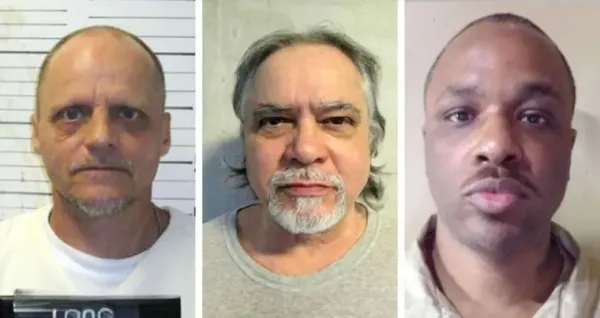
In America, on August 13, for the first time after 16 years, three people were given death penalty in three states on the same day. Executions by lethal injection in Tennessee, Oklahoma and Alabama intensified the debate over increasing death penalty use and declining public support.
Washington: In America, on August 13, 2026, for the first time after 16 years, three death sentences were executed in three different states on the same day. Anthony Darrell Hines, Carlos Cuesta-Rodriguez and Jeremy Williams were executed by lethal injection in Tennessee, Oklahoma and Alabama. This development has happened at a time when there has been a sharp increase in the use of death penalty in America since last year.
Hangings took place in three states on the same day
On August 13, three different states in the US imposed sentences under their own death penalty procedures. Anthony Darrell Hines, 66, was put to death in Tennessee for the 1985 murder of a motel employee. In Oklahoma, 70-year-old Carlos Cuesta-Rodriguez was hanged for the 2003 murder of his partner, while in Alabama, 42-year-old Jeremy Williams was sentenced to death for the rape and murder of a five-year-old girl. Lethal injection was used in all three cases.
It is extremely rare in American history for executions to occur in three states on the same day. Earlier this had happened in January 2010. In this sense, the events of August 13, 2026 are drawing special attention to the current era of death penalty in America.
Use of death penalty increases rapidly in 2025
The debate over the return of capital punishment in the United States is not new, but the number of executions has increased significantly in recent years. In the year 2024, 25 people were given death sentence, while in 2025 this number will increase to 47. The 2025 figure was the highest in the US since 2009. After the three executions on August 13, at least 22 people had been put to death so far in 2026.
Florida has played a particularly important role in this increase. Of the 47 executions nationwide in 2025, 19 took place in Florida alone. The use of capital punishment has been a major political issue during the tenure of Republican Governor Ron DeSantis, who has a strict stance on the death penalty in the state.
Debate also to the policies of Trump administration
It is difficult to see the current state of capital punishment in America in isolation from the policies of President Donald Trump. Trump issued an executive order strengthening the death penalty on January 20, 2025, his first day in office. The order had directed the states to give priority to the demand for death penalty in serious crimes at the federal level and take steps towards ensuring availability of drugs required for lethal injection.
In April 2026, the US Department of Justice also announced several steps to strengthen the federal death penalty. The department reported re-adopting lethal injection protocols, incorporating other methods such as firing squads, and speeding up internal processes for death penalty cases.
However, experts say the full impact of the president's policies on the number of executions is not immediately visible, as appeals and legal processes in death penalty cases can last for years.
Florida becomes the center of increasing use of death penalty
The death penalty in the US falls under the jurisdiction of both the states and the federal government. Florida remained the largest center of executions in the country in 2025. The state government has made several policy changes regarding the use of death penalty.
A change was made to the jury process associated with recommending capital punishment in Florida in 2023. Apart from this, changes were made in the laws to bring some serious crimes under the ambit of death penalty. Proponents argue that the death penalty for the most serious crimes can be an effective means of justice and deterring crime.
At the same time, human rights organizations and anti-death penalty groups say that such a sentence poses a risk of judicial error, discrimination and serious problems in the execution process.
Previous failed process in Tennessee raises concerns
The execution of Anthony Hines also brought to the fore an already ongoing debate about the execution process in Tennessee. His lawyers had previously sought relief in state court on the grounds that previous executions had revealed serious problems with the medical procedure officials were about to use.
Tony Carruthers' lethal injection procedure in Tennessee in May 2026 could not be completed for a long time. After this incident, questions were raised regarding the state's execution system and medical protocols. Despite this, the state administration decided to continue with its prescribed lethal injection protocol.
In Hines' case, his lawyers also raised concerns about his age and health. Despite this, final relief could not be obtained from the courts and the sentence was executed on 13 August.
American society's opinion on death penalty is changing
Interestingly, despite the increase in executions, support for the death penalty in American society is weaker than before. In Gallup's May 2026 poll, 52 percent of Americans found the death penalty morally acceptable. This is significantly lower than the levels of 56 percent by 2025 and 71 percent in 2006. Whereas 39 percent people considered it morally wrong.
This indicates that political and social attitudes regarding the death penalty in America are not uniform. While governments in some states are speeding up executions, support at the national level has been in decline for a long time.
Number of states with death penalty still large
America is one of the few Western countries where the death penalty still exists legally. Many states have abolished it or put a moratorium on executions, but it is available under the law in a large number of states.
Death penalty supporters consider it the ultimate and appropriate punishment for serious violent crimes. They argue that this provides justice to the victims' families and sends a strong message against extremely serious crimes. On the other hand, opponents say that the power given to the state to take a person's life can lead to irreversible consequences in the case of judicial error.
The process of hanging also became a matter of controversy
The debate in America is not only on whether there should be death penalty or not, but also on how it should be implemented. Lethal injection was the predominant method for a long time, but availability of drugs, objections from drug companies, and some problematic executions have led many states to consider alternative methods.
In some states, methods like firing squad and nitrogen hypoxia have also been used. This has started a new debate at the domestic and international level regarding the method of death penalty in America.
Decline in death sentences handed down by juries
Despite the recent increase in the use of the death penalty, a significant change is that American juries are handing out fewer death sentences than before. In the 1990s, more than 300 death sentences were carried out each year across the country, while this number has fallen significantly in recent years.
This contradiction reveals a complex picture of the American capital punishment system. On one hand, some states are increasing executions in old cases after the long legal process is completed, while on the other hand, the trend of giving death sentence in new cases is not the same as before.
The incident of three people being killed on the same day on August 13 has happened amidst this changing scenario. This development shows that death penalty is still a part of the justice system in America, but the debate continues regarding its use, methods and moral justification. It will be important to see in the coming years whether the current increase in executions becomes a permanent trend or whether it declines again due to changing attitudes of states and the public.
-
Tripura CM Manik Saha attends blood donation camps, calls it noble

-
UGC-NET 2026: NTA to re-conduct exams for 3 subjects due to errors

-
Salman Khan, Varun Dhawan celebrate David Dhawan’s 75th birthday

-
Haryana’s Teej festival celebrated with fervour at Lok Bhavan
-
Amit Shah: PM Modi aims for village prosperity via cooperative sector