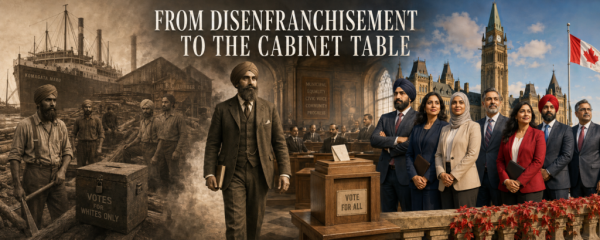
A century after South Asians were denied the vote, representation is no longer exceptional. Misconduct, imported conflicts, immigration backlash and rising anti South Asian hostility now test what earlier pioneers built.
By The Obnews Editorial Staff
Obnews Research Feature | Canada and Democracy | August 14, 2026

The Timeline
1907: Vote denied in British Columbia.
1947: Provincial voting rights restored.
1950: First elected threshold crossed.
2026: Representation under test.
Evidence Standard
Findings, penalties, allegations and political criticism are identified separately. Ancestry is never treated as evidence of conduct.
Reader’s Map
- The distance between two photographs
- Before representation came exclusion
- Naranjan Singh Grewall and the municipal foundation
- The provincial door opens
- Ottawa in 1993: the turban, the cabinet and the House
- Women, the Senate and institutional authority
- Representation has grown up. The standard must grow up too
- Where the public record establishes misconduct
- Jagmeet Singh: milestone, leverage and collapse
- Immigration backlash and anti Indian hostility are both real
- Who is doing serious work now?
- The builders’ code for the next generation
- What the pioneers actually built
Citation numbers in the text correspond to the source ledger. Current roles and policy status were checked through August 14, 2026.
Editorial Note on Language and Evidence
This article uses “South Asian” in its Canadian statistical and civic sense. The term includes people whose roots are in India, Pakistan, Sri Lanka, Bangladesh, Nepal and neighbouring societies, as well as families who reached Canada through East Africa, the Caribbean, Fiji, Britain and elsewhere. It does not mean only Indian, Punjabi or Sikh. Statistics Canada counted 111 countries of birth and 145 ethnic or cultural origins within Canada’s South Asian population in the 2021 Census. (5)
The population is no longer small. Statistics Canada counted 2.57 million South Asians in 2021, or 7.1 percent of the country, making them Canada’s largest racialized group. Twenty nine percent were born in Canada. Among South Asians aged 25 to 54, 58 percent held a bachelor’s degree or higher, yet 29 percent of degree holders worked in jobs requiring no more than high school. Representation therefore grew alongside a deeper Canadian story about education, blocked mobility and the slow conversion of credentials into authority. (5)
The article also uses a strict accountability test. A criminal conviction is not the same thing as an ethics finding. An ethics finding is not the same thing as an administrative election penalty. A substantiated workplace complaint is not the same thing as a criminal charge. An allegation is not a finding, and a political controversy is not proof of corruption. Where the public record establishes misconduct, this article says so plainly. Where the record shows only criticism, dispute or poor judgment, it says that plainly too.
Imagine two Canadian political photographs.
In the first, a Punjabi Sikh mill worker named Naranjan Singh Grewall is entering public life in Mission, British Columbia, in 1950. Only three years have passed since British Columbia restored the provincial vote to South Asians. The federal barriers tied to provincial exclusion were removed at the end of the 1940s. Grewall works in the lumber economy, participates in union and community life, speaks with the authority of someone who understands a working town, and wins a seat on the local board of commissioners. He later becomes chair, a position commonly described as mayor. Canadian public history recognizes him as the first person of Indian origin elected to public office in Canada, and often as the first Sikh elected to such office in North America. (1) (2) (6) (7)
In the second photograph, taken three quarters of a century later, a federal cabinet includes Anita Anand at Foreign Affairs, Gary Anandasangaree at Public Safety, Maninder Sidhu at International Trade, Shafqat Ali at the Treasury Board, Randeep Sarai in international development and Ruby Sahota with responsibility for combatting crime. The opposition includes experienced South Asian MPs too. Provincial governments and legislatures include figures such as British Columbia Deputy Premier and Attorney General Niki Sharma, minister Ravi Kahlon, Speaker Raj Chouhan, Ontario minister Prabmeet Sarkaria and Alberta opposition leader Naheed Nenshi. (18) (38) (47)
The distance between those photographs was not crossed by one charismatic leader or one party. It was crossed by workers who learned English after long shifts, families who saved through discrimination, business owners who left stable livelihoods to contest uncertain elections, union organizers, lawyers, physicians, teachers, gurdwaras, temples, mosques, cultural associations, local newspapers, volunteers and donors. Some were immigrants. Some were born in Canada to immigrant parents. Some spoke polished English on arrival. Others acquired it in adulthood. Accent was often treated as a measure of intelligence when it was nothing of the kind.
That history should produce pride, but not mythology. Representation is now mature enough to be judged by conduct and results. A South Asian surname is not a public service record. A turban, sari, mandir visit, mosque visit, language greeting or community photograph is not a policy achievement. Equally, the failure of one South Asian politician is not evidence against millions of Canadians who share a broad continental ancestry.
The pioneers fought for the right to be treated as individual citizens. The generation that inherited their work must accept the responsibility that follows: individual accountability.
Milestones at a Glance
1907: British Columbia excluded South Asians from the provincial vote. It made racial inequality part of election law.
1914: The Komagata Maru was forced from Vancouver after about two months offshore. The incident exposed how immigration rules were designed to exclude.
1947: British Columbia restored the provincial franchise to South Asians. Formal provincial political citizenship returned after 40 years.
1948: Federal racial voting exclusions ended. South Asians could participate fully in federal elections.
1950: Naranjan Singh Grewall won local office in Mission. A person of Indian origin crossed Canada’s first elected threshold.
1986: Moe Sihota entered the British Columbia legislature. South Asian representation reached a provincial legislature.
1993: Gurbax Malhi, Herb Dhaliwal and Hedy Fry entered the House of Commons. The federal breakthrough became visible and durable.
1997: Herb Dhaliwal entered cabinet and Deepak Obhrai entered Parliament. Executive authority and cross party representation expanded.
2000: Ujjal Dosanjh became premier of British Columbia. A person of Indian origin led a Canadian province for the first time.
2001: Mobina Jaffer entered the Senate. South Asian women reached the upper chamber.
2004: Ruby Dhalla, Nina Grewal and Yasmin Ratansi were elected. Three South Asian women entered the Commons in one election.
2015 to 2016: Bardish Chagger entered cabinet, then became government House leader. Representation moved into management of the national legislative agenda.
2017: Jagmeet Singh won the NDP leadership. A racialized Canadian became permanent leader of a major federal party.
2020: Raj Chouhan became Speaker in British Columbia. A South Asian Canadian presided over a legislature for the first time.
The early South Asian presence in Canada was small, overwhelmingly male and concentrated in British Columbia. Statistics Canada’s historical portrait says about 5,000 South Asians, mainly Punjabi Sikh men, arrived between 1905 and 1908. They worked on railways, in logging and lumber mills, and in agriculture. The Khalsa Diwan Society was established in Vancouver in 1906, providing religious, social and organizational support in a hostile environment. (5)
Hostility was not merely social. It was written into policy. British Columbia removed the provincial franchise from people from South Asia in 1907. Federal voting law then reinforced exclusion by using provincial voter eligibility in key parts of the country. The federal Dominion Elections Act of 1920 denied the federal vote to racial groups already excluded provincially. South Asians could be British subjects, pay taxes and contribute to the economy while being formally denied a voice in the governments that ruled them. (1) (2) (3)
Immigration controls were built with the same purpose. The 1908 continuous journey regulation required an immigrant to reach Canada through a continuous trip from the country of nationality or citizenship, using tickets bought there. Since direct passage from India was effectively unavailable, the regulation operated as a racial gate without using an explicit racial label.
The Komagata Maru became the enduring symbol. In 1914 the ship reached Vancouver carrying 376 passengers, 340 Sikhs, 24 Muslims and 12 Hindus. Canadian authorities kept most passengers offshore for about two months and forced the ship to leave. The episode was not a misunderstanding at the border. It was an application of a system designed to exclude. (4)
Political equality therefore began outside legislatures. South Asians petitioned, organized, retained lawyers, built alliances and insisted that military service, taxes and community contribution must carry citizenship rights. One of the important campaigners was Dr. Durai Pal Pandia, whose lobbying and public advocacy helped make disenfranchisement a national issue. The franchise campaign joined South Asian activists with Chinese and Japanese Canadian organizations and with allies who understood that a democracy divided by race was not a full democracy. (3)
British Columbia amended its election law in 1947 to enfranchise Chinese and South Asian residents. Federal exclusion ended shortly afterward, with Asian Canadians gaining the federal vote regardless of provincial restrictions by 1948. Those dates matter. They show that South Asian political representation is not an ancient feature of Canadian multiculturalism. It is the product of a rights struggle within living family memory. (1) (2)
National histories often begin with members of Parliament. That misses where democratic trust is usually built: the municipality.
Grewall’s election in Mission in 1950 was revolutionary precisely because it was local. A town that had seen South Asian men mainly as labour elected one of them to help govern. Grewall was a millwright, union participant and lumberman, not a product of a professional political class. He dealt with the practical economy of the Fraser Valley and with the municipal questions that make politics tangible. (6) (7)
His career also warns against turning pioneers into statues. Grewall operated in a rough industrial and political environment, faced powerful interests and died young in 1957. Accounts of his final years remain contested. What is beyond dispute is the democratic threshold he crossed. He showed that political legitimacy could be earned in daily civic life before national parties were ready to offer South Asians a serious route to Ottawa.
The lesson is still relevant. Municipal office, school boards, labour councils, professional organizations and neighbourhood associations are not merely stepping stones for ethnic candidates. They are places where a future legislator learns budgets, land use, public safety, compromise and the difference between a photo opportunity and a solved problem.
It took another generation for South Asian candidates to enter provincial legislatures in durable numbers.
In 1986, Moe Sihota won election to the British Columbia legislature. He is widely recognized as the first Indo Canadian elected to a provincial legislature and, after entering cabinet in 1991, the first to serve in a provincial cabinet. His arrival mattered beyond one party. It showed that a person of Indian origin could exercise authority over a general government department, not only act as a community liaison.
In Manitoba, physician Gulzar Cheema was elected as a Liberal in 1988, becoming an early Indian born provincial legislator. He later crossed provincial and party geography, winning a seat in British Columbia and serving in a Liberal cabinet there. His career demonstrated a theme that would become increasingly important: South Asian politics in Canada was never the property of one party. (10)
The most dramatic provincial breakthrough belonged to Ujjal Dosanjh. Born in Punjab, he left India for Britain as a young man, moved to Canada and worked manual jobs while improving his English. He studied political science and law, built a legal practice and entered British Columbia politics. In the 1980s, as violence and intimidation linked to extremist conflicts shook parts of the Sikh diaspora, Dosanjh spoke publicly against political violence. In 1985 he was attacked outside his law office and severely beaten with a metal bar. He required scores of stitches. He did not stop speaking. (9)
Dosanjh became attorney general and, in February 2000, premier of British Columbia, the first Indo Canadian premier in the country. He later moved to federal politics and served as Canada’s minister of health. (8) (9)
His significance is not that every one of his policies was correct. No serious democratic legacy requires that claim. His significance is that he combined immigrant adaptation, professional achievement, resistance to intimidation and responsibility for the whole province. He refused the idea that speaking against extremists from one’s own background was betrayal. In an era when some politicians still calculate which overseas dispute will produce the most votes in a Canadian riding, that courage remains a standard.
The federal election of 1993 changed the visible place of South Asians in Parliament.
Gurbax Singh Malhi won Bramalea as a Liberal and became the first turban wearing Sikh elected to the House of Commons, as well as the first in a national legislature in the Western world. He served through six elections, from 1993 to 2011. His presence forced a physical institution to accommodate religious identity that had long been treated as foreign. (11)
Herb Dhaliwal, elected from Vancouver in the same election, became the first person of South Asian origin appointed to the federal cabinet in 1997. He held several portfolios and helped move Indo Canadian participation from the back benches into executive government. (12)
Hedy Fry also entered Parliament in 1993. Born in Trinidad and Tobago, with Indian as well as Chinese, Scottish and Spanish ancestry, the physician defeated sitting prime minister Kim Campbell in Vancouver Centre. Fry was reelected again in 2025, an eleventh victory that made her the longest serving woman in House of Commons history. Her career is a useful correction to narrow assumptions about what “South Asian” looks like or how the diaspora reached Canada. (13)
Deepak Obhrai offered a different path. Born in Tanzania to a family of Indian origin, he was elected in Calgary in 1997 under the Reform banner and later served the Canadian Alliance and Conservative parties. He became the first Hindu member of Parliament and served for more than two decades, including as parliamentary secretary for foreign affairs. At his death in 2019, he was the longest continuously serving Conservative MP. (14)
Obhrai’s deeper contribution was philosophical. He argued inside a western conservative movement for an outward looking Canada and broader immigrant participation. During the 2017 Conservative leadership contest, he rejected Kellie Leitch’s proposed screening for “Canadian values.” He showed that opposing identity politics did not require hostility to immigrants, and that immigrant inclusion did not require loyalty to the Liberal Party.
Together, Malhi, Dhaliwal, Fry and Obhrai changed the grammar of federal politics. They did not erase racism. They made exclusion harder to present as normal.
Representation remained heavily male. The next breakthroughs therefore mattered in a different way.
Mobina Jaffer, born in Uganda to a family of Indian origin, became the first South Asian woman to practise law in Canada. Appointed to the Senate in 2001, she became the first Muslim, African born and South Asian senator. Over a 23 year Senate career, she worked on human rights, peace and security, and the experiences of women and minorities. (15)
The 2004 federal election sent three women of South Asian origin to the House of Commons: Ruby Dhalla, Nina Grewal and Yasmin Ratansi. They came from different political and personal paths. Their presence did not end sexism inside diaspora politics, but it made it impossible to argue that South Asian women were absent because no qualified candidates existed. (16)
In 2015, Bardish Chagger became the first Indo Canadian woman appointed to the federal cabinet. In 2016 she became the first woman to serve as government House leader. That job is not ceremonial. It requires negotiating the movement of legislation, managing parliamentary conflict and answering for the government’s agenda. (17)
In British Columbia, Raj Chouhan brought another kind of institutional authority. A founding president of the Canadian Farmworkers Union, he spent years organizing workers whose labour was often hidden behind the province’s agricultural prosperity. In 2020 he became the first South Asian Speaker of a Canadian legislature. He remained Speaker in 2026. (18)
These milestones show an important progression. The first stage of representation is presence. The second is authority. The third is normality, when a South Asian official can be evaluated as a foreign minister, finance critic, attorney general, committee chair or Speaker without every success or error being turned into a referendum on an entire community.
For decades, candidates of colour faced a cruel asymmetry. A white politician’s mistake was personal; a racialized politician’s mistake was treated as cultural evidence. Communities understandably became defensive. They knew one scandal could be used by people who never wanted them in politics at all.
That defensive instinct once protected fragile representation. Today it can become a shield for poor conduct. Silence in the name of community pride does not protect the pioneers. It transfers the cost of one officeholder’s behaviour to every honest person with a similar name or appearance.
The right standard has four levels:
- Criminal responsibility: A conviction after due process.
- Official misconduct: A finding by an ethics, conflict, lobbying, parliamentary or professional authority within its jurisdiction.
- Administrative breach: An election or regulatory violation carrying a penalty, but not necessarily a criminal conviction.
- Political judgment: Controversial associations, evasive answers, broken promises, poor strategy or electoral failure. These can be serious, but they must not be falsely described as crimes or corruption.
This distinction is more than legal caution. It is democratic hygiene.
Several cases deserve direct treatment because an authorized body made a finding. They are not interchangeable, and none should be exaggerated beyond the decision.
Yasmin Ratansi
The House of Commons Board of Internal Economy found that she breached the Members By law by employing her sister from January 2017 to November 2020. The Board ordered repayment of $9,391.27 connected to termination and severance payments and criticized a lack of cooperation. (19)
This was a parliamentary employment and resource finding, not a criminal conviction.
Darshan Kang
Following an investigation and appeal under the House of Commons harassment policy, the Board stated that some allegations constituted sexual harassment. It required conciliation and appropriate training at his personal cost. (20)
The finding should not be inflated into a criminal conviction or into allegations the process did not substantiate.
Gary Grewal
Saskatchewan’s Conflict of Interest Commissioner found that the then MLA contravened provincial conflict rules in relation to government business involving motels in which he had an interest. (21)
A conflict finding is serious, but it is not automatically a criminal corruption conviction.
Devinder Toor
Elections Alberta imposed administrative penalties totalling $15,000 on him in 2021 for multiple nomination and candidate finance violations, including prohibited contributions, expense limit breaches and false financial statements. The penalties were paid. (22)
These were administrative election law penalties, not a criminal judgment.
Rahim Jaffer
The federal Commissioner of Lobbying concluded that Jaffer and a business associate breached the Lobbyists’ Code through unregistered lobbying activity and conduct. In a separate 2010 driving case, drug and impaired driving charges were withdrawn and Jaffer pleaded guilty to careless driving. (23)
The withdrawn charges must not be reported as convictions, and the lobbying finding must not be confused with the driving disposition.
These cases show different failures: nepotism, workplace harassment, conflict of interest, election finance violations and improper lobbying. The responsible response is not euphemism. It is accuracy, consequences and institutional repair.
Accuracy also requires reporting exoneration. In 2020, for example, a special prosecutor in British Columbia concluded there was no basis for charges arising from allegations involving then MLA Jinny Sims. An allegation that produces headlines but no charge cannot be preserved forever as if it were a finding. (24)
There is a broader lesson here. “Bad actor” is a political label, not a legal category. Journalists and community leaders should state the exact conduct, the exact decision maker, the exact sanction and the exact status of any appeal. That practice is harder than outrage, but far more useful.
No modern South Asian Canadian politician carries more symbolism, or provokes more polarized judgment, than Jagmeet Singh.
Singh’s rise was historic. The son of Punjabi Sikh immigrants, an Ontario lawyer and provincial legislator, he won the federal NDP leadership in 2017. He became the first racialized person elected permanent leader of a major federal party in Canada. For Sikh children who had seen turbans mocked or treated as incompatible with authority, his national visibility meant something. His composed response to a heckler who interrupted a 2017 event was admired well beyond the NDP. (25)
Symbolism, however, cannot settle the record.
The Extremism Question and Failures of Clarity
Singh damaged trust by being too slow and too lawyerly when direct moral language was required. In a 2017 interview he declined to condemn specifically the glorification of Talwinder Singh Parmar, identified by the Air India inquiry as a leader of the conspiracy behind the 1985 bombing of Flight 182. In March 2018, Singh said he accepted the inquiry’s findings and condemned all those responsible. That later statement was necessary, but the earlier hesitation had already created a reasonable question: why was an aspiring prime minister unable to give a clear answer immediately about the glorification of a mass murder conspirator? (26) (27)
Video also showed Singh speaking at a 2015 event in San Francisco where imagery and speeches praised figures associated with violent Sikh separatism, including Jarnail Singh Bhindranwale. Singh said his participation concerned human rights and that he condemned terrorism. Those facts must be presented together. Attendance amid such imagery is a legitimate subject of criticism. It is not, by itself, proof that Singh endorsed every image, statement or violent act associated with the event. (28)
The political failure was one of judgment and clarity. A federal leader must be able to defend minority rights, criticize abuses by foreign governments and support lawful debate about self determination while drawing a bright line against political violence and the romanticizing of those linked to it. The line should not depend on which audience is listening.
That standard should apply equally to every imported conflict, whether it concerns India, Pakistan, Sri Lanka, the Middle East or any other region. Canadian politicians should not turn ancestral trauma into a domestic vote bank, and foreign governments should not be permitted to intimidate Canadians or manipulate Canadian institutions.
The Supply Agreement Produced Real Policy
Singh’s defenders are right about one important part of his record. The NDP’s 2022 supply and confidence agreement with Justin Trudeau’s minority Liberal government created leverage. It contributed to the establishment of the Canadian Dental Care Plan, the first phase of federal pharmacare focused on contraception and diabetes medications, federal anti replacement worker legislation, and other affordability and labour measures. The agreement contained 25 commitments and kept the minority Parliament stable for more than two years. (29) (30)
Those are not imaginary accomplishments. A small caucus used parliamentary arithmetic to obtain programs that affected real households. Any assessment that erases them is partisan rather than historical.
Yet leverage carries responsibility. Singh repeatedly criticized the Liberal government while keeping it in office. As public anger grew over affordability, housing, immigration management and the prime minister, the NDP looked less like an independent alternative and more like a junior guarantor of the government. Singh ended the agreement in September 2024, but by then the political association was deeply fixed.
It is impossible to prove that one strategic decision caused a national election result. Leaders face many forces, and the 2025 campaign was transformed by a change of Liberal leader and the external pressure of the United States. Still, the NDP’s result was catastrophic by any reasonable measure.
In the 2025 federal election, the party won seven seats and about 6.3 percent of the national vote, losing recognized party status in the House of Commons. It was the NDP’s worst federal result since the party was founded. Singh finished third in Burnaby Central with 9,353 votes, or 18.2 percent, behind Liberal Wade Chang and Conservative James Yan. He announced his resignation on election night. Avi Lewis was elected NDP leader in March 2026. (31) (32)
A Verdict Grounded in Evidence
Calling Singh a “public disgrace” may express a voter’s anger, but it is not an established fact and it obscures more than it explains. There is no evidence in the record reviewed for this article that he was found corrupt. The supportable verdict is harder and more precise.
Singh was a historic barrier breaker who helped extract meaningful social policy from a minority Parliament. He also showed damaging ambiguity around extremist symbolism early in his federal leadership, tied his party too closely to an unpopular government, failed to build a durable working class coalition, and presided over an electoral collapse that cost him his seat and the NDP its official status. That is a consequential political failure. It does not erase the milestone or convert controversy into corruption.
For South Asian representation, the lesson is especially sharp. Visibility can open a door. It cannot substitute for unmistakable democratic values, strategic independence, constituency trust and results.
The political environment facing South Asian Canadians changed rapidly after 2022. Canada increased both permanent and temporary migration while housing construction, health systems, transit and postsecondary oversight failed to keep pace. Governments and institutions approved the numbers and designed the programs. Many individual newcomers then arrived through lawful routes and discovered high rents, insecure work, crowded housing and credentials that employers would not recognize.
Public confidence fell. Government of Canada research reported that 47 percent of Canadians in November 2025 said too many immigrants were coming, up from 22 percent in March 2023, although lower than in late 2024. Only 22 percent in an August 2025 survey agreed that the immigration system was well managed. Environics, using a separate representative telephone survey in September 2025, found 56 percent said Canada accepted too many immigrants. The difference reflects separate surveys and wording, but the direction is unmistakable. Concern had risen sharply. (33) (34)
The reasons matter. Respondents most often pointed to housing, jobs, economic capacity and public services. Environics found little difference between first generation respondents and people born in Canada, and said concern increasingly focused on poor government management. This is evidence against the lazy claim that every person who wants lower immigration is motivated by racism. (33) (34)
The federal government itself changed course. The 2026 to 2028 plan set a permanent resident target of 380,000 a year and aimed to reduce temporary residents to less than five percent of the population by the end of 2027. Its annual report said immigration must be aligned with the capacity of communities and services. In 2024, before the reductions took hold, Canada admitted 483,640 permanent residents and international migration accounted for 97.3 percent of population growth. (35)
It is legitimate to ask whether 380,000 is still too high, whether student and temporary worker programs distorted labour and housing markets, whether colleges exploited international students, whether fraud controls were adequate, and whether family, humanitarian and economic streams are properly balanced. These are policy questions. South Asian politicians should be able to debate them without treating immigration levels as a test of ethnic loyalty.
At the same time, policy criticism has spilled into collective hostility. Statistics Canada recorded 321 police reported hate crimes targeting South Asians in 2024, up from 279 in 2023 and 135 in 2020. That is an increase of about 138 percent in four years. The national hate crime table includes incidents police classified as confirmed or suspected hate crimes and covers services responsible for more than 99 percent of the population, so it is an important measure with stated limits. (36)
Online research by the Institute for Strategic Dialogue found a dramatic increase in anti South Asian slurs and engagement, including spikes during federal political debate. Its keyword based method and platform focus require caution, but the scale of the change supports what many Canadians of Indian origin have experienced directly: immigration anger is increasingly expressed as contempt for a people. (37)
The boundary should be clear.
Saying that admission levels exceeded housing and service capacity is a policy judgment. Saying that temporary programs require stronger enforcement is a policy judgment. Demanding transparent language, security and credential standards is a policy judgment.
Calling Canadians dirty, disloyal, unqualified or deportable because of Indian ancestry is racism. Telling a Canadian born person to “go home” is racism. Treating every Sikh as a separatist, every Hindu as an agent of the Indian government, every Muslim as suspect, or every international student as fraudulent is collective blame.
The government, provinces, colleges, employers and regulators made the policy choices. It is irrational to place the full burden on a cashier, truck driver, nurse, student or child because that person is visibly South Asian.
The fairest answer does not begin with a list of “good faces.” It begins with a test. What responsibility does the person hold? What did the person actually do? Was the work completed, independently verified and implemented? Did the person answer hard questions? Did the work serve the whole public rather than only a vote bank?
By that test, several contemporary records deserve attention.
Ruby Sahota: From Representation to a Public Safety File
Ruby Sahota was first elected in 2015 and won again in 2019, 2021 and 2025. As of August 2026, the House of Commons lists her as MP for Brampton North to Caledon and Secretary of State for Combatting Crime. (39)
Her portfolio sits at the centre of concerns that have hit Peel Region and other communities, including extortion, auto theft, organized crime and repeat violent offending. In January 2026 she participated in a Peel summit bringing federal, provincial, local and police leaders together on extortion. In June, Parliament’s Bail and Sentencing Reform Act received royal assent. The law made more than 80 targeted Criminal Code changes affecting bail and sentencing, with provisions focused on repeat violence, organized auto theft, home invasion and extortion. (40) (41)
Sahota should not receive sole credit for a government bill led by the justice minister and shaped by provinces, police, mayors and other partners. Nor should a press release be treated as proof that crime has fallen. The meaningful test now is implementation: charge and court data, witness protection, extortion reporting, case completion, repeat offending and whether provinces fund the parts of the justice system they administer. Her work deserves recognition because the file is concrete and consequential. It also deserves measurement.
Iqwinder Gaheer: An Early Record Built Around Committee Work
Iqwinder Gaheer, a lawyer first elected for Mississauga to Malton in 2021 and reelected in 2025, is still early in his career. His strongest evidence of serious work is institutional rather than theatrical. He chaired the House public safety committee when it produced a detailed 2024 report on vehicle theft, and in September 2025 he was appointed to the National Security and Intelligence Committee of Parliamentarians. His current House profile lists that national security role. (42) (43) (44)
Committee reports are collective products, not personal legislation. Appointment to a security committee is a responsibility, not an achievement by itself. Still, these are demanding files that require evidence review, discretion and cross party work. Gaheer’s future reputation should turn on whether recommendations are implemented, whether he demonstrates independence when scrutiny reaches his own government, and whether constituents can see results beyond attendance and announcements.
Sonia Sidhu and the Route From a Private Member’s Bill to Law
Sonia Sidhu’s work on diabetes offers a useful example of a measurable parliamentary contribution. Her private member’s Bill C 237, the National Framework for Diabetes Act, received royal assent in 2021. It required the federal health minister to develop a national framework in consultation with provinces, Indigenous groups and other stakeholders. (45)
A framework is not the same thing as improved health outcomes. The next questions concern prevention, access, culturally appropriate care, data and accountability. Still, moving a private member’s bill through Parliament and into law is a substantive accomplishment, particularly on a chronic disease affecting families across the country.
Sameer Zuberi and the Difference Between a Parliamentary Win and Delivery
In February 2023, the House of Commons unanimously adopted Sameer Zuberi’s motion calling on the government to facilitate the entry of 10,000 vulnerable Uyghurs and other Turkic Muslims in need of protection, beginning in 2024. The motion was a notable cross party human rights achievement. (46)
Implementation has been much slower. Parliamentary evidence in October 2025 indicated only about 140 arrivals toward the 10,000 target. That gap is exactly why political work must be measured twice: first by adoption, and then by delivery. Zuberi deserves credit for assembling unanimity. Government must still answer for execution.
High Office Across Government and Opposition
Anita Anand’s appointment as foreign affairs minister, following senior portfolios in public services, defence and the Treasury Board, placed a Canadian of Indian origin in one of the most demanding jobs in government. Gary Anandasangaree, whose family fled Sri Lanka, has held responsibility for public safety. Maninder Sidhu has served in trade, Shafqat Ali at the Treasury Board and Randeep Sarai in international development. These offices matter because they concern Canada’s general national interest, not an ethnic affairs desk. (38)
On the Conservative side, Tim Uppal has served as deputy leader and Jasraj Singh Hallan as a senior critic. Their presence matters for democratic competition. South Asian Canadians should be courted by all parties, and no party should assume ownership of their votes.
At the provincial level, Niki Sharma’s work as British Columbia’s deputy premier and attorney general, Ravi Kahlon’s economic and housing responsibilities, Raj Chouhan’s stewardship of the legislature, Prabmeet Sarkaria’s Ontario transportation portfolio and Naheed Nenshi’s leadership of Alberta’s Official Opposition show the breadth of the pipeline. (18) (47)
Titles are not verdicts. Every person named here should be judged on budgets, bills, audit findings, service standards, constituency work and willingness to correct error. The point is not that all are beyond criticism. It is that modern South Asian political work can be evaluated through the same substantive tools applied to every other officeholder.
The next phase of representation needs fewer symbolic firsts and stronger democratic habits.
1. Canada Must Be the Governing Constituency
Diaspora communities have every right to care about human rights abroad. Canadian officials also have a duty to defend citizens from foreign interference, threats and intimidation. But elected office cannot become a stage for another country’s party system, sectarian rivalry or historical grievance. A politician may criticize India, Pakistan, Sri Lanka or any other state. The test is whether the position is grounded in evidence, Canadian law, universal rights and Canada’s interests, not in whichever faction can mobilize a nomination meeting.
2. Draw an Unambiguous Line Against Violence
There should be no romantic portraits of people linked to terrorism, no selective excuses for intimidation and no moral fog when civilians are murdered. The rule must apply across religions and ideologies. Dosanjh’s willingness to oppose violence despite personal danger remains more valuable than any number of carefully staged unity photographs.
3. Treat Nominations as Public Trust, Not Private Property
Party nominations in safe or competitive ridings can be captured by membership drives, family networks and slate politics. Parties should publish clear rules, verify memberships, enforce financing law, disclose disqualifications and provide meaningful appeal. Community organizations should refuse to defend a candidate merely because an opponent is from another subgroup.
4. Measure Output
For legislators, useful measures include bills advanced, amendments accepted, committee attendance and reports, constituency case completion, access to the member’s office, spending compliance and follow through on promises. For ministers, measures include program results, audit findings, processing times, budget control and transparent correction of failure.
5. Make Immigration Sustainable and Integration Real
Canada needs immigration, but need is not a licence for unmanaged volume. Targets should be tied transparently to housing completions, health and school capacity, infrastructure, labour demand and settlement resources. Temporary worker and student programs need enforcement against exploitative employers, dishonest recruiters and low quality institutions. Credential recognition should be faster, and language training should be accessible.
English and French proficiency matter for economic participation and national political communication. They should be supported, not used as a disguise for contempt about accent. Multilingual outreach can strengthen democracy, but leaders seeking national office must also communicate directly and confidently across the country’s official language communities.
6. Refuse Collective Blame
South Asian leaders should be among the strongest advocates of program integrity, lower or higher targets when evidence supports them, public safety and civic integration. They should also be among the strongest opponents of racial slurs and attacks. Those positions are not contradictory. They are the combination required to restore public confidence without sacrificing equal citizenship.
7. Welcome Scrutiny
The most damaging response to misconduct is the claim that criticism helps racists. Sometimes racists do exploit scandal. The answer is not concealment. It is faster disclosure, independent investigation, proportionate consequences and a refusal to generalize.
South Asian political history in Canada is sometimes told as a smooth ascent from immigrant hardship to cabinet success. It was not smooth.
It passed through exclusion laws, the Komagata Maru, disenfranchisement, dangerous work, family separation, overt racism and long campaigns for the vote. It passed through Grewall’s municipal courage, Sihota and Cheema’s provincial breakthroughs, Dosanjh’s defiance of violence, Malhi’s turban in the Commons, Dhaliwal’s place at the cabinet table, Fry and Obhrai’s longevity, Jaffer and Chagger’s institutional firsts, and Chouhan’s path from farmworker organizing to the Speaker’s chair.
It also passed through misconduct that institutions properly exposed, controversies that demanded clearer judgment and Jagmeet Singh’s extraordinary combination of historic visibility, policy leverage and electoral failure.
The record is neither a celebration brochure nor an indictment. It is a democratic inheritance.
Earlier generations did not endure exclusion so that later politicians could claim immunity because of surname, religion or birthplace. They endured it so that every citizen could enter public life, compete, succeed, fail, be investigated, be cleared when evidence failed, and be held responsible when evidence proved misconduct.
The future of South Asian representation will not be secured by demanding gratitude from other Canadians. It will be secured by clean nominations, competent offices, visible constituency service, sustainable immigration policy, resistance to foreign interference, courage against extremism and a record of solving problems shared by the whole country.
That is the standard the builders earned. It is also the only standard strong enough for what comes next.
- Legislative Assembly of British Columbia, “Women and the Vote: A Timeline,” including the 1947 enfranchisement of Chinese and South Asian residents.
- Elections and Democracy, “A Brief History of Federal Voting Rights in Canada,” and Canadian Heritage, “Significant Events in Asian Canadian History.”
https://electionsanddemocracy.ca/voting-rights-through-time-0/brief-history-federal-voting-rights-canada
https://www.canada.ca/en/canadian-heritage/campaigns/asian-heritage-month/important-events.html - University of the Fraser Valley and British Columbia Historical Federation, “The Battle for the South Asian Right to Vote.”
- Parks Canada, “Komagata Maru Incident.”
- Statistics Canada, “A Portrait of the South Asian Populations in Canada,” 2025.
- Canadian Heritage, “Noteworthy Canadians of Asian Heritage,” entry on Naranjan Singh Grewall.
- South Asian Post, “South Asian Pioneers: Naranjan Singh Grewal.”
- Government of British Columbia archive, “Ujjal Dosanjh Sworn In As Premier.”
- The Canadian Encyclopedia, “Ujjal Dosanjh.”
- Global News, report on Dr. Gulzar Cheema and recognition in Winnipeg.
- House of Commons, member profile for Gurbax S. Malhi.
- House of Commons, member profile for Herb Dhaliwal.
- Library of Parliament, profile for Hedy Fry.
- House of Commons, member profile for Deepak Obhrai.
- Senate of Canada, “The Beauty of Canada: Senator Jaffer Reflects on Her 23 Year Senate Career.”
- Canadian Women in Politics, gender and diversity audit, historical discussion of the 2004 election.
- House of Commons, roles of Bardish Chagger.
- Global News, “MLA Raj Chouhan Becomes B.C.’s First South Asian Speaker of the House,” and Legislative Assembly of British Columbia member index.
https://globalnews.ca/news/7506336/mla-raj-chouhan-becomes-b-c-s-first-south-asian-speaker-of-the-house/
https://www.leg.bc.ca/hansard-content/Index/43rd2nd/2026-members-indexmhds.htm - House of Commons Board of Internal Economy, statement concerning Yasmin Ratansi and use of House resources.
- House of Commons Board of Internal Economy, statement on the final harassment determination concerning Darshan Kang.
- Saskatchewan Conflict of Interest Commissioner, inquiry report concerning Gary Grewal, 2024.
- Elections Alberta, administrative penalties and decisions concerning Devinder Toor.
- Commissioner of Lobbying of Canada, “The Lobbying Activities of GPG Green Power Generation Corp. and RLP Energy Inc.,” and Global News, driving case disposition.
https://epe.bac-lac.gc.ca/100/205/301/tbs/reports_plans_priorities/2013-2014e/ocl-cal.gc.ca/eic/site/012.nsf/eng/h_00331.html
https://globalnews.ca/news/85899/former-alberta-mp-pleads-guilty-to-careless-driving/ - British Columbia Prosecution Service and CityNews, conclusion of the special prosecutor review involving Jinny Sims.
https://www2.gov.bc.ca/gov/content/justice/criminal-justice/bc-prosecution-service/media-statements/2020
https://vancouver.citynews.ca/2020/04/03/special-prosecutor-finds-no-basis-for-allegations-against-jinny-sims/ - TIME, profile of Jagmeet Singh after his 2017 leadership victory.
- Public Safety Canada, “Lessons to be Learned,” summary of the Air India Flight 182 inquiry findings.
- Global News, “Jagmeet Singh Accepts Air India Inquiry Conclusion on Talwinder Singh Parmar.”
- Global News reporting on Singh’s 2015 San Francisco appearance and his response.
https://globalnews.ca/news/4083047/jagmeet-singh-sikh-separatist-rally/
https://globalnews.ca/news/4085349/jagmeet-singh-video-event-speakers-endorsed-violence/ - Government of Canada, summary of the Liberal and NDP supply and confidence agreement.
- New Democratic Party, statement ending the supply and confidence agreement and listing policy gains.
- Elections Canada, 2025 result for Burnaby Central and national results.
https://www.elections.ca/Scripts/vis/PastResults?ED=59002&EV=99&EV_TYPE=1&L=e&PAGEID=28
https://www.elections.ca/res/rep/off/ovrGE45/62/table12E.html - Simon Fraser University, federal election results, 1867 to present.
- Immigration, Refugees and Citizenship Canada, “Public Opinion Research on Immigration,” updated July 2026.
- Environics Institute, “Canadian Public Opinion About Immigration and Refugees,” 2025.
- Immigration, Refugees and Citizenship Canada, “2025 Annual Report to Parliament on Immigration,” including the 2026 to 2028 levels plan.
- Statistics Canada, “Police Reported Hate Crimes, by Detailed Motivation, Canada, 2020 to 2024.”
- Institute for Strategic Dialogue, “The Rise of Anti South Asian Hate in Canada.”
- Prime Minister of Canada, ministry announcement, May 13, 2025.
- House of Commons, current member and role profile for Ruby Sahota.
- Department of Justice Canada, “Canada’s Sweeping Bail and Sentencing Reforms Targeting Extortion, Auto Theft and Organized Crime Become Law,” June 22, 2026.
- Public Safety Canada, “Summit Brings Federal, Provincial and Local Leaders Together to Combat Extortion in Peel Region,” January 2026.
- House of Commons, current member and role profile for Iqwinder Gaheer.
- Prime Minister of Canada, appointments to the National Security and Intelligence Committee of Parliamentarians, September 2025.
- House of Commons Standing Committee on Public Safety and National Security, “Fighting the Phenomenon of Vehicle Thefts in Canada,” 2024.
- Parliament of Canada, LEGISinfo record for Bill C 237, the National Framework for Diabetes Act, including sponsorship, votes and royal assent.
- House of Commons, Motion M 62 concerning vulnerable Uyghurs and other Turkic Muslims, plus 2025 committee evidence on implementation.
https://www.ourcommons.ca/members/en/54157/motions/11892002
https://www.ourcommons.ca/documentviewer/en/45-1/CIMM/meeting-9/evidence - Official current role pages for Niki Sharma, Ravi Kahlon, Prabmeet Sarkaria and Alberta’s Official Opposition.
https://news.gov.bc.ca/ministries/attorney-general/biography
https://news.gov.bc.ca/ministries/jobs-and-economic-growth/biography
https://www.ola.org/en/members/all/prabmeet-singh-sarkaria
https://www.assembly.ab.ca/learn/the-legislative-assembly/roles/official-opposition
-
The key to good luck hidden in the fridge magnet! Know what is auspicious according to Vastum

-
Make traditional jaggery puri on Nag Panchami, know the complete method from ingredients to preparation.
-
Snapdragon 8 Elite Gen 6 Pro: 4.8M Leak Reported

-
Seized people in the machine! The AI boss fired the worker for 'slightly' forgetting, did the job go to 'crime'?

-
VB Realty Cheetahs reach semi-finals as World Padel League heads into final day – Read.com