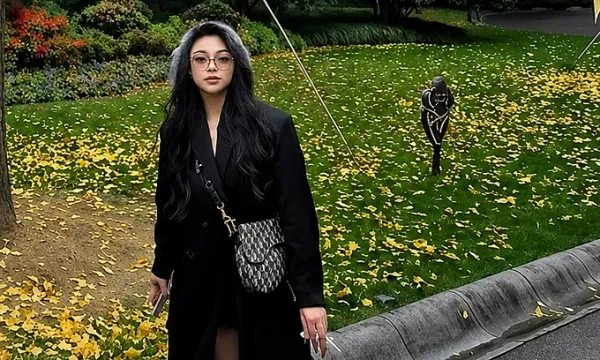
Van Nhi, 38, shares a three-bedroom apartment in Ho Chi Minh City with six cats. While many of her peers are consumed by marriage and child-rearing commitments, she splits her time between Hanoi and Ho Chi Minh City, managing her businesses, socializing with friends, and rescuing stray animals.
Three years ago, she had been on a completely different trajectory, with hersingle life seemingly all set to end. But she called off her engagement to her boyfriend of nearly a decade because he wanted them to relocate to the U.S.
She chose to stay in Vietnam to remain close to her family. “Even if a husband is wealthy, it is not your money,” she says. “Women need to have their own careers.”
Since then, she has turned around a struggling restaurant in Hanoi, opened a second in Ho Chi Minh City, and invested in a third venue.
While she remains open to marriage, she no longer sees it as a mandatory requirement. On the few matchmaking dates she attended, she firmly rejected the unsolicited advice that “women over 30 should lower their standards.”
“I refuse to enter a marriage just to satisfy societal expectations,” she says.
|
Van Nhi, 38, on a business trip to Shanghai, China, in 2025. Photo courtesy of Nhi |
Women are increasingly making choices like she has. Data from the General Statistics Office shows that the rate of never-married women nearly doubled between 2009 and 2024. Among women aged 25 to 29, the figure rose from 18.2% in 2009 to 31.9%, and among those aged 30 to 34, it rose from 8% to 13.1%.
Urban women now tie the knot for the first time at an average age of 26.8, nearly three years later than their rural counterparts.
Marriage is not disappearing, but is taking place significantly later in life for many women. Linh Trang, 36, an office worker in Hanoi, follows a daily routine of working during the day, practicing yoga in the evening, strolling around town on weekends, and traveling several times a year.
This comfortable lifestyle sometimes sparks rumors that she is “kept” by a wealthy man. Trang laughs off the gossip, knowing that behind her seemingly effortless life lies strict personal discipline.
“The life of a single woman is like a duck swimming,” Trang says. “Above the water, it looks serene, but beneath the surface, its feet are paddling relentlessly.”
She balances a corporate job with side projects to diversify her income streams.
While in her twenties, she used to view marriage as inevitable, but her perspective has evolved. “In the past, the question was ‘When am I getting married?'” she says. “Now, I care more about ‘If I marry this person, will our lives be better together?’ If I don’t have a clear answer to that, I see no reason to rush.”
Sharing a similar mindset is Cam Tu, 33, who rents a luxury apartment in central Ho Chi Minh City and invests her earnings in a startup.
She has turned down several marriage proposals from her boyfriend, despite heavy pressure from both families.
“I deeply value my current relationship, but deep down, I feel no pressure to get married,” she says. “If I were to turn a blind eye and marry just to make someone else happy, it wouldn’t be fair to myself.”
Tu wants to focus her energy on the field of AI. “If I have a child, I want to give it my complete devotion rather than have a baby only to leave it with its grandparents while I carry on with work,” she says.
This shift reflects a broader trend across Asia. According to Assoc. Prof. Bussarawan Teerawichitchainan, an expert in sociology and family demography at the National University of Singapore (NUS), delayed marriages and growing singlehood are increasing not just in Vietnam but also Japan, South Korea, Taiwan, Hong Kong, and Singapore.
In Singapore, housing subsidies and financial incentives from the government have failed to reverse the trend. Part of the driving force is the rapid rise in women’s social status.
The 2025 Global Gender Gap Report shows that Vietnam has closed 97% of its educational gender gap and 76% of its economic opportunity gap, but these advancements have not been matched by a rebalancing of domestic duties.
“When opportunities and status advance without a corresponding redistribution of domestic burdens, it is entirely understandable that women think twice before marrying,” Prof. Ngo Thi Phuong Lan, rector of the University of Social Sciences and Humanities, Vietnam National University Ho Chi Minh City, says.
 |
|
Linh Trang, 36, during a trip to Da Lat in 2022. Photo courtesy of Trang |
Teerawichitchainan tells Read that for a marriage to appeal to modern women, it must be a genuine partnership, one that respects a woman’s career and autonomy, and share domestic chores equitably. “The crucial question is whether marriage will actually enrich the life she has built for herself.”
The single status of these women is not a rebellion against marriage, but a deliberate life plan. Nhi plans to retire in 10 years and establish an animal rescue farm in Da Lat. Trang continues to build her financial foundation and nurture her social connections. “I want to be certain that if someone enters my life, I am with them by choice, not because I am looking for a lifeline to escape loneliness,” she adds.
-
Fiber Benefits: Lack of fiber in the diet can prove costly, know why it is important and which things will provide you with plenty of fiber.

-
Asian Games 2026: India’s Jemimah Rodrigues ruled out

-
T20 leagues pushed international cricket to backseat: Harbhajan – Tezzbuzz

-
Hockey World Cup Winners: India or Pakistan, who has won more Hockey World Cup?

-
JP Nadda Health Update: JP Nadda underwent coronary angiography, treatment is going on in the cardiology department of Delhi AIIMS, know why this test is done?