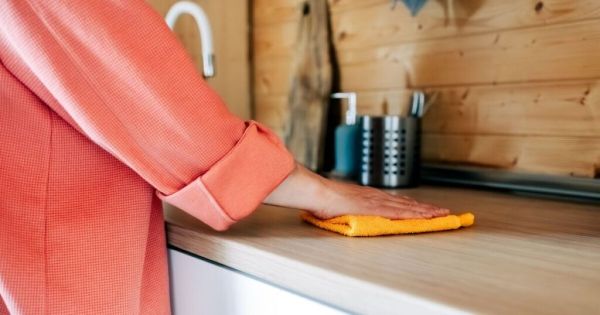
Kitchens are one of the most annoying places to clean. No matter how frequently you wipe surfaces, they soon look grubby. Grease and grime from everyday use means messes are constantly regenerating.
When frying or sautéing food, oil transforms into minuscule droplets carried by steam that settles on every surface in sight. Not only does this cause decidedly grimy looking stains, but it also produces a sticky bacteria-harbouring residue. Fortunately, cleaning guru Lynsey Crombie, widely known online as the Queen of Clean, has revealed a straightforward technique to keep your kitchen “shiny and streak-free” — and all you need is some ordinary washing-up liquid.
Lynsey said: “I am constantly asked how I keep my high gloss, kitchen cabinets clean, shiny and streak-free.
“To remove grease, grime, food splashes and finger marks, I start by cleaning with warm water and washing up liquid. Washing up liquid is a degreaser, so I.T. is the perfect product to use.”
It may sound deceptively simple, but washing-up liquid is brilliantly effective at tackling kitchen surface stains, given that it is specifically formulated to cut through hardened food, grease and oil on plates. Most conventional products struggle to eliminate greasy stains, as oil and water simply do not mix.
However, washing-up liquid contains surfactants that effectively break down oil, allowing it to be rinsed away with ease.
This makes tackling a kitchen considerably more straightforward, as it loosens stubborn stains from surfaces without the need for any vigorous scrubbing.
How to deep clean kitchen cabinets and worktops
Start by adding a few squirts of washing-up liquid to a basin or bowl of warm water, taking care not to add too much, as this may leave a soapy film across your kitchen surfaces.
Dip a cloth into the solution, wring it out thoroughly, and wipe in a circular motion. Pay particular attention to areas where grease commonly accumulates, such as cabinet handles, zones around the hob, and the backs of worktops.
For particularly stubborn or sticky residue, place the damp cloth directly onto the stain for 30 seconds before wiping — it should dissolve with minimal effort.
Take a second cloth to rinse the surfaces with warm water, removing any remaining soap residue, then dry everything thoroughly with a third cloth. With just five minutes of work, your kitchen should be left spotlessly clean and entirely free of stains.
-
‘Club ko manipulate karne ki koshish!’ - Gusse mein Fenerbahce ne Chelsea star Jamie Gittens se judi ‘jhuthi’ transfer afwaahon ko kharij kiya

-
UP Issues Strict Anti-Adulteration Order For Paneer, Khoya, Other Milk Products

-
Why drink warm water on an empty stomach after waking up in the morning? Know the Ayurvedic and scientific benefits behind it
-
Will KL Rahul Gall bat on the second day of the test or not? Coach gave fitness update

-
Sanjay Manjrekar gave a big statement on Devdutt Padikkal's first test century. Read