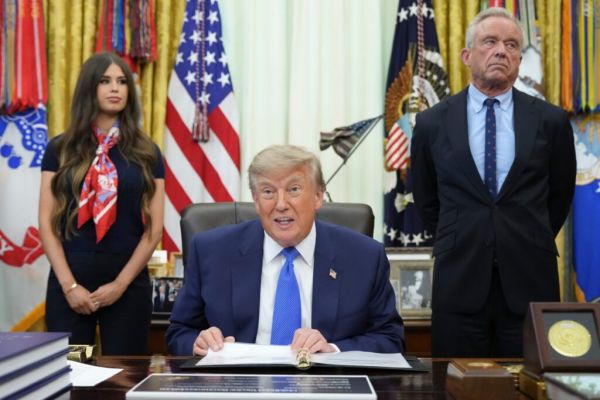
Trump Vaccine Plan Would Require Millions of Individual Shots Abandoned Decades Ago/ TezzBuzz/ WASHINGTON/ J. Mansour/ Trump’s plan to separate combination childhood vaccines would require manufacturers to revive individual shots largely unused in the United States for decades. Experts say the changes could take years, cost millions of dollars and force families to make substantially more medical appointments. The executive order is not legally binding, and neither the White House nor the FDA can compel companies to develop the standalone vaccines.
Quick Look
- Trump’s order calls for separating the MMR vaccine into individual measles, mumps and rubella shots.
- Federal officials have 90 days to develop plans for unbundling MMR and spacing out other vaccines.
- No standalone measles, mumps or rubella vaccines are currently available in the United States.
- Drugmakers could need new studies, manufacturing facilities and separate FDA approvals.
- Designing and obtaining approval for a vaccine plant generally takes about five years.
- Two MMR doses could become six separate medical visits.
- Additional spacing of other vaccines could create even more appointments.
- Studies indicate combination vaccines improve the likelihood that children are fully vaccinated before school.
- Manufacturers have little financial incentive to compete with their existing combination products.
- States, rather than the federal government, control school vaccination requirements.
Deep Look
Trump plan faces practical obstacles
WASHINGTON — Public health experts swiftly criticized President Donald Trump’s executive order seeking to transform childhood vaccination practices in the United States, but its largest barriers may be financial and logistical.
The order could impose significant new demands on parents, medical providers and pharmaceutical companies while requiring the production of millions of individual vaccine doses that are not currently used in the country.
Trump’s announcement Monday calls for combination vaccines—including the measles, mumps and rubella vaccine, commonly called MMR—to be separated into individual injections. It also recommends spacing appointments for those and other childhood immunizations whenever possible.
Implementing that approach would require drugmakers to revive several standalone vaccines that have not been widely administered in the United States for decades. Manufacturers could also need to construct new facilities capable of producing millions more doses than the country currently requires.
Combination vaccines improve completion rates
Parents would have to make significantly more trips to doctors’ offices if the MMR vaccine were divided and appointments were spaced apart.
The additional visits could strain pediatricians, who administer most childhood immunizations, and raise expenses for syringes and other medical supplies.
Research conducted in the United States and other countries has found that combination vaccines increase the chances that children will receive full protection against infectious diseases before entering school.
Public health specialists say there is no scientific justification for reversing the current approach.
Drugmakers could need years to overhaul production
Trump’s executive order directs federal officials to produce plans within 90 days for separating the MMR vaccine and spacing out other childhood immunizations.
Pharmaceutical scientists and former regulators say implementing those changes would likely take years. Drugmakers could have to spend tens of millions of dollars on clinical studies and new manufacturing facilities.
No individual vaccines for measles, mumps or rubella are currently available in the United States. Every vaccine approved by the Food and Drug Administration for those viruses is a combination product.
The three-in-one MMR vaccine has been the American standard since the 1970s.
Standalone shots could require new clinical studies
Dr. Jesse Goodman, a former FDA vaccine chief, said pharmaceutical companies might have to conduct large studies demonstrating that new standalone vaccines produce immune responses in children comparable to those generated by current combination shots.
Regulatory requirements would depend partly on the quality of the original data supporting the older individual vaccines and whether FDA reviewers consider those findings applicable today.
Manufacturers might also be required to establish the safety of new production processes and facilities because individual measles vaccines have not been widely manufactured domestically for decades.
Building a vaccine plant and securing federal approval for it typically takes about five years, according to industry experts.
FDA would have to license each vaccine separately
Goodman said the FDA could also have to review and license every unbundled vaccine as a separate product, creating a regulatory process without precedent.
Standalone vaccines for measles and illnesses are more commonly used in lower-income countries that cannot afford the MMR combination shot.
Merck, GSK and the small number of other manufacturers supplying childhood vaccines in the United States produce only combination versions.
In separate statements, Merck and GSK affirmed the safety and effectiveness of their vaccines. Neither company said it intended to separate its combination products.
Two MMR doses could become six appointments
Children currently receive the MMR vaccine in two doses. The first is generally administered at age 1, followed by a second dose after age 4.
Dividing each MMR dose into separate measles, mumps and rubella injections could turn those two appointments into six office visits.
Separating and spacing vaccines for pertussis and other infectious diseases could multiply the number of necessary visits even further.
Durbin said families become increasingly likely to miss appointments or stop scheduling them as the required number of visits grows.
Trump has long questioned the vaccine schedule
For more than a decade, Trump has argued—contrary to guidance from medical organizations—that American children receive too many vaccines and should get smaller doses over a longer period.
Last year, he asked Health Secretary Robert F. Kennedy Jr. to consider reducing the number of childhood vaccinations. Kennedy and other administration officials have cited smaller countries such as Denmark, which recommends slightly fewer vaccines than the United States.
Durbin noted, however, that separating combination vaccines would cause American children to receive far more individual injections than children in comparable countries.
Executive order cannot force companies to act
Despite the sweeping nature of Trump’s announcementsome experts doubt it will produce substantial changes.
Neither the White House nor the FDA has the authority to require pharmaceutical manufacturers to develop individual vaccines and apply for their approval.
Companies also appear to have little commercial incentive to create standalone versions of vaccines they already sell as combination products.
States control school vaccination mandates
Trump’s executive order calls for additional federal research and recommendations, but the federal government does not control school vaccination mandates.
Only state governments have the legal authority to require children to be vaccinated before attending school. The order advises states to consider changing their laws to align with the administration’s preferred approach, but it does not compel them to do so.
More on US News
-
'Best possible specialists' - Xabi Alonso explains Chelsea's move to appoint Aston Villa set-piece expert Austin MacPhee

-
Manchester United considering late move for versatile target as Bruno Fernandes talks continue

-
Soha Ali Khan's High-Protein Oats Recipe For Vegetarians Is Perfect for A Healthy Breakfast
-
How can cancer or treatment in children affect the eyes and vision? Know in detail
-
Meta cornered on children's safety, demands compensation up to 1.4 trillion dollars; Serious questions raised on Facebook-Instagram