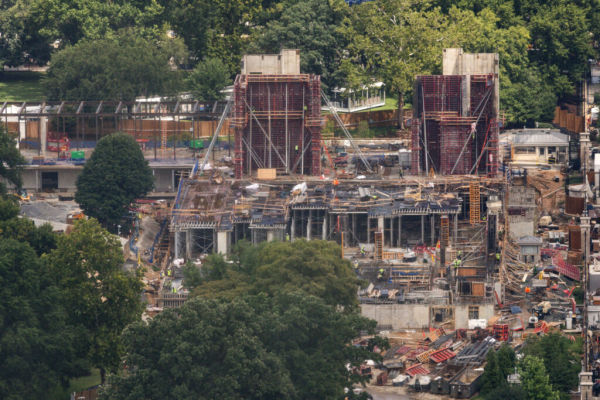
Trump Asks Supreme Court to Allow $400M White House Ballroom Construction During Appeal/ TezzBuzz/ WASHINGTON/ J. Mansour/ The Trump administration asked the Supreme Court to let construction continue on its $400 million White House ballroom while litigation proceeds. An appeals court ruled that Congress must approve the 90,000-square-foot project, which replaced the demolished East Wing. The administration argues that stopping the roughly 65%-completed project would create security risks and construction chaos.
Quick Look
- The Trump administration filed its Supreme Court request Friday.
- It wants the justices to suspend an appellate ruling before it takes effect Aug. 21.
- The $400 million ballroom has been under construction for 10 months.
- The administration says the project is approximately 65% complete.
- A divided appeals court ruled that Trump cannot build the ballroom without congressional approval.
- Historic preservationists sued to stop the project.
- The White House says an unfinished construction site complicates presidential security.
- Lower courts have allowed work necessary for White House safety and security to continue.
Deep Look
Trump takes ballroom dispute to Supreme Court
WASHINGTON — President Donald Trump’s administration asked the U.S. Supreme Court on Friday to allow construction of the White House’s $400 million ballroom to continue while the government appeals a lower-court order stopping the work.
Solicitor General D. John Sauer asked the justices to suspend a ruling issued last week by a three-judge panel of the U.S. Court of Appeals for the District of Columbia Circuit.
The appeals court temporarily delayed its own decision for two weeks, giving the Republican administration time to seek emergency relief from the Supreme Court. Sauer asked the justices to act before the ruling is scheduled to take effect on Aug. 21.
Appeals court says Congress must approve project
In a divided 2-1 ruling, the appellate panel said Trump must halt construction because Congress has not authorized the project.
The majority concluded that the president does not have unilateral authority to construct a 90,000-square-foot, or approximately 8,400-square-meter, ballroom on the site formerly occupied by the White House’s East Wing. Trump ordered the East Wing demolished last fall.
The ruling upheld an earlier order pausing aboveground construction. The legal challenge was brought by historic preservationists seeking to stop the ballroom project.
Trump-appointed judge dissents
Judge Neomi Rao, a Trump appointee, dissented from the panel’s decision. She concluded that the preservationist organization challenging the project lacked the legal standing required to bring the lawsuit.
The administration has similarly argued that the National Trust for Historic Preservation does not have a sufficient legal basis to sue over the project.
Administration claims broad renovation authority
Trump’s administration maintains that control over renovations to the White House belongs to the president, without interference from Congress or the federal courts.
The Justice Department also argues that leaving the East Wing site in its current condition as an open construction zone makes protecting the White House more difficult.
The ballroom is part of Trump’s broader effort to rapidly reshape prominent buildings and public spaces across Washington.
Government lawyer defended sweeping presidential power
During an appeals court hearing in early June, Justice Department attorney Yaakov Roth defended an expansive interpretation of presidential authority over nationally significant public properties.
Responding to a hypothetical question, Roth said the government could demolish the Statue of Liberty and the White House without giving the descendants of immigrants who passed through Ellis Island or enslaved people who built the White House standing to file a lawsuit.
The argument formed part of the administration’s broader position that the preservationist plaintiffs cannot demonstrate the type of direct legal injury required to challenge the ballroom construction.
District judge allowed security- work
The appeals court panel upheld a ruling by U.S. District Judge Richard Leon, who was appointed by Republican President George W. Bush.
Leon determined that temporarily pausing aboveground construction would not endanger national security. His order nevertheless exempted any work considered necessary to protect the safety and security of the White House.
The administration is now asking the Supreme Court to put that broader construction pause on hold while its appeal continues.
Project reportedly 65% complete
Construction on the ballroom has continued for approximately 10 monthsand the Trump administration says the project is about 65% finished.
Government lawyers argue that interrupting work at this stage would be disruptive, potentially undermine security and provide no meaningful benefit while the courts consider the underlying dispute.
More on US News
-
When is Bahula Chaturthi know its significance

-
Weeds will stop growing on patios if you swap vinegar and salt for a better item

-
Simple ways and benefits of making Rakhi at home

-
PNG Connection Big Update: Now gas will reach home directly without any detour

-
The magical herb of Gudmar is a sugar destroyer, you will be shocked to know its infallible Ayurvedic benefits of getting rid of sweet addiction and controlling diabetes.