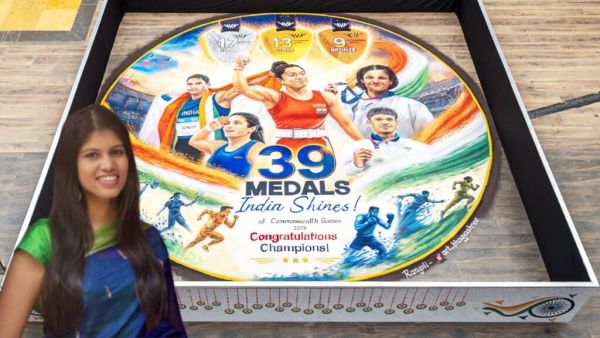
- A dream to give global recognition to traditional Rangoli
- A journey from 34 thousand square feet 3D rangoli to international platform
- A story of sportsmen's success through rangoli
- The artwork at Phoenix MarketCity caught everyone's attention
Rangoli Artist: In Indian culture, drawing a rangoli in front of a door is considered a symbol of happiness, prosperity, purity and positive energy. Also drawing rangoli in the courtyard, around the dinner plate, Diwali Or during Tihar, Onam, Pongal and other Hindu festivals in the Indian subcontinent Rangoli Hamkhas is drawn in front of the house. Rangoli designs are passed on from one generation to another keeping both the art and tradition alive. One such artist is Bhagyashree Deshpande who specializes in Rangoli art and creates large-scale and three-dimensional (3D) Rangoli artworks through Art Bhagyashree Studio. On this occasion, Bhagyashree Deshpande has shared his experience in Rangoli art.
A journey that started with grandma's rangoli
The relationship with Rangoli started from childhood. This art was introduced by seeing the rangolis drawn on the Indian culture's festivals, auspicious occasions and doorsteps. Especially seeing grandmother drawing Rangoli became an important source of inspiration in this artist's artistic journey. At an early age, I realized that Rangoli is not just a means of decorating a home, but behind it lies emotion, patience, geometry, imagination and tradition. Later, there was a desire to experiment in this art. Moving on from traditional rangoli, experiments began with portraits, realistic depictions, light-shadow, perspective and eventually large-scale 3D rangolis.
The only hill station in Asia where trains have no entry; This beautiful place in Maharashtra was discovered by the British
Rangoli from the threshold to the public platform
Bhagyashree Deshpande does not think that Rangoli should be seen only on the threshold of the house during festivals. The concept of performing Rangoli in large public spaces came from the thought that thousands of people could experience this art and especially connect the younger generation with Indian traditional art. This was the beginning of the creation of large-scale works of art. Behind these experiments is an attempt to create a visual language that appeals to a modern audience while staying true to the roots of traditional Indian art.
A confluence of traditional Rangoli and modern 3D techniques
Colors, motifs, symmetry, restraint and the process of creating the artwork by hand remain the basic characteristics of Rangoli even today. It adds realistic rendering, perspective, shading and 3D effects. Bhagyashree Deshpande has argued that 'traditional' and 'modern' Rangoli are not two separate things but an attempt to take the traditional art forward with the help of modern technology and creativity. When a person sees a rangoli and says, 'I had no idea a rangoli could look like this,' it is a special moment for a rangoli artist.
Special Independence Day Rangoli at Phoenix Market City
The concept behind the artwork created on the occasion of Independence Day at Phoenix Market City in Mumbai was to celebrate India and especially the achievements of Indian sportspersons. Independence Day is not only a day to remember history but also an opportunity to look at the kind of India we are building today. Indian players represent this new India. An attempt was made to convey the feelings of their struggle, hard work, discipline and pride for the country through Rangoli. An attempt was made to tell a complete story through athletes and sporting moments rather than just creating a rangoli of the colors of the tricolor.
A story of sportsmen's success through rangoli
The player was at the center of this artwork. Each athlete represents not only a medal, but years of hard work, practice, sacrifice, failure, discipline and the contribution of family-coaches. Orange, white and green colors in Rangoli are not only used for color. He gave Indian identity and emotional context to the entire artwork.
Efforts were made to bring the artwork to life through player poses, facial expressions, shadows and 3D effects. So the aim was to make the audience feel like they were actually experiencing a moment of victory. The happiest moment for the artist is when people from different countries stop to see the artwork, admire it and connect with this unique form of Indian Rangoli.
3D rangoli of 34 thousand square feet
Working in a large scale changes the entire approach to rangoli. A rangoli created in a small space can be seen at a glance; But a work of thousands of square feet requires consideration of scale, perspective, distance, light, and audience movement. The 34 thousand square feet 3D rangoli experience highlighted that this art is not limited to decoration but can be a medium of public storytelling. Through Rangoli, history, culture, emotions and social messages can be conveyed to thousands of people without words.
Representation of India at international level
Bhagyashree Deshpande recounted the experience of performing Rangoli outside India where people from different countries appreciated the colour, embroidery, nuances and 3D realism. This reinforced the belief that Rangoli is not an art confined to Indian homes but an art that can communicate with audiences worldwide. Bhagyashree Deshpande's dream is that Rangoli artists should take this art across the world with confidence. Color and creativity do not need language or geographical boundaries, the experience gained from this trip.
Rangoli at platforms like Ram Mandir, Mahakumbh and National Games
Although Rangoli is closely associated with Indian homes and traditions, getting the opportunity to perform this art at major national-cultural platforms like Ram Temple inauguration, Mahakumbh and National Games was a special experience for the artist. The traditional art was presented on a modern and larger platform, allowing the audience to see a different form of it. This journey is not only about personal success but also about giving Rangoli a bigger platform.
Rangoli to the youth thanks to social media
Today, digital media has greatly increased the opportunity to disseminate traditional art. Earlier Rangoli, which was seen only in the confines of a house or on a festival day, can now reach people all over the world including India through social media. The artist's digital community has more than 7 lakh followers and efforts are being made to connect the younger generation with Rangoli through social media. Film and television industry personalities have also taken interest in this unique art form and various collaboration opportunities are available. For an artist, social media is not just about followers or views, but a medium to create curiosity among the youth and make them fall in love with Indian art.
Another collaboration with Phoenix MarketCity
Bhagyashree Deshpande (Art Bhagyashree Studio) The collaboration with Phoenix Market City Mumbai is special for the artist. The previous collaboration was well received by the audience and the artist said that the artwork reached 47.7 million people worldwide. This response gave me the confidence to work on a bigger scale and a different concept. This is the second collaboration with Phoenix Market City, and the artist finds the artistic freedom to experiment and take Rangoli outside the traditional box particularly important.
Expansion of art from public spaces such as malls
One does not necessarily go for an art gallery or a cultural exhibition. But a shopper at the mall can stop for a few minutes after seeing an attractive rangoli, take a picture of it, and learn something new about Indian art. Hence, malls, public places and large platforms can be effective mediums to bring traditional Indian art to the masses. According to the artist, the smile on people's faces and their reactions is the biggest inspiration for creating new works of art.
This story of three colors…! Send patriotic Marathi wishes to friends and loved ones on Independence Day
A dream to make Rangoli global
The ultimate goal of this artist is not limited to creating beautiful rangoli. His big dream is to create pride in Indian art and culture, to continuously expand the possibilities of Rangoli and to bring this art to the world. It is an attempt to re-identify Rangoli as an art that is traditional yet modern, stunning yet emotional and connected to its Indian roots yet appeals to a global audience.
-
16-year-old girl dies after lorry hits bike on Hyderabad highway

-
Free Umar Khalid, Sharjeel Imam: Open letter to CJI Surya Kant
-
Who is Komal Rani Swarnkar, woman Sunita Ahuja links to Govinda?
-
WATCH: Wasim Akram Brings Back The Magic, England Legend Tested By Deadly Swing
-
WATCH: Jaiswal Suffers Bizarre Run-Out After Chaos With KL Rahul In Galle