China built its first high-speed rail line in 2008. Less than two decades later, it operates the world’s largest high-speed rail network, connecting cities across the country with frequent departures throughout the day.
For many foreign visitors, the network has become the preferred way to travel between Chinese cities rather than flights.
Vietnamese travelers Nguyen Thang and Trinh Hang are among them. After multiple trips across China, they say the railway stands out not only for its speed, but also for its competitive prices, comfortable onboard experience, and traveler-friendly service.
Thang has traveled extensively across China since the early 2010s and now chooses high-speed rail for most intercity journeys, from short routes such as Shanghai-Hangzhou to longer trips like Shanghai-Nanning.
|
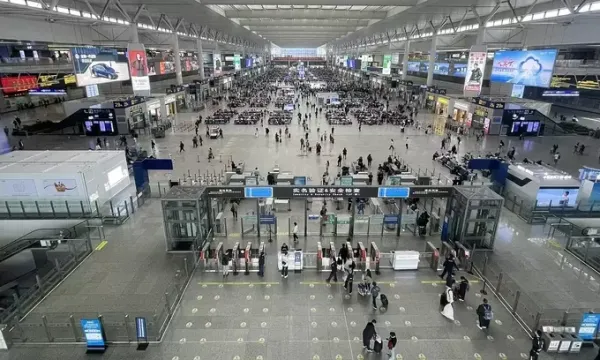
A railway station in Shanghai. Photo by Linh Huong |
Hang, who has visited China three times since the Covid-19 pandemic, says she prefers subways and buses within cities but almost always takes high-speed trains when traveling between provinces.
Among the network’s biggest draws are the balance between speed and cost and how consistent the fares are.
Unlike airfares, or even European rail fares, high-speed ticket prices in China for a given route stay fairly stable regardless of the time of day or how far ahead a passenger books.
On the roughly 1,350-kilometer route between Kunming and Guangzhou, for instance, travelers can pick from more than 20 departures a day, with prices ranging from about 160 yuan (US$22) for the cheapest seats to roughly 1,275 yuan for premium cabins.
A flight on the same route and of the same duration typically costs 1,500-2,000 yuan, or several times the price of a comparable train seat.
That is a sharp contrast with rail pricing in some parts of Europe, where a train departing at 8 a.m. can cost triple the fare of one leaving just two hours earlier, Hang says.
Distance-based pricing follows a similar logic elsewhere on the network. The roughly 1,200-kilometer trip between Beijing and Shanghai takes about five hours, with tickets costing around 510 yuan. The short 110-kilometer hop between Shanghai and Suzhou takes just 25 minutes and costs 32 yuan.
Beyond speed, both travelers say convenience is what keeps them coming back.
Screens inside each carriage display real-time speed, route information, and cabin temperature in both Chinese and English. Speeds can dip below 200 km/h in mountainous terrain but regularly top 300 km/h on flatter stretches, yet the ride stays notably stable.
Hang describes leaving a full cup of water untouched on a tray table through an entire five-hour journey without spilling a drop.
Seating is typically split into two or three classes: second, business and first. Even second class, the cheapest option, offers more legroom and a deeper recline than a typical economy airline seat.
First class cabins have just six power-reclining seats that fold nearly flat per row, and some long-distance routes include proper sleeper cars.
Every row has a power outlet, and free drinking water dispensers are standard in each carriage.
There’s no baggage limit, either. Large suitcases fit into storage areas at the ends of carriages, while smaller bags go on overhead racks.
Booking tickets is easy, whether through the app or at the counter, and so is getting a refund or making changes. China’s railways have also made things easier for foreign visitors, letting them compare prices and schedules and check departure and arrival stations, all in one app.
 |
|
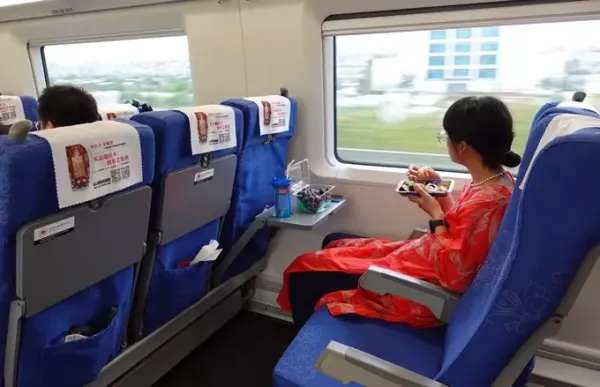
Economy-class seats on a Chinese high-speed train. Photo by Trinh Hang |
High-speed rail can also cut overall travel time. Passengers generally need to arrive at the station only about 30 minutes before departure, compared with at least 90 minutes for most flights. Security screening is quick, taking around five minutes, while boarding begins 10 to 15 minutes before departure.
Thang says trains depart almost exactly on schedule and sometimes even arrive ahead of time.
Passengers who miss a train can often change to a later one at no extra cost.
Many major stations are integrated with airports, metro systems and long-distance bus terminals, making transfers straightforward. Some also feature restaurants, supermarkets and retail shops, functioning more like transport hubs than traditional railway stations.
However, the system is not without its drawbacks.
Tickets can sell out quickly during peak travel periods such as Lunar New Year, making advance booking essential. Trains also stop at each station for only two to four minutes, which can be tight for passengers traveling with multiple bags.
Toilets used to be a sore point for Thang. Today, trains offer both western-style and squat toilets, and he says the facilities lose nothing in comparison with those on airplanes.
“Ten years ago, I wasn’t comfortable using squat toilets on trains, but now there’s nothing to complain about.”
He adds that in future he will continue to travel by the high-speed trains.
-
ChatGPT helps Goa man find lost footwear outside Ujjain Temple

-
UGC-NET 2026 answer key out; NTA allows objections till Aug 18

-
Himanshi Khurana nearly converted to Islam for Asim Riaz?

-
Worried your toddler lacks iron? What parents need to know

-
Blinkit delivery agent assault case: UCO Bank manager arrested