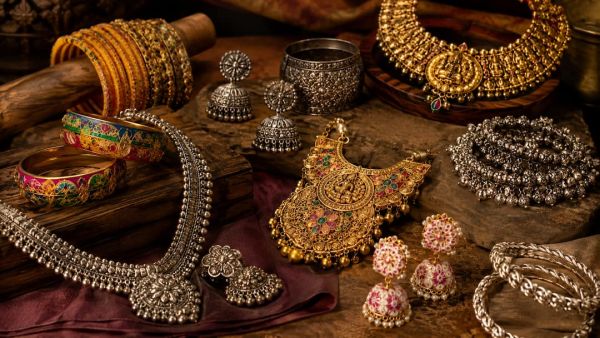
Indian jewellery has always carried more than decorative value. Its designs reflect the places where they were created, the communities that perfected them, and the techniques passed from one generation to another. From Odisha’s intricate silver filigree to Rajasthan’s Thewa work, regional crafts have developed distinctive identities over centuries. Several traditional jewellery forms now have Geographical Indication (GI) recognition, linking them officially to their places of origin. Some traditions date back hundreds of years, while others draw from techniques that are thousands of years old. Together, they offer a glimpse into India’s diverse jewellery-making heritage and the skilled artisans keeping it alive.
Silver Filigree And Enamel Jewellery
Tarakasi, Cuttack: Odisha’s famous silver filigree, locally called Tarakasi, involves shaping extremely fine silver wires into intricate patterns. The craft is believed to have a history dating back around 800 years, with floral designs and motifs inspired by Odisha’s cultural heritage featuring prominently in jewellery.
Gulabi Meenakari, Varanasi: Known for its distinctive pink enamel, Gulabi Meenakari is associated with Varanasi’s traditional metalwork. The technique is used on gold and silver pieces, with floral and animal-inspired patterns appearing on earrings, necklaces and other ornaments.
Karimnagar Silver Filigree: This Telangana craft is known for its fine, thread-like silver work. Artisans create detailed floral and geometric patterns, giving jewellery and decorative pieces a delicate appearance. The craft received GI recognition in 2007.
Hupari Silver Jewellery: The town of Hupari in Maharashtra has a long-standing silver-working tradition, particularly known for anklets, bangles and ghungroo-style ornaments. Traditional motifs, including pipal, champak and ambi patterns, are commonly associated with the craft.
Gold, Glass And Lac Craft
Thewa, Pratapgarh: Rajasthan’s Thewa jewellery is made by carefully fusing an intricately worked gold sheet onto coloured glass. The technique is associated with the Pratapgarh region and often features scenes inspired by royal life, nature, hunting and folklore.
Hyderabad Lac Bangles: Laad Bazaar in Hyderabad is closely associated with colourful lac bangles, a craft linked to the city’s Qutub Shahi-era heritage. Lac is shaped using heat before the bangles are decorated with colourful stones and other embellishments.
Akhomiya Gohona, Assam: Assamese traditional jewellery reflects the region’s cultural history and Ahom-era influences. Designs such as the joonbiri and lokaparo are particularly recognisable, with artisans continuing to produce pieces associated with Assamese celebrations and cultural identity.
Temple Jewellery, Nagercoil: This traditional jewellery is associated with Tamil Nadu and has historical links to temple adornment. Its designs often feature gods, goddesses, and architectural elements, and the jewellery continues to be used in classical dance and bridal ensembles.
Ancient Stone And Tribal Jewellery
Agates Of Cambay: Khambhat, historically known as Cambay, has a renowned stone-cutting tradition associated with agate. Its lapidary history reaches back thousands of years, with links to the Harappan period. The region remains known for processing and crafting these distinctive stones.
Odisha Brass and Bell Metal Tribal Jewellery: Traditional Dhokra techniques, based on lost-wax casting, are used to create distinctive brass and bell-metal ornaments. The craft is associated with tribal communities and produces bold designs used for adornment as well as cultural and ritual purposes.
These jewellery traditions show how closely Indian adornment is connected to regional craftsmanship. GI recognition gives many of these forms an official link to their geographical roots, while generations of artisans continue to keep the techniques in practice.