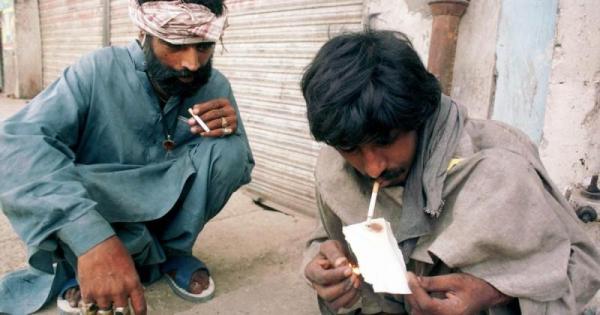
Situated on the highly sensitive border with Pakistan, the Union Territory of Jammu and Kashmir is emerging as one of the biggest hotspots of the country, with the number of drug addicts increasing with every passing year.
According to data tabled in the Rajya Sabha, substance abuse in J&K has spiralled into a full-blown public health emergency, with the number of people seeking treatment for drug addiction rocketing from 5,382 in 2021-22 to a staggering 46,491 in 2025-26 — an almost ninefold surge in just five years.
The starting and worrisome revelation came in a written reply to an unstarred question raised by Jammu and Kashmir Rajya Sabha Member of Parliament Sajjad Ahmad Kichloo, who sought details on the prevalence of substance abuse among J&K’s youth, district-wise treatment figures, the status of de-addiction infrastructure, and the steps being taken to curb the crisis.
Responding on behalf of the government, Union Minister of State for Social Justice and Empowerment B.L. Verma placed on record a detailed, district-by-district breakdown that paints a sobering picture of a region grappling with an addiction burden growing faster than its ability to treat it.
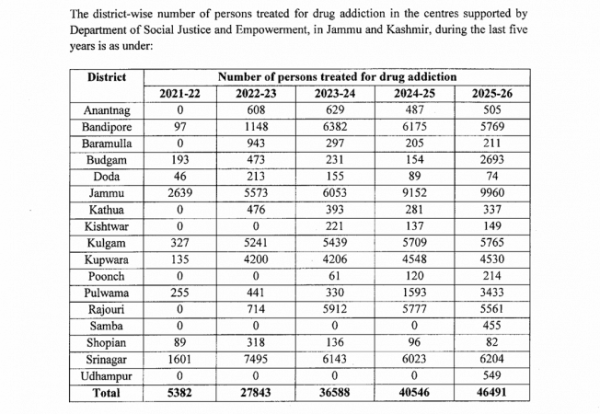
A District-Wise Breakdown That Tells Its Own Story
The numbers, drawn from centres supported by the Department of Social Justice and Empowerment, show that no corner of Jammu and Kashmir has been left untouched. The Jammu district, the winter capital of the Union Territory, recorded the highest caseload throughout the five-year period, with treatment numbers climbing steadily from 2,639 in 2021-22 to 5,573 the following year, before crossing 9,000 and eventually touching 9,960 cases in 2025-26 — nearly a fourfold jump.
Srinagar was not far behind, registering 1,601 cases in 2021-22 before an extraordinary jump to 7,495 cases in 2022-23 and settling at just over 6,200 cases in the most recent year. Bandipore emerged as one of the most alarming hotspots, with cases surging from a mere 97 in 2021-22 to 6,382 in 2023-24 — a jump of more than sixty times in just two years — before stabilising at around 5,769 cases in 2025-26.
Kulgam and Kupwara also reported dramatic escalations. Kulgam’s numbers rose from 327 to 5,765, while Kupwara went from 135 to 4,530 over the five-year window. Rajouri, which recorded zero treated cases in 2021-22, saw an explosive rise to 5,912 cases by 2023-24, before settling at 5,561 in the latest year — underscoring how quickly the crisis can take root in districts with previously little documented addiction burden.
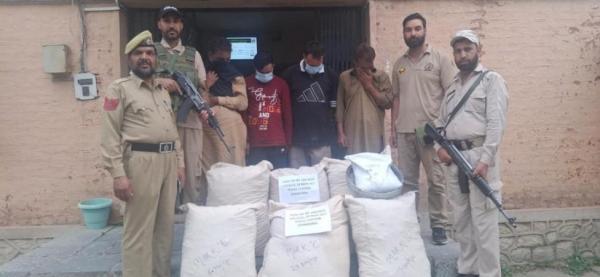
Kishtwar, Poonch, Samba, Udhampur emerge new drug hotspots
Several districts that reported zero or near-zero cases just five years ago — including Kishtwar, Poonch, Samba, and Udhampur — have now begun registering hundreds of cases each, a trend that health officials and addiction researchers often flag as evidence of substance abuse spreading beyond its traditional urban and border-adjacent strongholds into previously less-affected rural belts.
Only a handful of districts, such as Doda and Shopian, showed relatively modest or fluctuating numbers, offering little comfort given the overwhelming upward trend seen almost everywhere else across the Union Territory. In total, the cumulative five-year figure across all eighteen districts stood at 156,850 persons treated for drug addiction — a number that, officials caution, likely represents only a fraction of the actual affected population, given that many addicts never seek formal treatment.
What the 2018 National Survey Revealed
To contextualise the scale of the problem, the Minister’s reply cited the National Survey on Extent and Pattern of Substance Use in India, conducted in 2018 by the National Drug Dependence Treatment Centre (NDDTC) at AIIMS.
That survey had estimated that opioids were the most widely abused substance in Jammu and Kashmir, with a prevalence rate of 4.91 per cent and an estimated 5.4 lakh users in the 10-75 age group. Alcohol followed with a 3.50 per cent prevalence rate and roughly 3.9 lakh users, while sedatives affected an estimated 1.7 lakh people at a prevalence of 1.54 per cent.
Cannabis use stood at 1.31 per cent prevalence with around 1.4 lakh users, while inhalants — often the entry point for younger, first-time users — affected an estimated 1.35 lakh people. Harder substances like cocaine, amphetamine-type stimulants, and hallucinogens showed comparatively low prevalence, each affecting a few thousand users, though experts note that such figures likely undercount usage given the stigma and secrecy surrounding harder drug consumption.
Treatment Infrastructure: Stretched Thin Against a Growing Crisis
Confronted with such steeply rising caseloads, the question of whether J&K’s treatment infrastructure can keep pace looms large. As per the government’s own submission, the Union Territory currently has just one Integrated Rehabilitation Centre for Addicts (IRCA), three Outreach and Drop-In Centres (ODICs), two Community-based Peer-Led Intervention (CPLI) programmes aimed at adolescents, six District De-Addiction Centres (DDACs), and 21 Addiction Treatment Facilities (ATFs) operating out of government hospitals.
Set against a national backdrop of 344 IRCAs, 155 ATFs, 145 DDACs, 76 ODICs, and 45 CPLI programmes running under the Centre’s National Action Plan for Drug Demand Reduction (NAPDDR) scheme, J&K’s share of dedicated de-addiction infrastructure appears strikingly modest when weighed against the nearly 46,500 people it treated for addiction in the last year alone — raising pointed questions about whether the region’s facilities are being stretched well beyond their intended capacity.
Awareness Campaigns: The Data Behind Them
The Ministry was quick to cite its prevention-focused measures as proof of proactive intervention. The Nasha Mukt Bharat Abhiyaan (NMBA), launched on 15th August, 2020, was initially targeted toward 272 identified vulnerable districts in the country based on inputs from Narcotics Control Bureau and findings of the first national survey and later extended to cover every district in the country from August 2023 onwards.
While the government has projected the rising treatment figures as a sign of expanding outreach, improved diagnostic capacity, and greater willingness among affected individuals to seek help, the sheer scale of the increase — from just over 5,000 cases to nearly 46,500 in five years — is likely to reignite concerns among civil society groups, mental health professionals, and parents’ associations across Jammu and Kashmir about how deeply narcotics abuse has embedded itself in the region’s social fabric.
-
Proud to be 'dimagi Naxal': Cong's P Chidambaram hits back at PM

-
Beauty with gold! Have you ever bought '24 Carat Gold Serum'? A small mistake can cause a big loss

-
Central government to organize road show in Patna for eighth phase of 'Critical Mineral Block' auction
-
Anthropic CEO says AI backlash is ‘fundamentally a crisis of trust’
-
Instagram New Wordmark Sparks “Instagzam” Backlash