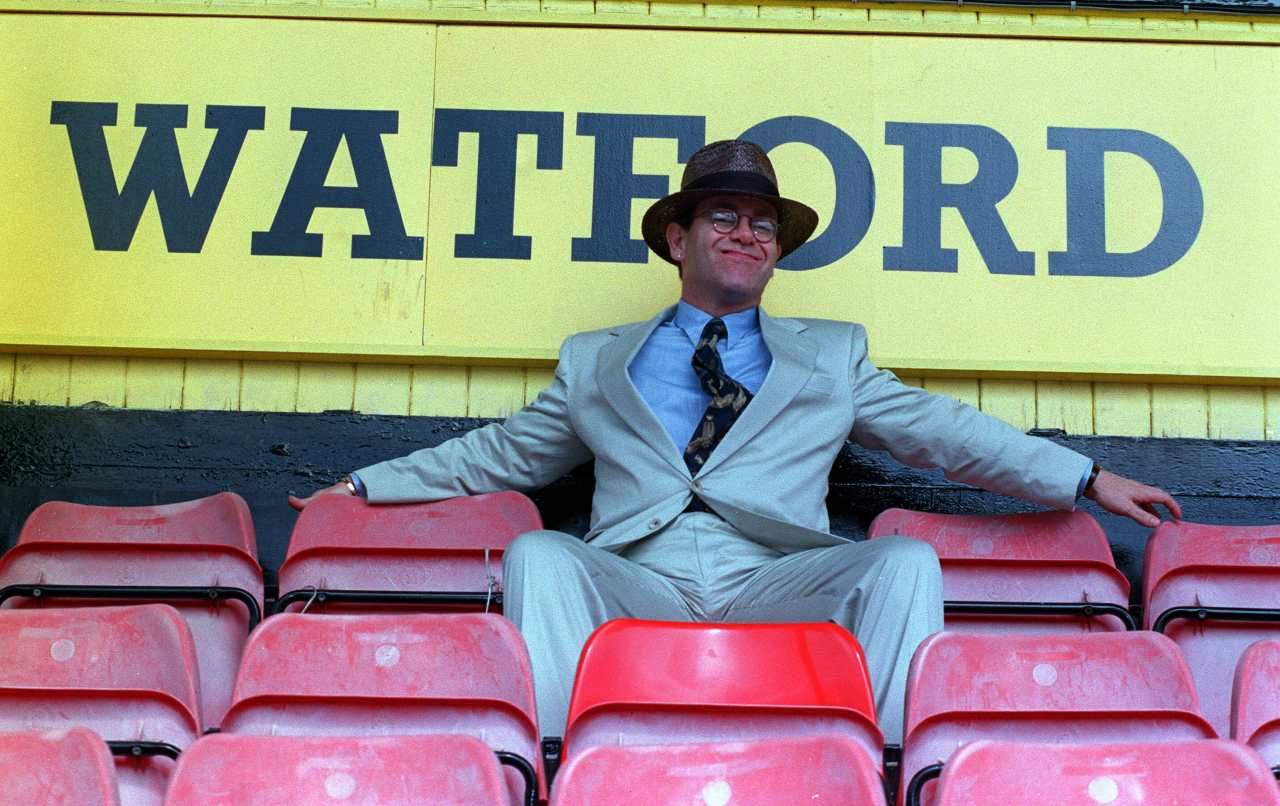
The late Oli Phillips, who reported for the Watford Observer from 1963 to 2005, shared with FourFourTwo before his death a compelling insider account of a rock-and-roll icon’s enduring attachment to his football club.
In hindsight, it is amusing to think we may once have picked berries from the same bush. In 1959, blackberries grew behind The Bend, the least attractive corner of an unfashionable stadium – Vicarage Road, home to the then largely overlooked Watford FC.
At the time, I was 18 and one of the ‘Boys on The Bend’, a loose group of around 20 supporters who used the low bank as a perch to look over the greyhound track and watch the newly renamed Hornets. I knew only my own crowd, but I may well have spotted a slightly chubby 13-year-old boy from Pinner County Grammar School looking just as delighted.
Had we spoken, he might have told me that his passion for Watford came from his father, Stanley, and that his uncle, Roy Dwight, had both scored and broken his leg in that year’s FA Cup final. But the distance between our teenage worlds was far too wide to be crossed then.
We would both have been astonished if anyone had foretold that, through my own negotiations, our next meeting would come deep inside the breeze-block core of Watford’s modest main stand. That schoolboy, Reggie Dwight, would go on to become Elton Hercules John, the flamboyant global rock star. My route to meeting him was less glamorous: I joined the local newspaper.
In the early 1970s, after a string of calls to my home from Elton’s European manager Vic Lewis saying the star wanted to become a director, I convinced him that I could present the idea in a way Watford’s autocratic chairman Jim Bonser might accept.
Under pressure from supporters’ criticism, Bonser saw wealthy outsiders as a threat to his control. Even so, I persuaded him that making Elton one of around 20 vice-presidents – paying £50 a year for a seat, along with access to a pay bar and free sandwiches – would be excellent publicity.
So, on a Friday morning in August 1973, the neat, stylish and personable Lewis arrived at Vicarage Road, followed shortly afterwards by Elton who, apart from his platform shoes, was by his own standards dressed rather conservatively.
Bonser, expecting an oddly dressed and inarticulate eccentric he had never heard of, was pleasantly surprised. Elton made a strong impression: polite, articulate, knowledgeable about football and respectful towards the chairman, even addressing him as ‘Sir’.
Right on cue, Bonser offered him honorary vice-president privileges, but Elton turned them down, saying: “I’ll pay. I’m here to help not sponge”, and Lewis then added casually: “Perhaps Elton might do a concert to raise funds.” It later became a familiar Fleet Street cliché, but Elton had by then stepped on to the Yellow Brick Road, entering the third phase of a relationship that had begun with schoolboy enthusiasm, grown into a teenage infatuation and become a full adult commitment lasting decades.
There were separations and reunions – he served twice as chairman, three times as a director and twice as life president – but however often he departed, he always returned to Watford. The relationship cost him more than £4m, much of it spent on stadium improvements, along with a huge rise in his personal telephone bill and many tears of frustration. Above all, though, it brought him the satisfaction of seeing his ambitions fulfilled. Watford climbed out of Division Four in 1978 and, five years later, finished runners-up to Liverpool in the top flight before reaching the FA Cup final in 1984.
It was not all smooth progress. The early years were grim. Soon after staging a concert at the ground in 1974, he was elected to the board, only for the club to be relegated to Division Four that same season. Elton did not handle setbacks well. During poor runs, he was often difficult to reach and, if Watford seemed headed for defeat at Vicarage Road, then chief executive Eddie Plumley remembered: “He would go down the stairs from the directors' box, and turn and peep over, like a small child. I have known him turn to his mother and say ‘Come on, we’re going’, long before a match has ended.”
Not everybody was delighted to welcome him into the traditional world of League football. At one club, Elton was asked to leave the boardroom because he was considered ‘improperly dressed’.
A few years later, among those casting amused glances were diners in an especially fashionable hotel restaurant in Vienna, one of several unusual places – others included Paris and Milan – chosen for board meetings. “Elton was in Austria on tour, and we flew out there and met at this crowded hotel restaurant,” fellow director Muir Stratford recalled. “Elton joined us at the table dressed as Wolfgang Amadeus Mozart, complete with wig. You could have heard a pin drop when he came in.”
He was not told to leave on that occasion, and in those early years Elton generally took the snubs, the stares and even relegation in his stride, insisting: “This is not a momentary indulgence by a showbusiness personality who will tire of it and look for a new toy. I’m here for the long haul.”
His arrival delighted the players, adding a touch of celebrity to an unfashionable Fourth Division side, though there was some irritation at the media’s fixation with Elton’s connection to the club.
“I see Elton scored again,” one player grumbled after a victory was met by the familiar headline ‘Rocket Men take off’. Elton himself admitted: “Everyone at Watford is so normal and down to earth. It’s a stabilising influence on my life and keeps me sane, compared to the falseness of showbusiness. I get my leg pulled more at Watford than anywhere else.”
In return, he was warmly valued, not least because he was genuine. Luther Blissett, who rose with Watford from Division Four to Division One and went on to play for England, said: “The thing with him, he just wanted to be one of the lads. He would come into the dressing room before games and the older players would even give him some stick over what he was wearing.”
After chartering a plane to attend a Division Four match at Workington, he returned by train with the Watford party. When it emerged that the meals ordered were sitting in the kitchen but no British Rail staff were available to prepare and serve them, the rock star immediately pitched in alongside a fellow director and his wife, serving the players and taking it in good humour when they asked: “Any mustard, my good man?”
After two relegations in four seasons, Jim Bonser was under pressure, but he was not prepared to give in to supporters’ demands. “How can Elton John be chairman, when he’s out of the country most of the time?” he complained. Through it all, Elton kept a relatively low profile in the boardroom until the right moment arrived in May 1976, when he bought out Bonser and took control of the club.
We arranged a major interview for a Monday morning, only for the national newspapers to publish on the previous Saturday Elton’s revelation that he was bisexual. That afternoon there was unusual media interest in Watford’s match at Rochdale. Elton held off most of the reporters before hearing the Spotland crowd become the first to chant: “Elton John’s a homosexual.”
I feared that would end any chance of the interview, but he kept his promise, turning up on the Monday and answering every question. Looking back over his quotes, one line troubled him: “I’m not a raving homosexual.” At that stage, his coming out was only partial.
Even so, he was relaxed enough during the interview to take off his hat. A few wispy hairs were not a concern; what worried him far more was how the dressing room – “such a heterosexual environment” – would respond to his own revelations in that setting. On arriving at Rochdale, he had been reassured by manager Mike Keen: “We are behind you, your private life is your own affair.” Elton found that “uplifting” and later felt saddened by the “maturing experience” of having to sack Keen a few months afterwards.
“I’m not a quitter, I’m used to setbacks and jibes,” he said, though there were moments when it affected him, especially when Watford stalled after looking certain to win promotion to Division Two. On Good Friday, after watching much of a 3-0 home defeat to Colchester, Elton went to the boardroom toilet to reflect and come to terms with the setback.
Later, manager Graham Taylor noticed the chairman was plainly furious. It emerged that while in the toilet, Elton had heard members of the Colchester party come in and joke that their side had “shoved it up Watford and that poofter”.
“I said he must be used to rising above it and suggested, as chairman, he should go over to the Colchester directors and express congratulations and wish them all the best for the rest of the season,” Taylor later said. “He did just that but when he came back, he looked at me, said ‘F**k you’ and went home.”
At times, visiting chairmen would be astonished to receive a phone call from the star immediately after a match, with Elton congratulating them on their defending, discussing missed chances and reviewing other results.
“If he’s so keen, why doesn’t he attend games?” many would say after hanging up, only to be stunned when they learned the Watford chairman was actually in Auckland or somewhere similar, away on tour.
“Those phone calls were amazing. No matter where he was or what time zone it was, he would phone in before a match,” Plumley remembered. “He would get the team news, then hook into the local hospital commentary and listen to it for two hours. He would talk to me and the manager afterwards. It might be the middle of the night where he was, but he was always on, practically every home match.” For away games, he spent the afternoon phoning his mother for teletext updates.
Elton remained generous throughout. When I asked for an interview to mark 10 years of his chairmanship, he arranged for me to fly to Miami, where he was touring, and spend 48 hours in a luxurious country club.
Every pre-season, he opened up his home and garden in Old Windsor for a party for players, staff and their families, complete with a bouncy castle, and threw himself fully into the occasion. “I remember Elton grabbed my baby son Elliott, and laughed when he was sick all over his shoulder,” Blissett recalled.
During his time as chairman, Watford became pioneers of the ‘family club’ image, and Elton was deeply involved, handing out Easter eggs and Christmas presents to the Junior Hornets. Vicarage Road was even praised in Parliament as a hooligan-free family setting – an idea Elton had taken from his links with the American club LA Aztecs.
His greatest frustration was what he saw as Watford Council’s “lack of people with similar vision” as he tried to build the country’s first all-seater stadium since the war. The council blocked every proposal and eventually rejected plans to redevelop Vicarage Road, prompting Watford to appeal to the environment minister. The club won, with costs awarded – and Elton walked on to the pitch before a match holding a sign that simply read: ‘We’ve won’. So when he and Taylor were granted the freedom of the borough, Elton did not personally accept the honour.
“Elton’s main contribution, apart from the money for the ground, was his enthusiasm, that was terrific,” director Stratford said. “But there were a couple of times when we took issue with him.”
The first came when Elton’s early association with Watford led to a friendship with England manager Don Revie and his squad. When searching for a manager to lift the Hornets from the lower reaches, Elton first approached England captain Bobby Moore, to the alarm of his fellow directors, who preferred Lincoln’s Graham Taylor. Moore, as time showed, was not cut out for management. Then, 10 years later, after Taylor had left Watford, Elton again upset colleagues by lining up Dave Bassett as his successor without consulting the board. The outcome was conflict and relegation.
Back in 1977, once Revie had confirmed that Taylor was “the best young coach in the country”, Elton made his move. After one false start – Taylor had no desire to tie himself to a rock star and what he assumed might be temporary whims – he eventually went to Elton’s home for an interview and heard him describe his vision of taking Watford not merely into the Third Division, or even the Second. Taylor, who wanted to build something distinctive rather than repeat old achievements, was won over.
“He said he wanted to get Fourth Division Watford into Europe,” Taylor later explained. “I asked him how much he thought such a thing would cost, and he replied, ‘About a million’. I thought, ‘You will do for me pal’.
He said he wanted to get Fourth Division Watford into Europe. I asked him how much he thought such a thing would cost, and he replied, ‘About a million’. I thought, ‘You will do for me pal’.
They set themselves a target of reaching the First Division within 10 years, but achieved it in five, with Taylor telling his chairman after the promotion-clinching win: “Mission accomplished.” It was also achieved more or less within budget – the club’s accounts showed that Watford owed Elton £1.2m.
The Hornets marked their first European campaign, in the UEFA Cup, with matches in Kaiserslautern, Sofia and Prague, six years into Taylor’s reign, and reached the FA Cup final after seven, watched by an emotional Elton and his new wife Renata.
“You can’t equate the millions with the joy being involved with Watford has given me,” he said after paying a further £2m towards the construction of a new stand in 1986.
Yet within a year, pursued by The Sun and stories about his private life, which led to 17 writs being issued, Elton tried to sell the club. Sensing that the honeymoon period had ended, Taylor moved to Aston Villa, and Elton eventually sold to developer Jack Petchey, accepting just £1 in settlement of his £4m in loans.
He returned a few years later as a director, but resigned over the policies of his successor, before re-emerging again in 1997 as figurehead chairman in a consortium that brought Taylor back as manager.
In his second spell, despite two straight promotions and one season in the Premier League, Elton attended only a small number of matches across four years because, in dressing-room language, “his missus doesn’t like football”.
After Taylor retired and Watford suffered financial collapse under Gianluca Vialli and amid the downfall of ITV Digital, Elton stepped down as chairman and director. Later, he remained in regular phone contact with a succession of managers, funded a couple of signings and their wages, and also donated the £750,000 proceeds from a concert held at Vicarage Road.
Across the years, his bond with Taylor was central. “He’s like a brother to me,” Elton admitted. In the early days, he spent many evenings with the manager and his family, playing board games and chatting at length. I was told both men were poor losers and prone to tantrums.
“Graham even tells me what he thinks about my records, clothes and concerts – he ‘s straight to the point, which I love,” said Elton, recalling how he had once been invited round for coffee at the manager’s house one morning and arrived fearing he was about to lose Taylor to a bigger club. “Rita served her husband a coffee,” Elton said. “Then Graham poured champagne and brandy into a pint pot and passed it to me, saying: ‘You can’t face the day without this’. That was an example of his being like a brother, giving me a wake-up call.”
Later revelations identified those years as a period when Elton was battling drugs. “I was never aware of that – as he said, he did drink a bit,” Taylor admitted.
Stratford agreed on that point: “I wasn’t aware of drugs – he was volatile, up one minute, down the next, but great company. We got pissed a few times. Sometimes we’d stay and drink, and plan ahead in the boardroom after a match, late into the night, sending out for fish and chips.”
Alcohol also featured on the night Watford residents were startled to find that the carol singers at their door were none other than the club’s chairman and manager.
“We’d been to the Chinese Embassy, for instructions, before the club toured China the following summer,” Taylor explained. “We had so many of these really potent liqueurs. Elton came back to our house and we were dropped off somewhat the worse for wear. That’s my major claim to fame – I went carol-singing with Elton.” The evening ended when they accidentally sang outside Taylor’s own house and were hauled inside by his wife.
For everyone connected with Watford, Elton John’s involvement, alongside Taylor, helped the club achieve its ‘impossible dream’ – the treasured golden age in its history.
One day, Elton opened the station halt behind the ground, allowing visiting supporters to avoid the streets and emerge directly on to the concrete away terrace. Years earlier, that spot had been The Bend, nothing more than clinker and railway sleepers. As we walked back into the stadium, I gestured towards the rear and he broke into a broad smile when I reminded him: “The blackberry bushes were just there.”
This article originally appeared in the September 2009 edition of FourFourTwo
-
Jeff Bezos-backed group could gain control of Liverpool within the next 12 months
-
Liverpool Women midfielder Sofie Lundgaard completes permanent move to Eintracht Frankfurt
-
German elder's Hindi won everyone's heart, called India 'heaven'

-
Nicole Kidman details her prep behind ‘Lioness’ season 3

-
Daily Tarot Horoscopes For Monday, August 17, 2026