The figure, based on both landed and non-landed home transactions from May 2023 to June 2026, was higher than the 62.8% recorded from March 2020 to April 2023, The Business Times reported, citing an analysis by local real estate portal Mogul.sg.
Landed properties performed slightly better than condominiums, with about half of resales since 2023 generating a profit.
The average loss on unprofitable resales fell roughly 18% to S$1.28 million (US$1 million), but the gross gains on profitable ones also plunged around 62% to S$655,590. The figures do not factor in stamp duties, property taxes, legal fees or agent commissions.
Property consultancies Cushman & Wakefield and Newmark’s separate analyses also found most resales in the area to be loss-making.
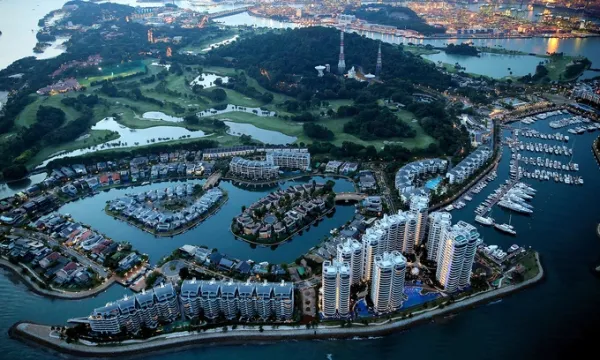
Sentosa Cove occupies the eastern end of the 5-square-kilometer Sentosa Island, which was turned from a military outpost into a leisure and tourism hub in the 1970s.
The enclave was developed in the early 2000s largely on reclaimed land and includes five man-made islands: Coral, Paradise, Treasure, Sandy and Pearl, according to the South China Morning Post.
Envisioned as a high-end residential destination for wealthy foreigners, it was once billed as the city-state’s answer to Monte Carlo or Dubai’s Palm Jumeirah.
To court the world’s rich, the enclave enjoys exemptions from some of the mainland property restrictions. It is the only part of the city-state where foreigners can purchase landed homes, subject to government approval. Property sales in the enclave were brisk in its early years, driving up prices.
|
Aerial view of Sentosa Cove in June 2015. Photo by SPH Media via AFP |
But demand has since waned following the 2008 global financial crisis and successive increases in Singapore’s additional buyer’s stamp duty. The tax, which is levied on top of the standard buyer’s stamp duty, was doubled to 60% in April 2023 for most foreign buyers, with Americans and a few other nationalities exempt.
“The government is still attracting the wealthy into Singapore but they’re no longer using real estate as a lure,” Nicholas Mak, chief research officer of Mogul.sg, told Bloomberg for a report late last month.
He said several factors are “not going in favor of Sentosa Cove,” including a lack of new residential developments, limited accessibility and corrosive coastal conditions. No residential land parcels in Sentosa Cove have been sold since 2008.
Another obstacle is a rule that bars foreign owners from renting out their standalone homes, meaning some properties have remained empty for years as their owners live overseas, travel or spend time at residences elsewhere on the mainland.
The report also found that many villas there have remained vacant for years while some homes have fallen into disrepair.
“There’s no catalyst to really excite the market there,” Mak told the outlet. “Sentosa Cove has lost its shine.”
Demand remains niche as Singaporeans appear generally uninterested in the area, partly due to its lack of amenities like shopping malls, wet markets and hawker centers. Many local buyers favor homes closer to schools and amenities on the mainland.
Ivan Chin, the Singaporean founder of Indonesian conglomerate Enesis Group, told Bloomberg that “Sentosa is a foreigners’ place.”
Chin has invested more than S$100 million developing six homes within a gated estate there.
“When you block the foreigners, that’s it,” he said in reference to the 60% levy on foreign buyers. “The tax is too high for foreigners, but foreigners love to live here, not Singaporeans. It’s a double negative but that’s how it is.”
-
World Photography Day: 6 Hyderabad photographers to watch out for
-
Gachibowli police nab 3 interstate peddlers, seize Rs 16L drugs
-
Iran claims California as its territory after Trump’s post
-
J-K important part of India, US to change travel advisory: Envoy
-
Bigg Boss 20: Top 6 already fixed? Read contract details here