Today, the firm has an annual production capacity of 1.08 million tonnes for smelting and 230,000 tonnes for extrusion, supplying a wide range of industries, including infrastructure, transportation, construction and consumer goods.
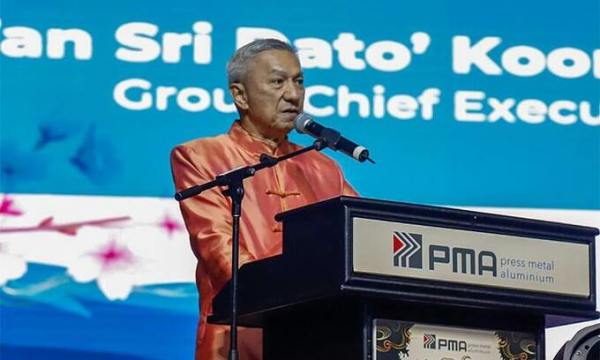
Leading the business is Koon Poh Keong, its group CEO and the youngest of the brothers who founded it.
When Koon returned to Malaysia in 1986 after graduating from the University of Oklahoma with a degree in electrical engineering, the economy was in recession and he struggled to find a job.
So he rallied his six brothers to start Press Metal. The siblings knew little about aluminum at the time, but the family ran a small hardware business, which traded aluminum bars.
They pooled $50,000 and set up an aluminum extrusion business in a small rented factory in Puchong, a town in Malaysia’s Selangor state. They started with secondhand machinery and just 12 workers, and the brothers themselves were closely involved in the operation.
As the business grew, the brothers moved operations into their own factory in Kapar, another town in Selangor.
Press Metal went public in 1993, when it was listed on the Second Board of the Kuala Lumpur Stock Exchange, before moving to the Main Board in 1999.
The company also began shipping its aluminum products to Europe, Australia and New Zealand that same year.
|
Koon Poh Keong, Press Metal group CEO, at a kungfu-themed staff annual dinner in 2024. Photo from Press Metal Aluminum’s website |
But with fierce competition from Chinese firms and growth prospects at home beginning to look limited, the Koons sought out new opportunities. China was their next destination.
In 2005, they established an aluminum extrusion plant in Foshan, Guangdong Province, choosing the area in part because of its proximity to Guangzhou, the hometown of Koon’s parents. The area offered a relatively low-cost location, while the brothers’ ability to speak Cantonese helped them navigate their new market.
The bet proved successful and became a major break for Press Metal, which rode China’s economic boom and grew in that market.
“As we are an international company in China, it makes a lot of sense for people to come and look at us,” Koon explained in a 2017 interview with The Edge Malaysia. “I am Chinese-educated, so we can communicate with them. At the same time, we also understand the international business. It is good for us to be there (because) the whole world is sourcing products from China.”
Press Metal took a major step up the aluminum supply chain, entering the upstream smelting business. It later opened Malaysia’s first aluminum smelting plant in the state of Sarawak in 2009.
“The business of extrusion has low barriers to entry, and there are many players,” Koon told Forbes in 2018, when his firm was named to the magazine’s list of Asia’s best big public firms. “But upstream requires a lot of capital and players are consolidated. From a business perspective, that’s where you want to be.”
For its smelting business, Press Metal adopted Chinese technology, which helped the company keep production costs down while maintaining efficiency and quality, giving it an advantage over Western competitors.
Sarawak also gave it an important edge: relatively cheap and abundant power. When the 2,400-megawatt Bakun hydroelectric dam came online, the state had surplus power and was looking to attract energy-intensive industries such as aluminum smelting.
 |
|
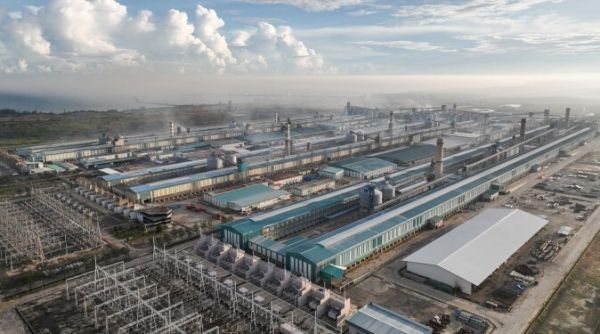
A plant of Press Metal in Malaysia. Photo from the company’s website |
Press Metal benefited from being an early investor in the Sarawak Corridor of Renewable Energy, securing what Koon calls an “early bird power price” through a 25-year power purchase agreement.
But the firm’s expansion has not been without setbacks. In 2013, its first aluminum smelter in Sarawak was forced to halt production following a state-wide power outage.
The shutdown caused molten aluminum in the smelting pots to solidify, damaging the equipment beyond salvage. The company spent more than four months rebuilding the damaged pots and wrote off some of its assets.
It faced another blow two years later when its Phase 2 smelting plant in Samalaju caught fire, followed by a sharp drop in global aluminum prices.
Yet Koon remained steadfast and steered Press Metal past these hurdles, eventually expanding its smelting capacity.
“I like to get things done quickly and not looking back,” he told The Star in 2017. “When growing a company, I can’t afford to be complacent, and it is very important to me to stay up in the game.”
Press Metal has continued to grow in recent years. It posted RM2.1 billion (US$467 million) in net profit for 2025, up 19% year-on-year, while revenue rose 8.7% to RM16.2 billion.
This year, the firm has benefited from a surge in aluminum prices following the war in the Middle East, though prices have since moderated.
The company’s growth has translated into a bigger fortune for Koon and his brothers. Together, they ranked second on Forbes’ list of Malaysia’s 50 richest people in April, with a combined estimated net worth of $9.7 billion.
While Koon may be the face of the firm and has led the company since its early days, Press Metal has very much been a family affair.
With two of his brothers having passed away, Koon runs the business with four siblings: Poh Ming is executive vice chairman while Poh Weng, Poh Tat and Poh Kong are executive directors.
Major decisions are made by the board, with the families remaining united and each member playing their part, the youngest Koon said.
“To us, it’s all about family. That has always been our core value. We don’t want to see family disputes … all the brothers have been very supportive,” he said.
-
World Photography Day: 6 Hyderabad photographers to watch out for
-
Gachibowli police nab 3 interstate peddlers, seize Rs 16L drugs
-
Iran claims California as its territory after Trump’s post
-
J-K important part of India, US to change travel advisory: Envoy
-
Bigg Boss 20: Top 6 already fixed? Read contract details here