
The layoffs of the past two years have released an unusual amount of senior talent into the market. Technology companies were the most visible participants, but the movement has extended across financial services, professional services, consumer businesses, and several other sectors.
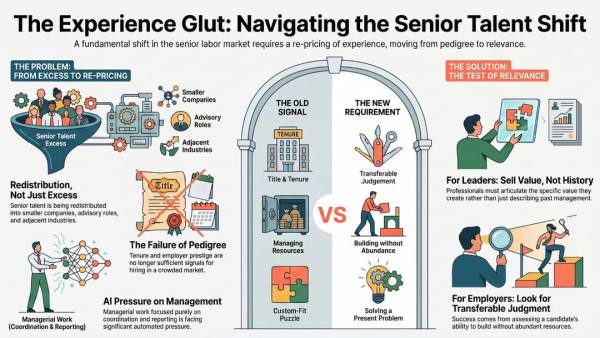
The immediate consequence is often described as an experience glut: more accomplished professionals competing for fewer roles of comparable scale. That description is directionally correct, but incomplete. What we are seeing is not simply an excess of experience. It is the redistribution and repricing of experience.
A senior leader leaving a large organisation does not necessarily move into an equivalent title, compensation band, or institutional setting. Some take on broader mandates in smaller companies. Others move into advisory work, entrepreneurship, interim leadership, or roles in adjacent industries. A few remain outside formal employment for longer than expected. The transition is neither seamless nor uniformly rewarding.
Experience Alone Is No Longer Enough
However, displacement does not make capability disappear. It separates the individual from the organisation that previously carried, amplified, and occasionally concealed that capability.
This is where the market becomes more exacting. Tenure, title, and employer pedigree remain useful signals, but they are no longer sufficient. When several candidates have held senior positions in respected organisations, employers begin to look more closely at what each person can carry into a different context.
Can the leader build without abundant resources? Can they make decisions when information is incomplete? Can they create alignment across functions, influence difficult stakeholders, understand customers, and take responsibility for commercial outcomes? Most importantly, can they explain where their judgement changed the result?
The market does not buy an entire career. It buys the part of that career that solves a present problem.
This creates an obligation for displaced senior professionals. They must move beyond describing what they managed and articulate the value they can create. A sales orientation becomes important here, not because every executive must become a salesperson, but because every executive must understand demand. They must know how to position their experience against an employer’s priorities, communicate relevance clearly and build confidence before authority is formally conferred upon them.
Employers also need to change their behaviour. A larger pool of available leaders may create the impression of a buyer’s market, but abundance can produce poor judgement. Organisations may delay decisions, search for unrealistic combinations of experience or mistake availability for suitability. The advantage belongs to employers that define the mandate clearly and assess candidates for transferable judgement, adaptability, and the ability to create value in their specific environment.
AI Will Reprice Leadership, Not Replace It
Artificial intelligence will add another layer to this transition, but it is unlikely to be its sole driver. It will place pressure on managerial work built mainly around reporting, coordination, and process supervision. At the same time, it will increase the value of leaders who can combine technological efficiency with human judgement, commercial instinct, and accountability.
Every market correction creates loss. It also releases people, ideas, and capabilities from established structures. Some senior professionals will struggle to regain their previous position. Others will discover that their next role offers wider authority, greater ownership, or the opportunity to build something of their own.
The experience glut is therefore not merely a story of oversupply. It is a test of relevance. The leaders who can make their value visible, and the organisations bold enough to recognise it will shape what comes next.
Fortune, as ever, favours the bold.
(The author is a Partner at Sapphire Human Capital)
niethThe opinions, beliefs, and views expressed by the various authors and forum participants on this website are personal and do not reflect the opinions, beliefs, and views of ABP Network Pvt. Ltd.
-
YSRCP must aim for massive victory in local polls: YS Jagan Reddy

-
NBIS Stock Falls After Announcing Its Third Multi-Billion Dollar Convertible Notes Sale in Under a Year

-
US Treasury Just Doubled Size Of Liquidity Support Buyback — El-Erian Says Move Is More About Possibility Of Broader Deployment Of Yield Curve Control

-
“Why Isn’t Everyone Doing This?”: Bengaluru Salon’s ₹2 Lakh Revenue Sparks Debate Online

-
FMGE June 2026: Candidates demand transparency, await NBEMS update