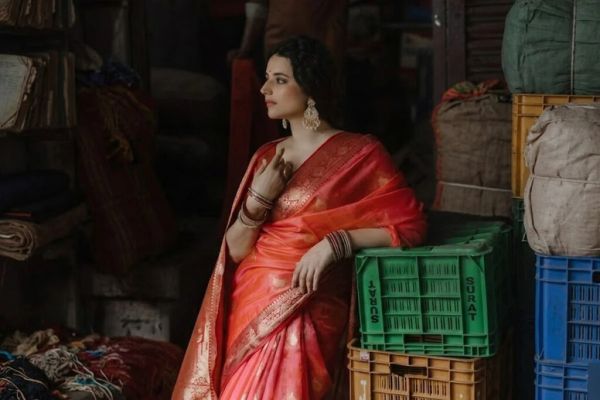
If you identify yourself as a saree lover, you must know about these 5 GI-Tagged Indian Sarees. Nowadays, there is a tendency to sell very high quality cloth under the name Varikki. A possibility that remains especially with online shopping. If you want to avoid pitfalls, get to know these traditional textiles of India in time.
Indian weaving industry is undoubtedly admirable. For generations, weavers in different parts of the country have been creating fabrics whose design, weave and craftsmanship are representative of a particular region and culture. Geographical Indication or GI recognition is used to recognize this regional identity.
Banarasi
Banarasi sarees come first when talking about wedding dresses. Closely associated with Varanasi in Uttar Pradesh, this saree received GI recognition in 2009. The real beauty of Banarasi lies in its lace-rich weaving. Flowers, creepers, leaves and various geometric designs are made with golden or silver lace on silk. The influence of Mughal art is also evident in the design of Banaras.
Kanjivaram silk
The history of this saree is deeply intertwined with the Kanchipuram region of Tamil Nadu. It received GI recognition in 2005–06. South Indian temple architecture, religious symbols and nature are the main inspiration for this saree design. Like, Rudraksham (Rudraksha design), Gopuram (temple entrance pattern), Moyilkan (Peacock's eye), Quilkan (Cuckoo's eye) etc.
The weaving process is also special. Kanchivaram saree body and anchal are woven separately, then joined together. As a result, the border and anchal structure is quite strong and the saree gets its unique weight and beauty.
Chanderi
The biggest attraction of this saree from the Chanderi region of Madhya Pradesh is its transparent weave. When wrapped around the body, the fabric feels as light as air. Chanderi saree got GI recognition in 2005. The design also has its own variety. Small coin-like designs, flowers, peacocks and various geometric motifs are seen in Chanderi. In the past, various royal families of central and western India had a special appreciation for this cloth.
Pochampally Ikat
This weaving industry of Bhudan Pochampally region of Telangana got GI recognition in 2004. The biggest feature of Ikat is its weaving method. First the thread is tightly tied in place. Then the yarn is dyed. Color cannot enter the blocked area. After that, when different colored threads are placed on the loom and woven, a specific design gradually emerges. That is, the design is not printed on the fabric afterwards. The design is made of thread. A slight mistake can cause the design to bend.
Motifs like diamonds, geometric shapes, flowers, birds and elephants are seen in Pochampalli designs. The use of bright colors is also one of the attractions of this saree.
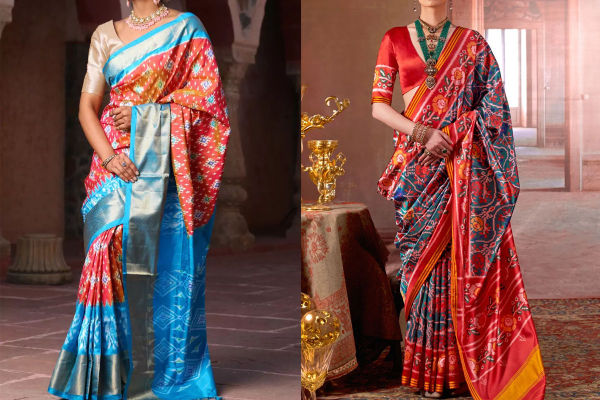
Patan Patola
It is one of the most complex and time-consuming weaving techniques. Associated with the city of Patan in Gujarat, this silk saree is made using the double ikat method. That is, both the lengthwise and crosswise threads of the loom are tied and dyed according to the design. It is then placed on the loom and woven together with great precision. Patan Patola received GI recognition in 2013.
The process of making this saree is very time consuming. Patolas were once highly prized and worn by the elite. Even today, a quality Patan Patola is a family heirloom passed down from generation to generation.
-
An unexpected bombshell: the complete story behind Rodri's move from Real Madrid to Barcelona

-
Silver Chutney: You have seen a lot of gold and silver ornaments, now taste the royal chutney made from them! You will be shocked to know the price
-
First bath in Pulastya, then darshan…, how to worship in Budha Amarnath temple?
-
Microwave stains will vanish immediately with 2 kitchen staples
-
Indian student's miracle, bribery will now be exposed through AI app, Indians will be able to report directly