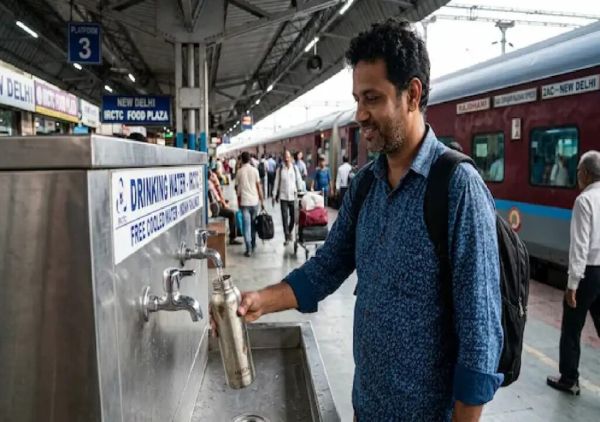
New Delhi: A recent Comptroller and Auditor General (CAG) audit has raised concerns over the safety and monitoring of drinking water at railway stations after water-cooler samples from eight stations across four railway zones tested positive for E. coli.
The findings are significant because railway stations serve millions of passengers every day, many of whom depend on public drinking-water facilities during their journeys. The audit also pointed to gaps in bacteriological testing and monitoring of water supplies at several stations.
The stations where water-cooler samples reportedly tested positive for E. coli include Coimbatore and Palakkad Junctions in Southern Railway, Hyderabad in South Central Railway, Chhatrapati Shivaji Maharaj Terminus, Bhiwandi Road, Kalyan and Lonavala in Central Railway, and Madhupur in Eastern Railway.
CAG audit finds gaps in water testing
The audit covered 512 non-suburban railway stations across the country. According to the findings, bacteriological analysis of drinking water had not been carried out at 59 stations across six railway zones.
The audit also detected total coliform bacteria, including E. coli, in drinking-water samples collected from taps at several stations.
The findings have highlighted concerns about whether prescribed water-quality monitoring procedures are being consistently followed across railway stations.
Regular bacteriological testing is particularly important because water can become contaminated not only at its source but also through storage tanks, pipelines, taps and other parts of the distribution system.
Why is E. coli in drinking water a concern?
Escherichia coli, commonly known as E. coli, is naturally present in the intestines of humans and many animals. Most strains are harmless.
However, detecting E. coli in drinking water is an important indicator of possible faecal contamination. It can suggest that sewage or faecal matter has entered the water supply and that other disease-causing microorganisms could also be present.
According to World Health Organization drinking-water guidelines, E. coli should not be detectable in a 100 ml sample of water intended for drinking.
Therefore, finding the bacterium in a drinking-water sample does not automatically mean that an outbreak has occurred, but it indicates a water-safety failure that requires investigation and corrective action.
Contamination can happen at multiple stages
Drinking water can become contaminated at several points between its source and the point where passengers consume it.
Poorly maintained water tanks, damaged pipelines, leaking infrastructure and inadequate cleaning can contribute to contamination. Problems with sanitation systems or accidental connections between wastewater and drinking-water lines can also introduce faecal organisms.
Even when water is treated adequately at its original source, contamination can occur later if the distribution and storage infrastructure is not properly maintained.
This makes regular testing and maintenance essential, particularly at busy railway stations where drinking-water facilities are used by large numbers of people every day.
What happens after consuming contaminated water?
Not everyone who consumes water containing E. coli will necessarily become ill, and the CAG findings do not establish that passengers at the affected stations developed E. coli infections.
The health effects also depend on the particular strain involved.
Certain diarrhoeagenic strains can cause gastrointestinal illness, while Shiga toxin-producing E. coli can result in more serious infections. Symptoms can include diarrhoea, abdominal cramps, vomiting and, in some cases, fever.
Some infections can cause bloody diarrhoea and serious complications such as haemolytic uraemic syndrome, or HUS, which can affect kidney function.
Children, particularly those under five years of age, are among those at greater risk of developing HUS following certain E. coli infections.
Warning signs should not be ignored
People who develop gastrointestinal symptoms after consuming potentially contaminated water should pay attention to the severity and duration of their illness.
Diarrhoea can lead to dehydration, particularly in children and older people. Signs such as reduced urination, unusual tiredness, dizziness or reduced alertness can indicate significant dehydration.
Bloody diarrhoea, severe abdominal pain, repeated vomiting or other serious symptoms require prompt medical attention.
Maintaining adequate hydration is important during diarrhoeal illness, although people should seek medical advice when symptoms are severe or persistent.
What should railway authorities do?
The CAG findings underline the need for continuous monitoring rather than testing only when contamination is suspected.
Railway authorities need to regularly test drinking water, clean and disinfect storage tanks and pipelines, repair damaged infrastructure and investigate any sample that fails microbiological safety standards.
The audit also recommended compliance with prescribed inspection protocols and comprehensive testing under the Railways’ Uniform Drinking Water Quality Protocol.
A systematic approach should include documented cleaning schedules, regular laboratory testing, proper maintenance of water tanks and pipelines, protection against sewage contamination and immediate corrective action when unsafe samples are detected.
Passengers can take simple precautions
Passengers need not panic because of the audit findings, but basic precautions can help reduce exposure to potentially unsafe drinking water.
Travellers can carry sealed drinking water or use a known safe source when the quality of water at a public facility is uncertain. It is also advisable to avoid taps, containers or water dispensers that appear visibly dirty or poorly maintained.
Safe water should also be used for brushing teeth and taking medicines when the safety of the available water is uncertain.
Hand hygiene is another important precaution. Washing hands before eating and choosing freshly prepared, properly cooked food can help reduce the risk of gastrointestinal infections while travelling.
Large railway network makes monitoring crucial
The scale of the railway network makes water-quality monitoring a major public-health responsibility.
According to the CAG material cited in the report, Indian Railways operated more than 7,400 non-suburban passenger trains every day and carried 292.4 crore non-suburban passengers in 2023-24.
With such a large number of passengers depending on railway facilities, even isolated water-quality failures deserve attention.
The detection of E. coli at eight stations should therefore be viewed as a warning about monitoring and maintenance rather than as evidence of a nationwide outbreak.
Safe drinking water remains essential
The CAG findings underline the importance of ensuring that drinking-water facilities at railway stations meet established safety standards.
For railway authorities, the priority should be regular testing, proper maintenance and immediate action whenever contamination is detected. Water-quality checks should also be supported by reliable record-keeping and timely corrective measures.
For passengers, carrying safe drinking water and maintaining basic hygiene can provide an additional layer of protection during travel.
The audit does not establish that passengers across the country are facing an E. coli outbreak. However, the presence of the bacterium in water samples and the gaps identified in testing demonstrate why safe drinking water cannot be treated as merely a routine railway amenity.
For a public transport system used by crores of people, ensuring clean and microbiologically safe drinking water is a fundamental public-health responsibility.
-
India Hand Sri Lanka Mammoth 372-Run Chase In Galle Test

-
Galatasaray line up ambitious move for Bruno Fernandes with doubled wages and a €50m offer to tempt Manchester United captain to Istanbul

-
Premier League 2026/27 opening weekend: Full fixtures, kick-off timings and TV channels

-
Kerala Shocker: iPhone Wanted, Grandfather Killed? Kerala Class 8 Girl’s Alleged Murder Plot Shocks Alappuzha
-
Digital Revenge! Tired of Toxic Bosses, Chinese Workers Are Turning Their Managers Into AI Pets