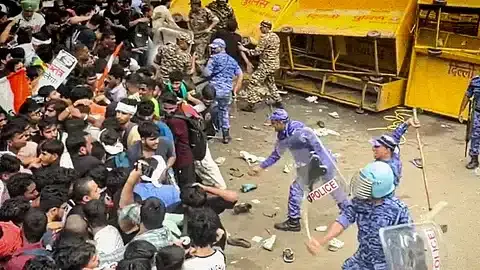
The Delhi Police has defended its response to the July 20 student-led “Sansad Chalo” protest, telling the Supreme Court that it adopted a “graded” use of force only after sections of the crowd allegedly breached multiple layers of barricades and attempted to move towards Parliament.
In a counter-affidavit filed before the Supreme Court, Deputy Commissioner of Police Sachin Sharma said around 5,000 police personnel were deployed to manage more than 30,000 protesters spread across nearly three kilometres.
The police claimed that the confrontation resulted in injuries to more than 240 police and uniformed personnel and around 200 protesters and members of the public.
The affidavit was filed in response to petitions seeking a court-monitored investigation into alleged police excesses during the protest. The matter is before a bench led by the Chief Justice of India.
Police says protest turned violent after barricades were breached
According to the Delhi Police, personnel initially attempted to regulate and contain the gathering. The situation allegedly deteriorated when sections of protesters breached successive barricades and moved towards Parliament despite the absence of permission for such a march.
The police has argued that the gathering consequently assumed the character of an unlawful assembly and that the attempt to proceed towards Parliament was itself unlawful.
The affidavit also challenged the reliance on photographs, videos and media and social-media reports, saying such material was selective and did not provide the complete picture of the events or the police response.
Police denies allegations over nail-studded lathis
The Delhi Police also addressed allegations that its personnel used lathis fitted with nails against protesters.
The affidavit said an examination of available videos showed one instance involving such an object, but claimed that it was in the hands of a protester rather than a police officer.
The police further disputed the description of the object as a nail-studded police lathi, saying it was a stick carrying the National Flag.
According to the police, lathis are permissible crowd-control equipment and were used to contain groups of protesters who allegedly attacked personnel.
The affidavit claimed that videos showed some protesters targeting individual police officers, pulling off their protective equipment and pushing or dragging them.
Police defends plainclothes personnel
The presence of plainclothes police personnel carrying lathis was also questioned during the controversy.
The Delhi Police said these personnel were “spotters” drawn from the Special Branch, Special Cell, Crime Branch and local police. They were allegedly deployed within the crowd because of the developing situation.
The police maintained that the deployment of plainclothes personnel during large public gatherings is neither illegal nor unusual, citing security arrangements used during major events such as Independence Day and Republic Day.
Facial recognition use defended
The affidavit also defended the use of facial-recognition technology at the protest site.
The Delhi Police described it as a “proportionate policing measure” and denied that the technology was used for indiscriminate surveillance of protesters.
According to the police, the system was intended to identify individuals with previous criminal records involving serious offences. It said petty violations such as traffic challans were excluded.
The police further maintained that no action was taken solely on the basis of a facial-recognition match and that field-level verification was conducted to establish whether an identified person was actually present at the protest.
Police cites protest restrictions
The Delhi Police also referred to its rules governing demonstrations around Jantar Mantar and Central Vista.
According to the affidavit, prior permission is required for demonstrations at Jantar Mantar, while the permitted gathering size is capped at 1,000 people. Marches from the designated protest area are also restricted, except for a limited symbolic march with prior permission.
The police therefore argued that the protesters’ attempt to proceed towards Parliament went beyond the permitted framework.
Supreme Court to examine allegations
While defending its actions, the Delhi Police said the question of whether the force used during the protest crossed permissible limits could appropriately be examined through the fact-finding mechanism proposed by the Supreme Court.
The police said it would cooperate with such an exercise.
The July 20 protest had triggered a major political controversy, with Opposition leaders alleging excessive use of force, including lathis, tear gas and pellet guns. Union minister Kiren Rijiju has separately denied that anyone suffered serious injuries during the protest and praised the Delhi Police for its handling of the situation.
The Supreme Court is now expected to consider the police’s response along with the allegations concerning the use of force, plainclothes personnel and facial-recognition technology.
-
Scared of Snakes This Monsoon? Here’s How to Keep Them Away During Monsoon
-
Delhi News: Get Cinema Hall Licence in Just One Click, New SOP Implemented
-
Vande Mataram row: BJP slams Congress over alleged insult to song
-
IAMGAME 2026 to blend sports business and culture with Sports Fest

-
Mangaluru Vande Bharat Trial At Yedakumeri Ghat,Someshwar Railway Gate Closed; Check Alternate Route