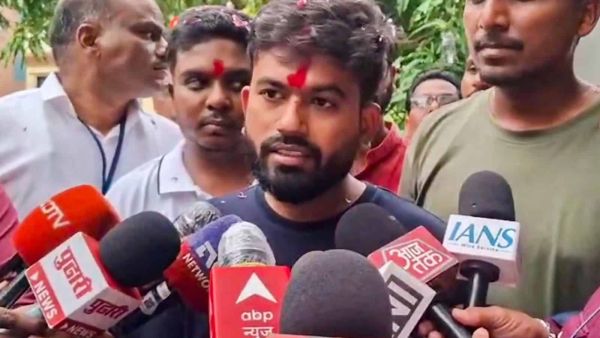
Hingoli: Cockroach Janta Party (CJP) founder Abhijit Dipke on Tuesday, August 18, said ministers and politicians should send their children to village schools for at least a day to understand the challenges of rural students who are forced to walk several kilometres to get access to education.
During a protest in Hingoli over school-related issues, he criticised the Maharashtra government for failing to provide basic transport for rural schoolchildren, saying leaders could arrange buses and trains for election rallies but were unable to provide even a single bus for poor students.
Dipke, who last week launched the ‘School Thik Karo’ campaign from his native village in Hingoli district, claimed that over the past decade, political debate divided people along caste and religious lines, while core concerns such as education and employment remain unaddressed.

Children in remote areas are often forced to walk 7 to 10 kilometres to reach schools, particularly during the monsoon when roads become muddy and waterlogged, the Cockroach Janta Party (CJP) convenor noted.
“Will these ministers send their own children to school walking like the children of villagers?” Dipke asked while talking to reporters.
“Ministers, MLAs and MPs should send their children to village schools for one day and make them walk to school like village children. Then they will understand what these children have to face,” he said.
Dipke said the government is responsible for ensuring that such things do not recur and vowed to continue his fight for tribal and poor children.
“The life of a tribal child should have the same value as the life of a minister’s child. The life of that child is not worth any less,” he added.
Referring to recent student fatalities in tribal residential schools, he noted that one student had died in Melghat in Amravati and others in Gadchiroli.
Dipke said he had chosen to hold the protest in Hingoli because he had personally seen his siblings walking to school as children.
“Even today, girls in rural areas have to walk to school. My sisters used to walk to school. I have seen my brothers walking to school. I have personally seen this,” he said.
“Even after 15 years, the situation has not changed. This is shameful. Politicians can arrange buses and trains for election rallies, but they are unable to provide a single bus for poor children travelling to school,” he charged.
Dipke said his campaign was not against village sarpanches or residents and that they should instead be involved in improving schools.
“Our fight is not against sarpanches or villagers. We want to work with them. Where do the sarpanches’ children study? They study in the same schools. Their children do not go to big schools like the children of ministers or MLAs,” he said.
“If the government cannot do it, we will do it with the help of villagers,” Dipke added.
He alleged that political discourse over the last decade had divided people along caste and religious lines, while basic issues such as education and employment remained unresolved.
“People are being made to fight among themselves, while those in power are benefiting from it. Who is suffering? We are suffering. Who is not getting education? Our children are not getting it. Who is not getting jobs? Our sons and daughters are not getting jobs,” Dipke said.
He also criticised the disparity between the facilities available to children of politicians and those available to poor, tribal and working-class children.
“Their children go to America to study. I studied at the same place where their children studied,” he added.
-
Burqa-clad women steal gold chain from Zaheerabad jewellery shop
-
A legendary journey will end next year: Ronaldo to retire

-
When India avenged 1982 Asian Games loss to Pakistan

-
SC to set up high-powered panel to probe Delhi Police brutality
-
What Relief Has Pak SC Granted Imran Khan Amid Concerns Over His Health? | Explained