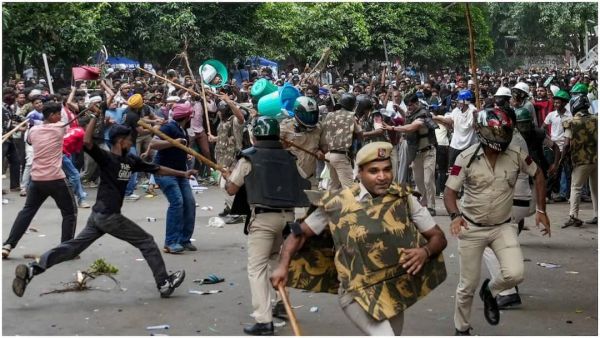
The Delhi Police has defended the deployment of plainclothes personnel during a massive student protest in the national capital, telling the Supreme Court that the officers were deployed as “spotters” to help manage an increasingly volatile crowd.
In a counter-affidavit filed by Deputy Commissioner of Police Sachin Sharma, the police denied allegations of excessive force and said its plainclothes personnel were part of a standard crowd-control strategy used during major public gatherings, Live Law reported.
The affidavit was filed in response to petitions seeking a court-monitored probe into alleged police excesses. It also serves as a common response in four connected petitions.
Why Were Cops In Plain Clothes?
Addressing questions over videos showing police personnel in plain clothes carrying lathis, the Delhi Police said the footage had been presented out of context.
According to the affidavit, “spotters” from the Special Branch, Special Cell, Crime Branch and local police were strategically positioned within the crowd because of the urgency of the situation.
The police said such deployments were neither illegal nor unusual, adding that similar tactics are used during major public events, including Independence Day and Republic Day gatherings.
The explanation comes amid allegations that plainclothes personnel were involved in the use of force against protesters.
Delhi Police Defends Use Of Force
The police said the demonstration stopped being peaceful after sections of the crowd allegedly breached several layers of barricades and attempted to march towards Parliament.
The affidavit said around 5,000 police personnel were deployed to manage more than 30,000 protesters spread across nearly 3 km.
As the situation spiralled out of control, clashes broke out and both protesters and police personnel were injured. More than 240 police and other uniformed personnel and around 200 members of the public and protesters sustained injuries, according to the affidavit.
The police maintained that the allegation of excessive force could not be assessed without considering the size and composition of the crowd. It alleged that anti-social elements and history-sheeters had infiltrated the protest.
It also argued that the proposed march towards Parliament had not been granted permission, making the gathering unlawful and the attempt to proceed towards Parliament an illegal act by an unlawful assembly.
‘Nailed Lathi’ Allegation
The Delhi Police also responded to allegations that personnel used lathis fitted with nails against protesters.
The affidavit said videos showed one isolated incident involving what appeared to be a stick with nails, but claimed it was held by a protester, not a police officer. It further said the object was not a police lathi but a stick carrying the National Flag.
The police maintained that lathis are permissible crowd-control equipment and said officers used them only while attempting to contain groups of protesters who allegedly attacked them.
The police said its actions were undertaken through permissible methods of controlling violence.
Police Cites Attacks On Personnel
The affidavit alleged that videos showed groups of protesters targeting individual police officers, pulling off their protective equipment, dragging them and pushing them onto stone pavements.
The police said it was forced to use graded force only after protesters allegedly breached multiple barricades and violence began.
It also claimed that around 2,873 people at the protest site had criminal cases against them, including charges related to murder, attempt to murder, dacoity, rape and offences under the POCSO Act.
The police said these individuals would be investigated by the SIT constituted by the Delhi Police Commissioner.
At the same time, the affidavit stated that the question of whether the police used excessive force could be examined by any committee constituted by the Supreme Court and assured the court of its cooperation.
Police Questions Evidence Of Alleged Excesses
The Delhi Police also challenged the material relied upon by the petitioners, saying their claims were based on selected photographs, incomplete video clips and unverified media and social media reports.
According to the police, such material presents a one-sided account and does not capture the actions taken by officers while attempting to control the situation.
Why Facial Recognition Was Used
The affidavit also addressed the deployment of facial recognition technology at the protest site, describing it as a proportionate policing measure.
The police claimed the software did not automatically create profiles of everyone present at the protest or enable indiscriminate surveillance of peaceful protesters.
According to the affidavit, the technology was used to identify people with previous criminal records for serious offences. No action, it said, was taken solely on the basis of a facial-recognition match.
The police said officers also conducted field verification to establish whether the identified person was actually present at the protest site.
It added that the system was not used to target people with minor offences such as traffic challans.
The Delhi Police's affidavit comes as the Supreme Court considers petitions alleging excessive force during the protests, with the police maintaining that its actions must be assessed against the scale of the gathering, the alleged breach of barricades and the violence that followed.
-
Scared of Snakes This Monsoon? Here’s How to Keep Them Away During Monsoon

-
Delhi News: Get Cinema Hall Licence in Just One Click, New SOP Implemented
-
Vande Mataram row: BJP slams Congress over alleged insult to song
-
IAMGAME 2026 to blend sports business and culture with Sports Fest

-
Mangaluru Vande Bharat Trial At Yedakumeri Ghat,Someshwar Railway Gate Closed; Check Alternate Route