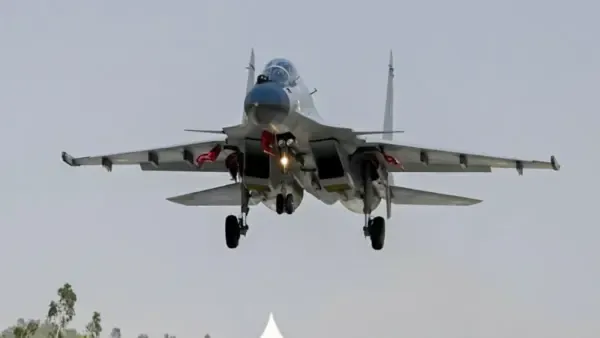
India on Tuesday imposed a phased ban on the import of 405 defence items, including critical components and spares for fighter jets, helicopters, warships, tanks, infantry combat vehicles and missile systems, in a fresh push to boost domestic production and reduce reliance on foreign suppliers.
The items have been included in the Defence Ministry's sixth Positive Indigenisation List. Their imports will be phased out according to specified timelines as Indian manufacturers develop and supply them domestically.
The list covers equipment linked to the Su 30MKI, Light Combat Aircraft, T 72 and T 90 tanks, warships, missile systems and defence electronics. The government estimates that the move could create business opportunities worth around Rs 3,070 crore for Indian industry.
The ban is phased, which means imports will not stop for all 405 items from Tuesday itself.
Each item on the list has an indicative timeline for indigenisation. During this period, Indian companies will be expected to develop the products and meet the technical and quality requirements of the armed forces.
Once the relevant indigenisation timeline takes effect and domestic alternatives are available, procurement will shift to Indian manufacturers.
In simple terms, India is preparing to replace these imported defence items with Indian made alternatives, rather than cutting off all imports overnight.
What Is The Positive Indigenisation List?
The Positive Indigenisation List is a list of defence equipment and components that the government wants to source from Indian manufacturers instead of foreign suppliers. It is part of the Centre's push for Aatmanirbhar Bharat in defence.
The lists do not only cover complete weapons or large military platforms. They also include the smaller components, spare parts and systems needed to operate and maintain them.
This is important because a defence platform being manufactured in India does not necessarily mean that every part inside it is made in India.
A fighter aircraft, tank or warship can still depend on imported engines, electronics, sensors, components or spares.
The indigenisation programme aims to reduce that dependence gradually.
What Are The 405 Defence Items On The List?
The sixth Positive Indigenisation List contains 405 items.
Of these, 389 are linked to Defence Public Sector Undertakings, or DPSUs, while 16 are related to the Indian Coast Guard.
The items cover several categories of military equipment.
Fighter Jets, Helicopters And Engines
The list includes items linked to the:
Su 30MKI
Light Combat Aircraft
Advanced Light Helicopter
Light Utility Helicopter
AL 31FP engine
The inclusion of components and spares is significant because these are required not just to build aircraft but also to keep them operational.
Tanks And Infantry Combat Vehicles
The list also includes equipment associated with:
T 72 tanks
T 90 tanks
BMP II infantry combat vehicles
For the armed forces, locally available spares and components can reduce dependence on overseas suppliers for maintenance and repairs.
Missiles And Ammunition
The list includes items related to missile systems such as Konkurs M, Invar and MRSAM.
It also covers High Explosive Anti Tank ammunition and other critical defence equipment.
Defence Electronics And Warships
The move is not limited to weapons and vehicles.
The list also includes equipment and components related to:
Radars
Sonars
Fire control systems
Satellite communication systems
Warship equipment
These are critical systems that support military operations even though they may not be as visible as fighter jets, tanks or missiles.
Why Is India Phasing Out These Imports?
The main objective is to reduce India's dependence on foreign defence suppliers.
India has traditionally relied heavily on imports to meet its military requirements. While domestic defence production has increased in recent years, several specialised components and systems are still sourced from overseas.
That dependence can create problems when global supply chains are disrupted or when geopolitical tensions affect the availability of equipment and spare parts.
For the armed forces, having a domestic source for critical components can also make procurement and maintenance easier.
Instead of waiting for a foreign supplier to provide a particular part, the aim is to have Indian manufacturers capable of producing it.
The move is therefore not only about reducing the defence import bill. It is also about building a domestic supply chain that can support India's military requirements.
The government estimates that the 405 items on the new list represent a business opportunity of around Rs 3,070 crore for Indian industry.
As these products move from foreign suppliers to Indian manufacturers, domestic companies will get opportunities to develop and supply them to the defence sector.
This could be particularly significant for MSMEs and start ups, which are increasingly being brought into the defence manufacturing ecosystem.
Companies working in aerospace, electronics, precision engineering, specialised manufacturing and defence components could benefit as more products are sourced domestically.
However, these companies will have to meet strict defence specifications before their products can replace imported equipment.
How Will Indian Companies Develop These Items?
The government will use different routes to support the indigenisation of the products. These include the Make procedure and in house development by defence organisations.
Indian industry will also be encouraged to take up the development and manufacture of the items. The process does not simply involve declaring an item as indigenous and immediately stopping its imports.
Manufacturers have to develop the product, meet the required specifications and demonstrate that it can perform reliably. Once the indigenous capability is established, procurement can move towards domestic suppliers.
What Is The SRIJAN Defence Portal?
The government launched the SRIJAN Defence Portal in August 2020 to help Indian companies identify defence products that can be developed and manufactured domestically.
Through the portal, Defence Public Sector Undertakings and Service Headquarters identify imported items and offer them to Indian industry for indigenous development.
The programme has expanded significantly.
According to the Defence Ministry, more than 33,000 defence items had been offered for indigenisation through the SRIJAN portal by June 2026.
This includes 5,012 items covered under the first five Positive Indigenisation Lists.
The sixth list therefore builds on an existing programme rather than starting a new one.
India Has Already Indigenised More Than 15,700 Items
According to the government, more than 15,700 defence items have already been successfully indigenised.
The resulting import substitution is estimated at around Rs 9,000 crore over the past five years.
DPSUs have also placed procurement orders, including in house production, worth around Rs 10,000 crore with domestic vendors up to March 2026.
-
Suthar’s 10-wicket haul hands India 165-run win over Sri Lanka

-
Chhattisgarh: Minor raped by father; fake papers used for delivery

-
Cybersecurity firm Proofpoint sets up AI CoE in Hyderabad

-
Why big Tollywood names are giving up voting rights in Hyderabad

-
Former Wimbledon Finalist Admits Testing Positive For Cocaine