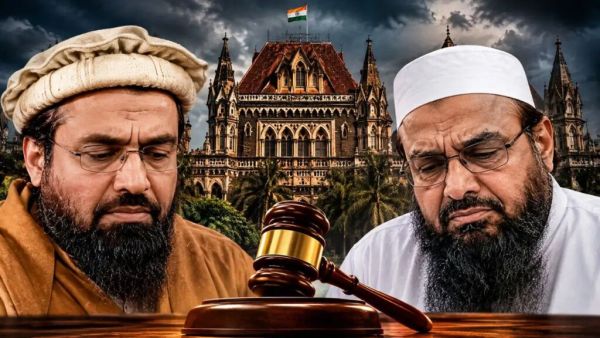
The Mumbai Police and the Home Ministry have initiated the legal process for a formal criminal trial 'in absentia' against six Pakistani nationals accused of masterminding the 26 November 2008 Mumbai terror attacks. This is the first case when the provision of 'in absentia trial' under Section 356 of the Indian Civil Security Code (BNSS), 2023, has been invoked in a major international terrorist case. BNSS replaced the old Criminal Procedure Code (CrPC) on July 1, 2024.
At the center of this legal process is Hafiz Saeed, the founder and chief of the banned terrorist organization Lashkar-e-Taiba (LeT) and its political wing Jamaat-ud-Dawa (JuD). Apart from Hafiz Saeed, the process is also going on against LeT operational commander Zaki-ur-Rehman Lakhvi, key handler Sajid Mir, Karachi control room manager Abu Alqama, Asim (alias Abu Kahfa) and former Pakistan Army officer Major Abdur Rehman Pasha.
The process formally began when Mumbai Police Commissioner Deven Bharti officially informed Special Public Prosecutor Ujjwal Nikam about the case. He had urged the prosecution to use the provisions of the new criminal law to ensure that fugitive accused hiding abroad cannot obstruct the judicial process indefinitely.
After hearing the prosecution's arguments, Special Judge S.R. Navandar issued legal notices to all the six accused and directed them to appear in the court by August 18. In case of non-appearance within the stipulated time limit, the court can now proceed with the process of recording evidence, recording statements of witnesses and pronouncing the final verdict against the accused.
How do absentee trials work in India? Earlier, the rule in India was that if an accused was not present in the court, the trial against him could not be completed nor could the final verdict be pronounced. In other words, the court could not convict or acquit the accused in his absence.
However, there was one limited exception to this. If an accused had absconded and there was no possibility of his being caught soon, the court could record the statements of witnesses in advance so that they could be used if the accused was caught. However, the court could only preserve the statements of witnesses; She could neither complete the trial nor declare the accused guilty or innocent. The final decision was possible only when the accused appeared in court.
This legal limitation created a major hurdle in cases to cross-border terrorism. The accused hiding abroad remained beyond the reach of Indian courts for years, due to which the trial could not reach the final stage.
The situation has now changed with the implementation of Section 356 of the Indian Civil Security Code (BNSS), 2023. Under this provision, if an accused deliberately avoids the judicial process and remains beyond the reach of Indian agencies, the court can complete the trial, record evidence and pronounce the final verdict even in his absence. Section 356 contains some strict legal rules. It is mandatory to follow these rules before starting the trial in the absence of the accused:
1- Seriousness of the offence: This provision is limited to serious criminal cases which are punishable with imprisonment of 10 years or more, life imprisonment or death penalty.
2- 'Proclaimed Offender' Status: In case of repeated failure to respond to judicial summons, the accused must first be formally declared a 'proclaimed offender' under Section 84 of the BNSS. 3- Double Warrant Rule: The Chief Magistrate or Judge has to issue two consecutive non-bailable arrest warrants with a mandatory gap of at least 30 days between the issuance of both the warrants.
4- Public notice through multiple mediums: The court's announcement should be published in leading national dailies that circulate in the area having the last known address or jurisdiction of the accused. For people who have fled abroad, the Home Ministry will have to send a notice to international policing channels, including Interpol.
5- Mandatory 90-day waiting period: BNSS mandates a 90-day waiting period after charges are formally framed. This additional time gives the accused a final opportunity to surrender or present his legal case before the court proceeds in his absence.
6- State-financed legal defence: To prevent abuse of ex-parte proceedings and ensure due process of law, Section 356 provides that if an absconding accused is unable to appoint a lawyer, the court must appoint a state-funded defense lawyer (legal aid). This lawyer will cross-examine the prosecution witnesses, examine the documentary evidence and present closing arguments on behalf of the accused.
Once these conditions are met, the trial proceeds under normal judicial rules. If convicted, the punishment remains in effect. This means that if the criminal ever comes to Indian jurisdiction or is extradited, he can be immediately arrested and sent to jail without any additional trial.
Who is Hafiz Saeed?
Hafiz Muhammad Saeed is the founder of the banned terrorist organization Lashkar-e-Taiba (LeT). His name has been linked to conspiracies of several terrorist attacks including the 26/11 Mumbai terror attacks. The United Nations Security Council has declared him a global terrorist. Additionally, the US State Department has designated him as a terrorist and has announced a reward of up to US$10 million for information leading to his arrest and conviction under the 'Rewards for Justice' program.
Legal action has also been taken against Hafiz Saeed in Pakistan, where he has been convicted in cases to terror financing. However, India has been demanding strict action against him and his extradition for a long time. India alleges that Hafiz Saeed was one of the key conspirators behind the 26/11 Mumbai terror attacks, in which 166 people were killed. India has consistently demanded that Pakistan hand him over so that he can be tried and punished in Indian courts.
-
UP school sealed after ‘burqa dance’ video from I-Day surfaces

-
Jr NTR’s beloved family member Bagheera passes away
-
WATCH: Hindu Girls Made To Wear Burqa, Dance To Bhojpuri Song At I-Day Celebration, School Sealed

-
Lanterns Timeline: Where DCU Series Fits Between Superman, Supergirl And 2026 Events
-
Indian-Origin Man Arrested In Canada Over Alleged Sexual Assault Of Woman At Park