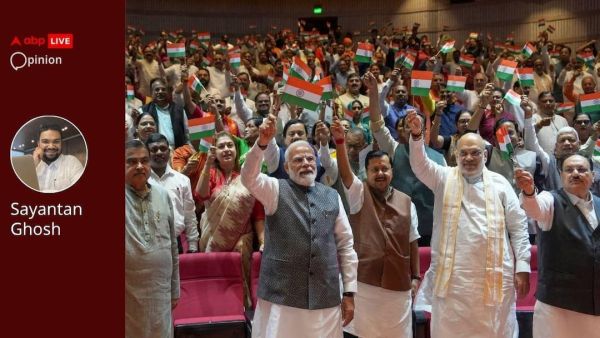
The Bharatiya Janata Party has always treated every challenge as a signal to recalibrate rather than dismiss. When Nitin Nabin, the youngest president in the party’s history, finally unveiled his national team after months of quiet consultations, it was clear the choices carried the imprint of both the Prime Minister and the Home Minister.
Opposition parties have remained largely static in their methods, yet the ground beneath Indian politics has shifted. A restless youth cohort, fuelled by the Gen Z protests that filled Jantar Mantar for weeks, forced the resignation of Education Minister Dharmendra Pradhan, something unseen since Narendra Modi first took office.
Those protests, organised under the Cockroach Janta Party banner and driven by Instagram Reels and sharp digital satire, exposed gaps in the BJP’s hold over younger Indians. The new team under Nabin does not place any pure Gen Z face in a top post, yet it brings in communicators such as Smriti Irani, whose ability to connect across audiences is well known.
The message is unmistakable: the party recognises that youth discontent is no longer a fringe noise but a structural concern that demands fresh outreach, both online and on the ground.
IT Cell Reset After Digital Blind Spots
The appointment of Deepak Mhaskey as the new social media convenor, replacing Amit Malviya, is the clearest admission that the old IT machinery fell short during the Gen Z protests. Malviya’s long tenure had built a formidable presence on certain platforms, yet it struggled to blunt the Cockroach Janta Party’s rapid rise on Instagram Reels, where humour and grievance spread faster than official rebuttals.
The protests revealed that Hindi-heartland youth in semi-urban and rural belts, long considered the BJP’s natural constituency, were consuming content the party had underestimated. Jharkhand and other eastern pockets showed similar patterns of quiet anger over jobs and examination integrity. Even the Prime Minister had to step onto Instagram himself and urge party leaders to engage there, an intervention that underscored how the central digital unit had lagged.
Mhaskey, a Chhattisgarh organiser with experience in data-driven campaigns and a grounded profile, is expected to rebuild outreach that feels less top-down and more conversational. The shift from a pure IT cell to a broader social media department signals an acceptance that every platform now matters, and that ignoring any one of them leaves the party exposed.
Yuva Morcha Change and the Search for Ground Connect
Replacing Tejasvi Surya with Hemang Joshi as Bharatiya Janata Yuva Morcha president is another direct response to the outreach vacuum the Jantar Mantar protests laid bare. Surya’s tenure had energy, yet neither the core pro-BJP youth nor the larger Gen Z cohort felt consistently engaged. Political reach among students remained thin because the BJP has no student organisation of its own.
The Akhil Bharatiya Vidyarthi Parishad answers to the RSS, leaving the party without a dedicated campus arm that can convert digital sympathy into organisational loyalty. Joshi, a first-time Vadodara MP known for steady organisational work in Gujarat, brings a more rooted style. The leadership appears to want a youth wing that starts afresh, building face-to-face networks rather than relying solely on social media noise.
The protests proved that absence on the ground cannot be compensated by online volume alone. Joshi’s elevation is therefore less about personality and more about creating a political bridge that the party simply did not possess when the Cockroach movement gathered momentum.
Ram Madhav’s Return as Ideological Bridge
The elevation of Ram Madhav as a national vice-president restores a polished, RSS-steeped organiser who carries both stature and a degree of autonomy. With Uttar Pradesh elections approaching, followed by Gujarat, Punjab and the longer shadow of the 2029 Lok Sabha contest, a fourth consecutive term for the government will demand more than routine campaigning.
Growing discontent among educated youth and their parents requires an ideological face who can speak fluently to urban elites without losing the cadre’s trust. Madhav has long demonstrated strategic skill in difficult terrains such as Jammu and Kashmir and the North-East, and his writing reaches audiences beyond the usual party circles.
His return after several years outside the formal structure suggests the leadership wants a master strategist who can operate with relative freedom while remaining anchored to the RSS ecosystem. In a moment when electoral arithmetic alone may not suffice, Madhav’s presence is meant to reframe the party’s conversation with a generation that feels unheard.
Wider Overhaul Signals End of Outdated Methods
The broader team overhaul confirms that the BJP now views its previous outreach model as a liability. Leaders such as Smriti Irani, brought back as a general secretary, embody the new emphasis on communication that mixes easily with people and coordinates across social groups. Irani’s ability to hold an audience and move between television fluency and street-level contact is precisely the skill the party feels it needs after the protests.
The induction of several younger faces and the retention of proven organisers show an attempt to balance continuity with urgency. The leadership has concluded that the combination of digital lethargy and thin on-ground youth structures is no longer sustainable.
The new architecture is therefore designed to rebuild engagement from the bottom up, treating the Gen Z moment as a lasting pressure rather than a temporary storm.
Inclusivity as Pragmatic Expansion
Higher women’s representation, with a dozen women in key posts, and the inclusion of Muslim faces such as Professor Tariq Mansoor as a vice-president, display a calculated effort to widen the party’s appeal. These choices are not ornamental.
They reflect an understanding that the core base alone cannot carry the party through the next cycle of state and national contests. Mansoor’s presence offers a quiet signal of openness in Uttar Pradesh, while the expanded role for women aims to consolidate the support the BJP has cultivated among female voters. Together with the other changes, the move underlines that the anxiety generated by the Gen Z protests has pushed the party toward a more expansive social strategy.
The Team Nabin that has emerged is therefore less a routine reshuffle and more a recognition that the old formulas of dominance now need careful, human recalibration.
Sayantan Ghosh teaches journalism at St. Xavier’s College (Autonomous), Kolkata. He is on X as @sayantan_gh.
-
Aisha Wahab becomes first Afghan-American elected to US Congress
-
Charter plane carrying eight crashes in United States

-
Harvard Medical School to pay USD 53 million for theft of body parts

-
SBI to charge Rs 15 for BSBD cash withdrawals from October 1
-
Mehul Choksi’s Lawyer Arrested In London, Charged With 4 Sexual Assault Counts