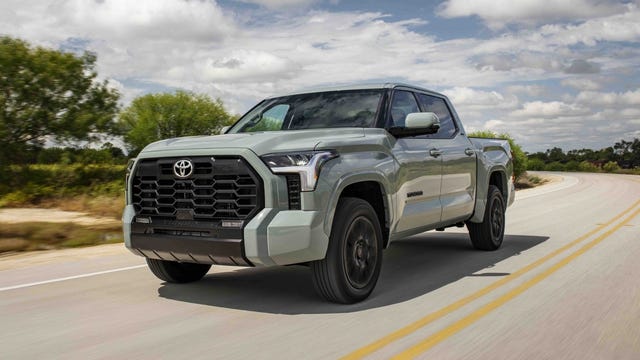
Toyota technicians are now checking recalled Tundra V-6 engines by striking them with a hammer. It may sound amusing at first, but Toyota is not doing this for show. The company’s 3.4-litre twin-turbo V-6 has been involved in multiple recalls, and Toyota needed a method to assess these engines without carrying out a complete teardown. As it turns out, a hammer has become a key part of that process.
The information comes from Pickup Truck + SUV Talk, which obtained Toyota’s technical instructions outlining the inspection method. Although the procedure—officially named the V35A Crank Bearing Inspection—does include hitting the engine with a hammer, the process is far more technical than it may appear.
The inspection is necessary because Toyota has determined that machining debris from the manufacturing process may remain inside the engine. That contamination can potentially damage the main bearings and, in the worst case, lead to engine failure. Earlier, Toyota’s response to the issue was to replace engines outright, but now, for certain affected vehicles, technicians have a way to determine whether an engine actually shows signs of bearing damage before deciding it must be replaced.
That is where the hammer comes into play. Technicians are not simply lifting the bonnet and taking random swings. The procedure requires an accelerometer to be attached to the engine, along with diagnostic equipment capable of measuring the vibrations passing through it. The hammer itself is not a sledgehammer or a ball-peen hammer either; according to Pickup Truck + SUV Talk, it is a custom-made plastic hammer that looks somewhat like a technical gavel.
“This remedy was developed to be effective in identifying if the engine needs to be replaced in a covered vehicle. Fundamentally, this inspection uses the resonant frequency of the front of the crankshaft to assess the condition of the #1 main bearing,” a Toyota spokesperson told Road & Track by email. “The development of this inspection included testing numerous engines to identify the resonant frequency differences between a #1 main bearing with and without abnormal wear. Using an inspection software, dealers will evaluate the #1 main bearing and collect available vehicle drive data to confirm the condition of that bearing. If the inspection software cannot confirm that the bearing will be free from abnormal wear due to this issue, dealers will replace the engine.”
So, it is less like smashing something with force and more like a doctor using a reflex hammer to check your knee—the real point is not the strike itself, but the reaction it produces. Based on the results, the Tundra engine may either be cleared for continued use or judged to need replacement. Either way, it seems Toyota technicians may have a slightly more interesting day at work than usual when diagnosing one of these twin-turbo V-6 engines.
Update, 3:45pm: This story has been updated with additional information from Toyota.
-
NYC Women Are Done With Men Who Play It Cool in Dating

-
'SP is the king of riots…' CM Yogi's sharpest attack on Akhilesh Yadav so far

-
Hania Aamir stuns fans with bold, varied looks from her travels

-
Adopt these easy methods to keep spices fresh for a long time, taste and aroma will remain intact.

-
4 Zodiac Signs Attract Abundance & Luck On Monday, August 31, 2026