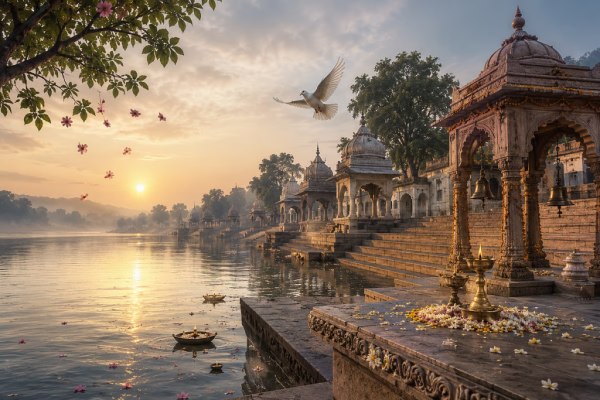
Saraswati: 5 Places Across India Where You Can Still Trace the Lost Vedic River
The Saraswati River occupies a unique place in India’s ancient religious and cultural traditions. Described prominently in Vedic literature, the river is traditionally believed to have once flowed across parts of northwestern India before disappearing. Modern research has identified a network of palaeochannels—old, now-dry river courses—across Haryana and Rajasthan that have often been associated with the ancient Saraswati system. However, the exact historical identity and course of the Vedic Saraswati remain subjects of scholarly debate.
Even today, several locations preserve archaeological remains, religious traditions and landscape features connected with the Saraswati. Here are five places where you can explore this fascinating history.
1. Adi Badri, Haryana
Located in the foothills of the Shivalik Hills in Yamunanagar district, Adi Badri is one of the most important places associated with the Saraswati tradition.
Studies of Haryana’s Saraswati drainage identify a stream in the Adi Badri region as the beginning of the present Saraswati channel. The area also has considerable archaeological and religious importance.
Adi Badri is therefore often described as one of the places where the journey of the ancient river can still be traced through its landscape and surviving watercourses.
2. Kurukshetra, Haryana
The Kurukshetra region has an exceptionally strong cultural connection with Saraswati. Ancient texts and later traditions associate numerous sacred sites in the region with the river.
The modern Sarsuti and palaeochannels in Haryana have also been studied as possible remnants of the ancient river system. Archaeological research has identified ancient settlements along these channels, suggesting that communities historically occupied areas associated with the river system.
3. Pehowa, Haryana
Pehowa, in Kurukshetra district, is another important stop on the Saraswati trail.
The Haryana Department of Archaeology and Museums records ancient sites in Pehowa situated on the southern bank of the Sarasvati River. The town has long been an important pilgrimage centre associated with ancestral rituals and Saraswati traditions.
The archaeological remains and religious sites here provide an interesting connection between the surviving landscape and centuries of cultural memory.
4. Kalibangan, Rajasthan
Moving westward, the Saraswati story becomes closely connected with the Ghaggar-Hakra palaeochannel and the archaeological remains of the Harappan civilisation.
Kalibangan, in Rajasthan’s Hanumangarh region, is one of the major archaeological sites located along the ancient Ghaggar system. Research has documented numerous Harappan settlements along the palaeochannels of the Ghaggar-Hakra system.
The concentration of ancient settlements along these old channels is one reason the region remains important in discussions about the ancient Saraswati basin.
5. Hanumangarh and the Ghaggar Valley, Rajasthan
The Hanumangarh region contains numerous archaeological sites associated with the ancient Ghaggar-Hakra river system.
Satellite studies and archaeological investigations have identified clusters of Harappan settlements along the old river channels in Rajasthan. These channels are frequently discussed in relation to the proposed Saraswati river system.
The landscape today is dramatically different from what it would have looked like when substantial rivers supported ancient settlements, but the old channels and archaeological mounds provide clues about the region’s watery past.
Is the Saraswati Really the Ghaggar-Hakra?
This is where the story becomes scientifically interesting.
A number of researchers have proposed that parts of the Ghaggar-Hakra-Sarsuti system correspond to the Saraswati described in ancient texts. Satellite imagery has helped map extensive palaeochannels across Haryana and Rajasthan.
However, there is no universal scholarly agreement that the entire Ghaggar-Hakra system was the Vedic Saraswati or that it followed one single course throughout history. Different geological, archaeological and historical studies have produced different interpretations.
The Saraswati Trail Today
From Adi Badri and Kurukshetra to Pehowa, Kalibangan and the Ghaggar Valley, the Saraswati story survives through a combination of religious traditions, archaeological discoveries and ancient river landscapes.
What makes these places fascinating is that visitors aren’t simply looking for a river—they are exploring the remains of an ancient landscape that once supported settlements and cultures thousands of years ago.
Note: The identification of specific modern channels with the Vedic Saraswati is a matter of ongoing historical and scientific research; the places above should be understood as locations associated with the Saraswati tradition or proposed palaeochannels, rather than proof of the river’s exact ancient course.
-
Joao Pedro handed Chelsea's No.9 shirt from Liam Delap as several squad number changes are confirmed

-
'You've Been Like An Elder Brother': PV Sindhu Pens Heartfelt Message For Kiren Rijiju After Entering BWF World Championships 2026 Pre-Quarter-Finals

-
'I Have Genuinely Forgotten Who I Am...': Apoorva Mukhija Aka The Rebel Kid Reveals Why She Decided To Move To The US

-
Toxic English Trailer: 'Better Than Hindi', 'Global Mayhem'; New Promo Of Yash Starrer Leaves Netizens Impressed

-
Carlos Baleba: How staff at Carrington reacted as Manchester United moved closer to a blockbuster deal