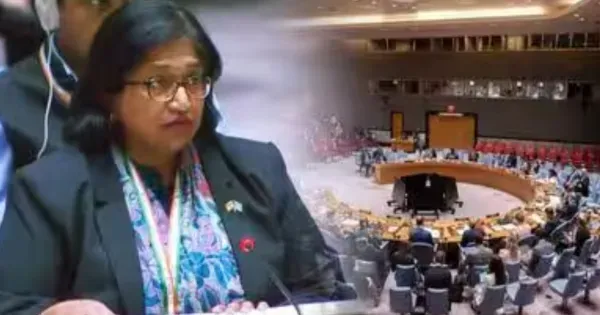
United Nations: India has said UN Security Council membership should not be used to provide “legitimacy” to terrorists by trying to keep them out of the sanctions regime or to blacklist entities merely on the basis of “political considerations”. India stressed that the powerful 15-member body should not become a platform to pursue narrow interests.
During a discussion on the functioning of the Security Council on Wednesday, Ambassador Yojana Patel, Charge d'Affaires in India's Permanent Mission to the United Nations, stressed the need for greater transparency and fairness in the process of blacklisting and delisting terrorists and terrorist organizations under the body's sanctions regime. He said, “There are important responsibilities associated with membership of the Security Council. It should not become a platform to pursue narrow political interests.
“Listing and delisting is an example of this,” Patel said. There should be more transparency and fairness in this matter. “Presence in the Security Council should not be used to legitimize terrorists by attempting to delist them, nor should it be used to designate other entities as terrorist organizations based solely on political considerations and without any objective criteria or providing necessary documentation.”
India has consistently opposed the opaque manner in which decisions are taken on proposals to list terrorists and terrorist organizations in the UN Security Council's Sanctions Committees. Delhi has also demanded greater transparency in the functioning of the council's subsidiary bodies. India says that listing decisions are made public, but information about proposals being rejected or kept on hold on technical grounds remains limited to a select few members.
India has termed such processes as a “hidden veto” and has particularly expressed concern over the functioning of the Al-Qaeda Sanctions Committee constituted under UN Security Council Resolution No. 1267. India has said evidence-based proposals to blacklist terrorists covered by international sanctions should not be stopped without adequate explanation. It says such procedures undermine the Council's stated commitment to combating terrorism.
India has faced such obstacles in the past in its efforts to list Pakistan-based terrorists. China, a permanent member of the Security Council, had abstained or blocked some resolutions. India also expressed concern over the delay in the selection of Chairmen of subsidiary bodies of the Security Council, including the Al-Qaeda and Taliban Sanctions Committees established under resolution 1267. Even after eight months of this year have passed, the Council has still not been able to finalize the names of presidents and vice-presidents of its subsidiary bodies. India has demanded immediate action on this.
“Subsidiary bodies perform important functions and help better implement Security Council mandates,” Patel said. However, in recent times, these bodies have not been able to function to their full capacity and this is mainly due to the delay in finalizing the names of chairpersons.'' He called for resolving the issue on priority basis and setting a ''fixed and non-compromising'' timeline for the selection of chairpersons of the subsidiary bodies.
Denmark, which holds the Security Council presidency for the month of August, said at the UN headquarters that the “unexpected delay” in the appointment of presidents of the council's subsidiary bodies undermines the council's “effectiveness, credibility and institutional integrity.” Denmark said council members called for flexibility and political will to resolve the impasse. India also sought “greater transparency” for the elected non-permanent members of the Council in several existing Security Council processes.
“For example, elected members and the General Assembly should have a greater role in important matters such as the election of the UN Secretary-General,” Patel said. The UN Secretary-General is appointed by the 193-member General Assembly on the recommendation of the Security Council. China, France, Russia, Britain and America are permanent members of the Security Council and they have the right to veto. Patel stressed that the need for Security Council reform has become clearer and more urgent than ever.
He said, “Our joint effort must be on making the UN Security Council properly capable of dealing with current and future challenges. The world of the year 1945 has now completely changed.'' He said, ''Since then the membership of the United Nations has increased four times. The structure of the Council, its functioning, approach and methods of working cannot forever determine the outcome of a conflict that took place 80 years ago. This needs to change and this change should happen as soon as possible.
Also read:
Bangladesh is adamant on 'guarantee' clause in Ganga Strait from India, UN is threatening to leave; Learn about the case in detail
-
Mixed Feelings at Red Bull as Verstappen Qualifies P7 for Final Home Dutch GP, While Stand-in Teammate Lawson Impresses

-
George Russell Leads from Start to Finish to Claim Victory in the First Dutch Sprint Race
-
Jeff Gordon Sweeps Both Historic IROC Races on the D.C. Street Circuit

-
Driver of Minister Konda Surekha’s former OSD Sumanth arrested

-
SC to hear plea for CBI probe into Jharkhand civil services exam