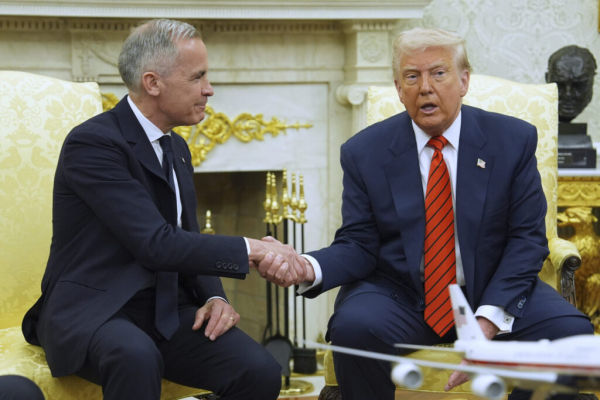
Trump Delays 50% Canada Tariffs for Three Days After Last-Minute Deal/ TezzBuzz/ WASHINGTON/ J. Mansour/ President Donald Trump delayed 50% tariffs on $20 billion in Canadian imports for three days after announcing a last-minute agreement with Canada. The temporary pause gives negotiators time to finalize documents, though Prime Minister Mark Carney said important work remains and Canada did not confirm all U.S.-claimed concessions. Business leaders welcomed the reprieve but warned that continued uncertainty could disrupt the $880 billion annual trading relationship.
Quick Look
- Trump announced the tariff delay Tuesday night.
- The 50% duties were scheduled to begin at 12:01 a.m. Wednesday.
- The tariffs cover approximately $20 billion in Canadian products.
- Trump paused them for three days.
- The agreement remains subject to final documentation.
- Carney confirmed the delay and cited “substantial progress.”
- Canada did not confirm all concessions claimed by the White House.
- The U.S. says Canada will address barriers involving alcohol, dairy and vehicles.
- Trump and Carney spoke twice in two days.
- Canada had threatened retaliatory tariffs.
- U.S.-Canada trade totaled $880 billion last year.
- Nearly 72% of Canadian goods exports go to the United States.
- American importers would pay the U.S. tariffs.
- Businesses warned that a temporary pause does not provide certainty.
- Trump invoked Section 338 of the Tariff Act of 1930.
- The provision has never been used to impose tariffs.
- The tariff threat gives Washington leverage in USMCA negotiations.
Deep Look
Trump announces three-day tariff delay
WASHINGTON — President Donald Trump delayed threatened 50% tariffs on Canadian imports Tuesday after the United States and Canada reached a last-minute preliminary agreement.
The announcement came less than two hours before the duties were scheduled to take effect.
The proposed tariffs would apply to approximately $20 billion in Canadian goods.
Trump said the three-day pause would allow both governments to complete documents and continue negotiations.
Trump claims the countries have a deal
The tariffs had been scheduled to begin at 12:01 a.m. Wednesday.
Products affected would have ranged from hockey sticks to medical tongue depressors.
The agreement temporarily avoids another major escalation between the neighboring allies.
Carney reports substantial progress
Canadian Prime Minister Mark Carney confirmed that Canada accepted the three-day delay while negotiations continued.
Carney’s statement was more cautious than Trump’s declaration that the countries had reached a deal.
The difference suggested that several details still required negotiation or formal approval.
Leaders hold repeated phone calls
Trump and Carney spoke twice by telephone during the final two days of negotiations.
Their discussions included a call Tuesday afternoon shortly before the scheduled tariff deadline.
The direct intervention by both leaders highlighted the urgency of finding a temporary solution.
Officials now have only three additional days to convert the preliminary understanding into a completed agreement.
White House claims Canadian concessions
A White House proclamation said Canada had committed to removing policies the Trump administration considers discriminatory.
The alleged barriers involve American alcohol, dairy products and motor vehicles.
Canada did not immediately confirm those commitments.
The discrepancy leaves uncertainty over the exact concessions Ottawa has offered and whether the two sides interpret the preliminary agreement differently.
Trade retaliation temporarily avoided
Canada had threatened to respond to the new U.S. tariffs with duties of its own.
That retaliation could have intensified an already damaging trade dispute.
The two countries exchanged approximately $880 billion in goods and services last year.
Although the tariffs directly targeted a relatively small portion of trade, their political impact and the risk of escalation would have been far greater.
Both countries had reason to compromise
Almost 72% of Canada’s goods exports went to the United States last year.
The country therefore has a significant economic interest in maintaining access to the American market.
The Trump administration also faced political and economic risks.
U.S. importers pay tariffs and often pass those additional costs to consumers through higher prices.
That could worsen public frustration over the cost of living before November’s midterm elections.
Former trade official saw push for off-ramp
The three-day delay provides that temporary escape.
However, it does not eliminate the possibility that the tariffs could take effect if negotiations fail.
Canadian businesses remain uncertain
Canadian Chamber of Commerce President and CEO Candace Laing said the pause provided some immediate relief.
However, she said it did not offer the stability businesses would receive from a signed interim agreement.
She urged negotiators to reach a final agreement quickly.
Companies on both sides of the border must continue preparing for the possibility of new tariffs after the three-day period expires.
US-Canada relationship remains strained
Trump’s approach to Canada represents a sharp departure from the traditionally cooperative relationship between the two countries.
He has imposed duties on Canadian goods as part of his campaign to return manufacturing to the United States.
Trump has also repeatedly suggested making Canada America’s 51st state.
Those comments have angered Canadians and complicated Carney’s ability to make concessions without appearing to submit to U.S. pressure.
Tariffs define Trump’s economic agenda
Trump has placed tariffs at the center of his second-term economic program.
Last year, he imposed double-digit duties on imports from almost every country.
He justified the action by declaring the longstanding U.S. trade deficit a national emergency.
The Supreme Court ruled in February that Trump had exceeded his legal authority.
The decision struck down those tariffs and prepared the way for the government to issue refunds to importers.
Trump turns to Depression-era law
Following the court’s ruling, Trump sought other legal authorities to impose import taxes.
For Canada, he invoked Section 338 of the Tariff Act of 1930.
The provision authorized his threat to impose 50% tariffs on goods representing approximately 5% of Canadian exports to the United States.
Section 338 has never previously been used to impose tariffs.
Smoot-Hawley legacy raises concerns
The Tariff Act of 1930 is commonly associated with the Smoot-Hawley tariffs.
Congress enacted those import taxes during the Great Depression.
Economists and historians widely view them as having restricted international trade and worsened the global economic downturn.
Section 338 grants broad authority
Section 338 allows a president to impose tariffs as high as 50% on goods from countries accused of discriminating against American businesses.
Unlike some other trade statutes, it does not require the government to conduct an investigation before applying duties.
The law also sets no limit on how long the tariffs can remain in place.
Those features could give the president extensive power if courts accept the administration’s interpretation.
Tariff threat adds USMCA leverage
The United States is renegotiating the U.S.-Mexico-Canada Agreement.
Trump pressured both neighboring countries to accept USMCA during his first term as a replacement for NAFTA.
The possibility of Section 338 tariffs gives Washington leverage to demand additional concessions from Ottawa.
The next three days will determine whether that pressure produces a finalized agreement or merely postpones a broader trade conflict.
More on US News
-
Mixed Feelings at Red Bull as Verstappen Qualifies P7 for Final Home Dutch GP, While Stand-in Teammate Lawson Impresses

-
George Russell Leads from Start to Finish to Claim Victory in the First Dutch Sprint Race

-
Jeff Gordon Sweeps Both Historic IROC Races on the D.C. Street Circuit

-
Driver of Minister Konda Surekha’s former OSD Sumanth arrested

-
SC to hear plea for CBI probe into Jharkhand civil services exam