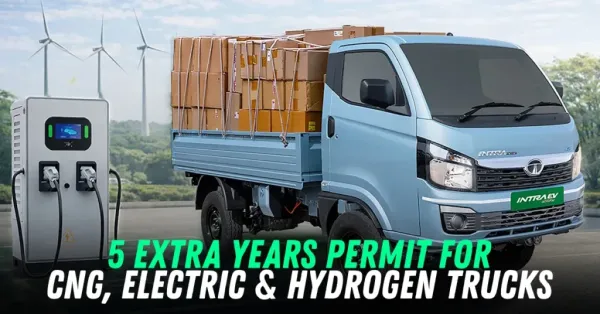
Commercial vehicles running on electricity, hydrogen or natural gas could be allowed to stay on national permits for five years longer under a new government proposal. This is not a blanket five-year extension for every commercial vehicle.
The change sits inside Rule 88 of the Central Motor Vehicles Rules, which deals with age limits for goods vehicles operating under national permits. At present, a national permit becomes invalid after 15 years for a multi-axle goods vehicle and after 12 years for other goods carriages. If the proposed five-year relaxation is applied as drafted, those limits would effectively become 20 years and 17 years respectively for battery-electric, hydrogen-fuel and natural-gas vehicles.
The biggest reason is purchase cost. Electric trucks remain substantially more expensive than comparable diesel trucks, while lenders are also more cautious about financing them.
A 2025 NITI Aayog study found that electric trucks and buses can cost two to three times as much as their internal-combustion equivalents. It also noted financing rates of roughly 15 to 18 per cent for electric trucks and buses, against about 10 to 12 per cent for diesel vehicles.
That makes useful asset life important. If a truck can legally remain on a national permit for five additional years, an operator gets more time to recover the initial investment. In principle, that can lower annual depreciation and improve residual value. It does not make an expensive electric truck cheap, but it addresses one concern for fleet operators.
The numbers explain why the government is looking for more levers. Of 8,34,578 trucks sold in 2024, only 6,220 were electric. Even that number was heavily concentrated at the light end. Just 280 electric trucks sold that year were above 3.5 tonnes, the category more relevant to longer-haul freight.
Electric heavy trucks are still a tiny market, while hydrogen commercial vehicles are even earlier in their development. In the near term, the proposal could therefore have a more visible effect on natural-gas fleets, especially CNG vehicles already used in commercial transport.
For future electric truck purchases, the signal may be more important. NITI Aayog has already highlighted financing, high battery cost and uncertainty over resale value as major barriers. Giving cleaner vehicles a longer permissible life under national permits could make their total-cost calculations easier to defend.
There is a catch. A longer national-permit age does not mean a vehicle can simply keep running without checks. The draft itself strengthens documentation requirements and calls for valid registration, insurance, pollution certificate where applicable, fitness certificate and challan history to be captured in the permit process. Battery condition could also become a real economic limit for an ageing EV long before the chassis reaches 17 or 20 years.
The same proposal would allow national-permit authorisations to be issued electronically for up to five years at a time. The fee remains Rs 16,500 per year, so five years would cost Rs 82,500. Forms 46 and 47 would move online, with more information pulled automatically from the VAHAN database.
Temporary registration rules would also be relaxed. A chassis awaiting body construction could get six months, while certain fully built vehicles being adapted or registered in another state could get 45 days.
None of this is final yet. The draft was published for public objections and suggestions, with a 30-day consultation period, and the changes take effect only after final notification.
-
Think It’s Acidity? These Signs Could Point To Something Else

-
Delhi HC Seeks WFI Response As Vinesh Phogat Challenges Two Show-Cause Notices And Disciplinary Action

-
‘LinkedIn Par Coach Dhoonda Jaa Raha Hai’: PCB Trolled After Posting Fielding Coach Vacancy Following England Series Debacle

-
Maharashtra Mandates CCTV Recording Of Assistant Professor Interviews To Ensure Transparent Recruitment

-
KDMC Schools Celebrate National Sports Day With Three-Day Fitness And Sporting Festival