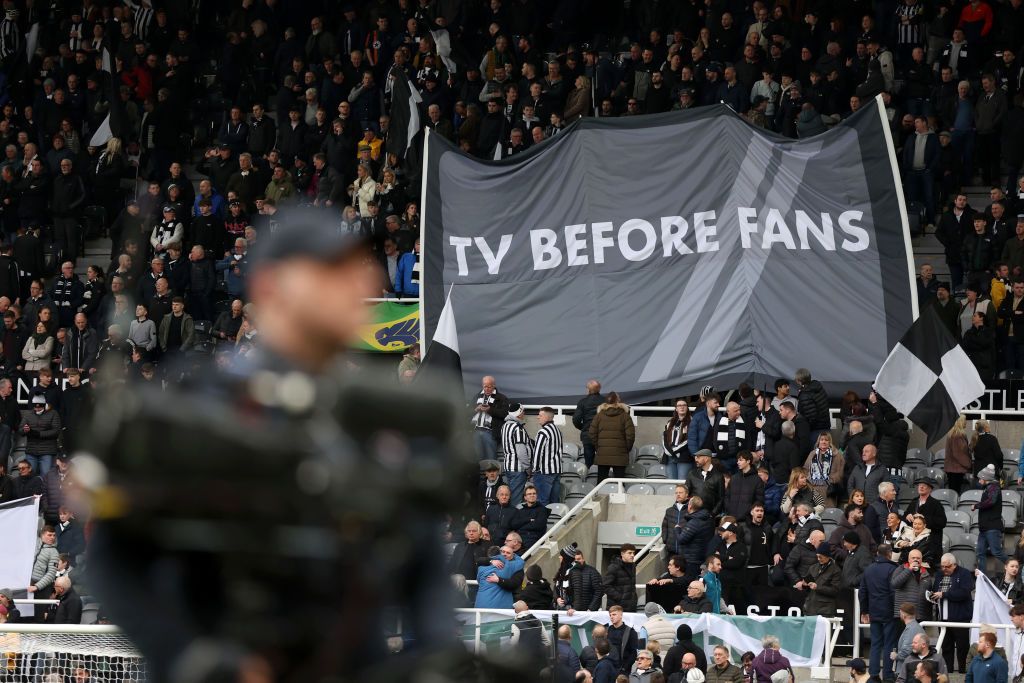
The Premier League’s new television package in Singapore throws into sharp relief what supporters in the UK are still left with at home.
The football revolution may be shown on screen — just not if you are living in the UK.
The Premier League has introduced a new direct-to-consumer streaming service that gives viewers live access to all 380 matches this season. Launched as ‘Premier League +’, the English top division is taking a clear step towards the long-discussed Netflix-style football model, often dubbed ‘Premflix’, by creating a single destination for watching matches from the sofa, on a tablet, or anywhere else fans choose to follow the game.
Demand for a similar model in the UK is already building. YouGov found that 42% of 876 football fans surveyed online last year supported the idea of subscribing to a potential in-house Premier League platform.
But that benefit will not be shared evenly. Only fans in Singapore will enjoy the new service, which has been created alongside the league’s long-term international broadcast partner StarHub, the company set to provide it in the former British colony.
Even before this latest agreement was unveiled, people in Singapore — both locals and expatriates — had long been able to enjoy a version of Premier League coverage unavailable to audiences back in Britain. Different kick-off times over the past 20 years helped build loyal groups of late-night and early-morning viewers eager to watch what is often called the ‘greatest league in the world’. They are far from alone, with supporters worldwide able to watch matches from grounds across England at all times of day. Meanwhile, those in the league’s home country remain restricted by steep prices and inflexible rules.
Premier League + is priced at roughly £25 a month, undermining the argument that premium live football has to come at a huge cost. Similar situations exist elsewhere, with viewers in the United States, South America and the Middle East also able to watch for far lower prices. By comparison, UK viewers may have to pay up to three times the Singapore price to access matches on Sky Sports and TNT Sports, and that still only covers 267 of the 380 matches in the coming season. And the expense does not end there. On top of a TV licence, fans would need subscriptions to eight separate services to watch all available matches in the Champions League and Europa League, EFL competitions, LaLiga, Serie A, Bundesliga and Ligue 1, at a staggering minimum cost of £132.97 per month. DAZN, Premier Sports, ESPN through Disney+, Amazon and even Ligue 1’s own platform now all take a share. What is left falls to free-to-air broadcasters BBC and ITV, once the pillars of mainstream football broadcasting but now reduced to scraps.
Worse still, Ligue 1’s newly introduced streaming platform at £17 a month is the only subscription that provides full coverage of one single competition, while televised matches from Europe’s other top five leagues are split unevenly across at least two providers. Supporters interested only in the Premier League would still need to spend £791.88 simply to watch matches legally, according to research by eSIMatic. There also remains no lawful way to watch this season’s other 113 matches that are not being shown by the league’s main broadcast partners. The 3pm blackout remains a major source of frustration, stopping fans who cannot attend in person from watching their own team — or any other football match — during the traditional Saturday afternoon slot. Those who defend the blackout as a sacred football custom often ignore the fact that it was never introduced purely for the good of the game. The ban on televising top-flight matches between 2.45pm and 5.15pm on Saturdays was first proposed in the 1960s by Burnley chairman Bob Lord, a staunch opponent of live football broadcasting who claimed it would protect attendances in the lower leagues. But another possible motive behind the proposal became clear when he said, in a keynote speech to the Variety Club in March 1974, to widespread disgust: “We have to stand up against a move to get soccer on the cheap by the Jews who run TV”.
The best features, fun and football quizzes, straight to your inbox every week.
Yet broadcasters seem every bit as committed to maintaining the restriction as those who see it as the last surviving piece of football tradition that must be protected. Jeff Stelling’s passionate defence of the blackout may well have come from a sincere place as a lifelong Hartlepool supporter, but he will also understand that changing the current system would effectively destroy one of its most valuable products. Having fronted Sky’s Soccer Saturday for 29 years, Stelling will know exactly how devoted the programme’s following remains because it offers an alternative way of experiencing live action. Prince William has also spoken out against the blackout, with the Football Association figurehead and future king calling it ‘irritating’ that he cannot watch his beloved Aston Villa during the 3pm slot when he is unable to be in the directors’ box.
Resourceful supporters continue to get around the outdated rule through illegal streaming, something that regularly becomes headline news as part of anti-piracy drives led by the Premier League and the UK authorities. Those convicted of enabling such workarounds through jailbroken technology are presented as enemies in the battle against online piracy, rather than as evidence of a much broader issue. Football is not a television programme, but the sport’s wealth keeps lifting the Premier League to new heights each season without rewarding the people on whom that wealth was built. New research from working-class think tank Democracia84 found that supporters aged 18 to 35 in the game’s traditional heartlands have been put under growing financial pressure because the cost of football rose by 47% between 2015 and 2025 while household incomes remained flat. At the same time, changing viewing habits and an increasingly technology-led way of consuming football raise the risk of a deeper disconnect between the sport and its audience.
There are ways around the blackout that do not involve breaking the law, as shown during Covid when all domestic football was made available free of the usual restrictions. A loophole in UEFA’s Article 48 — which can only be enforced if 50% of matches in a country’s top two divisions are played at the same time — was also set aside for the EFL’s opening weekend earlier this month while the Premier League was still in its summer break. As many as 25 matches across the Championship, League One and League Two were shown live, with concerns about falling attendances apparently brushed aside. That argument has still not been conclusively proven. Average attendance in last season’s Championship was 26,684, while the figure in League One was 9,912 — more than two and a half times lower — and League Two fell further to 4,164.
The case for keeping the blackout will come under review again over the next 18 months, when the next cycle of broadcast rights is due to be settled ahead of the 2029/30 season. But another possible challenger may already have entered the race to bring ‘Prem Flix’ to the UK. Jeff Bezos’s recent arrival at Liverpool as a minority investor through the 1892 Holdings consortium suggests more than a vanity investment, particularly with Amazon Prime Video having already established itself in Premier League and Champions League broadcasting in recent years. The company has won favour with supporters through smart but straightforward coverage of major competitions, including multi-match viewing and the option to swap standard commentary for raw crowd noise. Despite losing its Premier League rights, Amazon has remained involved in live football by offering selected Nations League matches on a pay-per-view basis. The chance for Bezos to dislodge Sky and TNT as the main home of Premier League television coverage may prove too tempting to ignore.
The Singapore arrangement shows that televised football can be both affordable and accessible for people watching on a screen — despite UK fans repeatedly being told that such a model cannot work. Removing the current barriers would not only add further value to the Premier League’s already enormous money-making machine, but could also help curb illegal streaming by giving supporters a realistic legal option.
Until the people in charge accept the need to adapt to modern times, however, supporters will continue to be unnecessarily overcharged in the supposed ‘good of the game’.
-
Liverpool delegation to visit Hyderabad in October for tie-up

-
Indian cricketer dies after collapsing during match in Oman
-
Koffee With Karan 9: Aamir to Samay, here’s expected full guest list

-
Chiranjeevi's 'Kaaka' Title Teaser OUT; Film To Hit Screens On Sankranthi 2027

-
Rice Turned Soggy? This Simple Bread Trick Can Help Fix Excess Water