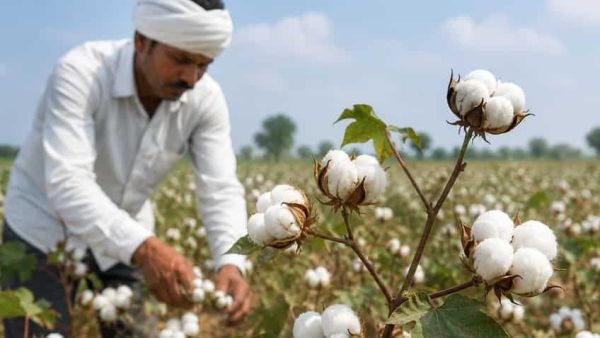
The Haryana government has taken a big and relief step for the farmers cultivating cotton in the Kharif season. In the last few years, the area under cotton was continuously decreasing due to the attack of Pink Bollworm and other pests and adverse weather conditions. With the aim of reducing the rising costs of farmers, protecting the crop from pests and promoting quality produce, the Department of Agriculture and Farmers Welfare has announced a special subsidy of up to ₹ 4,000 for cotton farmers. The direct benefits of this scheme will be sent directly to the bank accounts of farmers through DBT. Subsidy will be available on micronutrients and integrated pest management. The biggest expenditure in cotton crop is on expensive pesticides and fertilizers. Under this new welfare initiative launched by the Haryana Government, farmers are being given financial assistance at the rate of 50% or a maximum of ₹ 2,000 per acre on purchasing agricultural inputs to micronutrients and Integrated Pest Management (IPM). A total grant of ₹ 4,000 is being given to a farmer for a maximum of 2 acres. If a farmer's pesticide or nutrient bill comes to ₹5,000, he will get a maximum benefit of ₹2,000 per acre (₹4,000 on 2 acres). In case the bill is less, only 50 percent of the actual expenditure will be given as grant. Separate incentives to promote indigenous cotton varieties Apart from hybrid and BT varieties that are more sensitive to pests, the state government is also emphasizing on reviving the cultivation of indigenous cotton. Desi cotton varieties have more natural ability to fight pests and diseases and also have lower costs. Separate incentive amount per acre is also being given to the farmers sowing indigenous cotton. Along with this, special demonstration plots of two acres each are being prepared in every district under the supervision of agricultural scientists, where farmers are being given practical training in cotton cultivation using modern and scientific methods. Special focus will be on these major districts of traditional 'Cotton Belt'. This scheme is being implemented on war footing in the major cotton producing districts of Haryana. These include the districts considered to be the traditional cotton belt of the state – Sirsa, Fatehabad, Hisar, Bhiwani, Charkhi Dadri, Rewari and Mahendragarh. The special wing of the Agriculture Department 'Promotion of Cotton Cultivation in Haryana' (PCCH) is working actively to connect the farmers who were turning to water-intensive crops like paddy due to continuous pest attacks in these districts, to get them involved in the profitable cultivation of cotton again. Eligibility and essential conditions of the scheme: The benefit of the grant will be available only to those farmers who fulfill the guidelines prescribed by the department: The farmer must be a native of Haryana and must have agricultural land in the state. The farmer must have sown authorized/certified varieties of cotton in his field. It is mandatory to have authorized GST Purchase Bills for micronutrient and pest management materials purchased by the farmer. To avail the benefits of the scheme, it is necessary for the farmer to register on time on the official portal of the state government. Complete process of application: Register on 'Meri Fasal Mera Byora' portal To avail the benefit of this financial assistance, it is mandatory for farmers to duly register their crops on the government's official portal 'Meri Fasal Mera Byora' (fasal.haryana.gov.in). On the portal, farmers will enter Khasra-Khatauni details of their land, variety of cotton sown and bank account information. After this, after physical verification and checking of bills by the local agriculture officers, the approved amount of subsidy will be transferred directly to the bank account of the farmer. For any kind of technical assistance or detailed information, farmers can directly contact the Agriculture Department's toll-free helpline number 1800-180-2117. Costs will reduce, farmers' net income will increase. Cotton is called 'white gold', but uncontrolled increase in costs and pest infestation had reduced farmers' profits in recent years. By providing direct subsidy of up to ₹ 4,000 on pest management and essential nutrients by the government, the burden of pesticides on the farmers' pockets will be reduced, the fertility of the land will be protected and the quality of the yield will improve. Agricultural experts believe that by adopting timely scientific spraying of pesticides and supply of nutrients, farmers can achieve a direct increase of 20% to 30% in their yield.
-
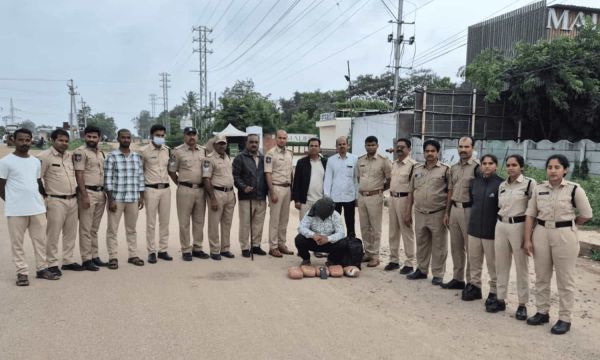
Hyderabad: Man on bus caught with 5 kg ganja worth Rs 2.5L
-
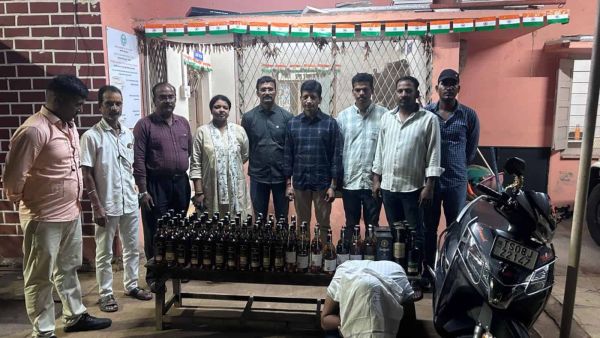
Hyderabad: Ex-Army man’s son held for illegal defence liquor sale
-
Mumbai court upholds Sunny Leone’s discharge in cheating case

-
WATCH | Rinku Singh's Hilarious Flex After Fan's Unusual Request: 'Dikha Dijiye...'

-
Glacier-Linked Flood Reported In Lhende River After Snow-Rock Landslide Near Nepal-China Border