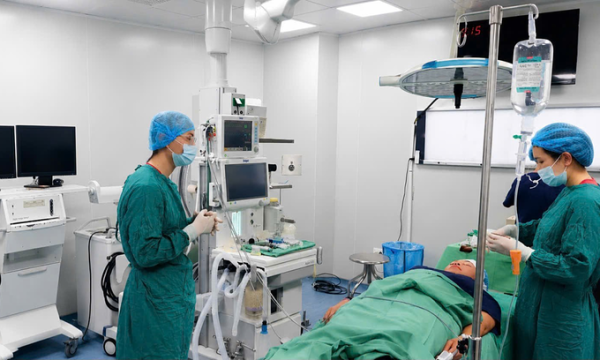
Liposuction is a common cosmetic procedure, but results are often discussed on social media in terms of how much fat was removed — five liters, eight liters or several kilograms from a single operation.
Such figures can give a misleading impression of the procedure’s purpose. According to the World Health Organization, 2.5 billion adults worldwide were overweight in 2022, including more than 890 million with obesity. However, liposuction is not a treatment for obesity or a substitute for weight management. Its primary purpose is body contouring, involving the removal of localized deposits of subcutaneous fat to improve body shape and proportion.
Dr. Tuan said one of the most common questions patients ask is how many liters of fat can be removed.
“The number of liters is only one parameter,” Tuan said. “A patient who has less fat removed may achieve a greater improvement in body shape, while removing more does not necessarily produce a better contour.”
The abdomen connects with the waist, flanks, back and hips, so treating one area without considering these transitions can produce an unnatural appearance. For abdominal liposuction, surgeons need to assess the waist, flanks, back, skin quality and overall proportions of the torso.
Body weight and BMI provide useful initial information, but neither fully reflects fat distribution or skin quality. Two people with the same height and weight may require different treatment plans.
|
The procedure is performed in a treatment room equipped with specialized and synchronized medical equipment, meeting the necessary requirements for liposuction. Photo courtesy of Dr. Tuan |
One patient may have localized subcutaneous fat around the abdomen and waist with relatively elastic skin. Another may have less fat but significant loose skin following pregnancy or major weight loss. A protruding abdomen may also be partly caused by visceral fat, which lies inside the abdominal cavity and cannot be removed through liposuction.
“If the main problem is subcutaneous fat, liposuction can produce a significant change,” Tuan said. “But if the problem is predominantly loose skin, changes in the abdominal wall, or visceral fat, simply removing more subcutaneous fat does not address the real cause.”
The American Society of Plastic Surgeons defines large-volume liposuction as the removal of 5,000 cc or more of total aspirate during a single procedure. This does not mean five liters is a universal safe limit for every patient.
|
Dr. Nguyen Quang Tuan (L) performs a liposuction procedure in a hospital operating room. Photo courtesy of Dr. Tuan |
ASPS guidance notes that there is no scientific evidence supporting a single maximum volume at which liposuction suddenly becomes unsafe. Surgeons instead consider factors such as body size, BMI, medical condition, the number of areas treated and the physiological effects of surgery. Risks increase as the volume of aspirate and number of anatomical areas treated rise.
Five liters of aspirate also does not necessarily mean five liters of pure fat, as total aspirate includes both fat and fluid removed during liposuction.
“Our objective is not to set a record for how much fat we can remove,” Tuan said. “We have to ask whether removing more will meaningfully improve the contour and whether that benefit justifies the additional risk.”
For extensive procedures, performing surgery in stages may be preferable to attempting to treat all areas in a single operation.
Liposuction is not simply about removing as much accessible fat as possible. Body contouring requires control over the thickness of the remaining soft tissue and smooth transitions between treated and untreated areas. Uneven fat removal can result in depressions, surface irregularities or asymmetry.
Skin quality is another consideration. Relatively firm, elastic skin is better able to accommodate changes in underlying volume, while skin that has lost elasticity because of pregnancy, major weight loss or aging may respond differently.
“Sometimes the most important question is not how much more fat I can remove,” Tuan said. “It is what will happen to the skin above it if I do.”
Modern liposuction uses different technologies to assist in treating fatty tissue and shaping the body. Tuan said such technologies can be useful in appropriate cases but cannot replace anatomical assessment and clinical judgment.
Patient selection begins before surgery. Medical history, medications, previous operations, fat distribution, skin quality and expectations all need to be assessed. For larger or multi-area procedures, anesthesia planning, fluid management, operating time and postoperative monitoring become increasingly important.
Liposuction carries surgical risks, including infection, anesthesia- complications, fluid accumulation, blood clots and contour irregularities. A consultation may therefore result in a recommendation to treat fewer areas, divide the procedure into stages or not proceed with surgery.
The modern concept of liposuction is better understood as body contouring rather than simply fat removal. Results should be assessed based on proportions, transitions between anatomical areas, symmetry and surface quality after swelling has subsided and tissues have stabilized.
Tuan earned a master’s degree in surgery from the University of Medicine and Pharmacy at Ho Chi Minh City in 2018 and completed Specialist Level I training in Aesthetic Plastic Surgery at Can Tho University of Medicine and Pharmacy in 2024. In 2025, he joined teaching activities at the Department of Family Medicine at Hanoi Medical University.
He currently serves as a principal surgeon in plastic and aesthetic surgery at Bac Ha International Hospital in Hanoi and is a member of the Vietnam Society of Aesthetic Plastic Surgery.
Alongside his clinical and teaching work, Tuan has been invited by national television broadcasters and Vietnamese newspapers, including Thanh Nien and Dan Tri, to provide commentary on plastic surgery, surgical safety and patient care.
 |
|
Dr. Nguyen Quang Tuan (L) during a television interview on plastic surgery and patient safety. Photo courtesy of Dr. Tuan |
Contact MSc. Dr. Nguyen Quang Tuan for professional consultation and medical information for domestic and international patients:
Website: drquangtuan.com
Bac Ha International Hospital
Address: No. 137 Nguyen Van Cu Street, Bo De Ward, Hanoi City, Vietnam.
Hotline/Zalo: (+84) 914045843
WhatsApp: (+84) 914045843 – (+84) 913991627
-
TPCC disciplinary committee seeks action against Konda Surekha

-
Hyderabad: Police nab two, seize medicines worth Rs 4.8L
-
Rahul Gandhi Backs Kriti Sanon Amid Raksha Bandhan Ad Backlash: Here's What He Said

-
Top 10 | ABP LIVE Evening Bulletin: Top News Headlines from 25 August 2026 - Evening

-
Rodri pushes for Manchester City exit as midfielder seeks special permission to skip training with Barcelona move close