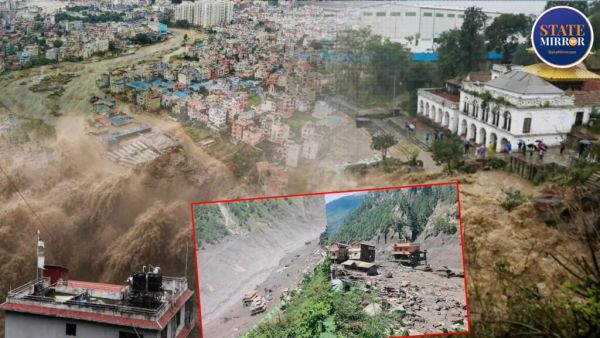
On the morning of 26th August, everything was normal in the hilly areas of Nepal, but after some time the water coming from the direction of Tibet descended into the Bhote Koshi river in such a way that within no time a scene of devastation was created. The strong current in Rasuwa's Timure and Syafrubesi swept away vehicles, goods, bridges and roads. There was chaos in many settlements and people went missing. Now the echo of this sudden flood is reaching India from Nepal. An alert has been issued in many districts of Bihar and Uttar Pradesh regarding the rising water level of Gandak and Narayani.
At present, the deaths of 55 people have been confirmed, but the death toll is said to be much higher. Information about a large number of people missing has come to light. According to Nepal Tourism Board, 384 travelers have been reported missing, which includes 291 foreigners and 93 Nepali citizens. At least 105 Indians are reported to be among the missing foreign nationals.
Where was the Bhote Koshi flood affected in Nepal?
The most severe damage occurred in Rasuwa district, which is located near the Tibet border. Apart from Timure and Syafrubesi, many settlements including Betravati, Mailung, Salletar, Shantibazar, Parebesi, Khalti Basti, Sole, Trishuli and Battar have been affected. Vehicles and goods parked in the customs complex of Rasuwa were also washed away in the water and a recently built bridge broke.
Hydroelectric projects in Nuwakot and Rasuwa districts have also been damaged due to the flash floods. According to the Independent Power Producers Association Nepal, eight operational hydropower projects and five under construction with a total capacity of 354 MW have been affected. Four bodies have been recovered from Trishuli river near Bidur municipality in Nuwakot district. Nepal Army, Armed Police Forces and Nepal Police are carrying out search and rescue operations in the affected areas.
Why did the flood come suddenly, was it GLOF?
The cause of the flood has not been officially confirmed yet. According to local officials, there was no local rainfall in Rasuwa at that time, which could have caused such a huge flood. There is a possibility that due to heavy rain, avalanche or some glacier- incident on the Tibet side, a large amount of water suddenly reached Bhote Koshi. Officials are still investigating whether this was a Glacial Lake Outburst Flood or GLOF. At this point it is definitely too early to call it GLOF.
What is GLO?
A GLOF (glacial lake outburst flood) is a sudden and devastating flood that occurs when standing water from a glacier or moraine (rock and soil debris left by a glacier) flows rapidly downstream.
Which Nepalese districts have been put on high alert?
The water of Bhote Koshi further reaches the Trishuli river system. For this reason, apart from Rasuwa, people living on the river banks in low-lying areas like Nuwakot, Dhading, Gorkha and Chitwan have been alerted. It would not be correct to describe these districts as directly devastated by Bhote Koshi; The main concern here is the rise in downstream water level and sudden floods.
Which districts of Bihar are on alert?
Under the existing alert of August 26 in Bihar, special vigilance is being maintained in West Champaran, East Champaran, Gopalganj, Saran, Muzaffarpur and Vaishali. The administration has been asked to be prepared in view of the possible rise in the water level of the Gandak River in these areas.
There are reports of increased surveillance in Sitamarhi and Shivhar also. Therefore, it is more correct to understand the situation of Bihar in such a way that there is main vigilance regarding Gandak in six districts, while additional vigilance is being maintained in some other districts also. The water of Bhote Koshi does not directly reach these districts of Bihar. Bhote Koshi further joins Trishuli and then Narayani/Gandak river system. Therefore, the possible impact in Bihar is being seen in the form of rising water level of Gandak and danger of flood in low-lying areas.
Which districts of UP are in danger?
At present in Uttar Pradesh, government vigilance is most evident regarding Maharajganj and Kushinagar. There is a possibility of the water level of Gandak and Narayani rivers increasing due to the impact of floods in Nepal. In view of this, instructions have been given to the local administration to be prepared. At present, it cannot be said that floods of similar level will occur in both these districts. The main concern is about the rise in the water level of the river and the possibility of water reaching low-lying areas.
Where does Bhote Koshi river originate and where does it go next?
Bhote Koshi originates from the Himalayan region of Tibet, where it is known as Poiqu. After crossing the Nepal-China border it is called Bhote Koshi. It meets Sunkoshi around Barhabise. Further major rivers like Sunakoshi, Arun and Tamor together form the Saptakoshi river system. This river system further enters India and forms part of the larger Kosi flood system in Bihar. The hilly geography of Bhote Koshi makes it extremely sensitive. Steep valleys, glaciers, landslides and heavy debris can cause river flows to reach dangerous levels in a very short time.
When did major floods occur in Bhote Koshi before?
The history of flood caused by bursting of glacial lake in Bhote Koshi-Sunkoshi area is old. Studies have shown the devastating impact of major GLOFs in 1935, 1964 and 1981. The 1981 incident was particularly devastating. During that time, suddenly a large amount of water came down, due to which five people died, 41 houses and two highway bridges were washed away and about 27 kilometers of road was damaged.
After this, on 2 August 2014, a huge landslide occurred in Jure of Sindhupalchok. The landslide blocked the path of Sunkoshi and created a natural dam. About 156 people died in this accident. The natural dam of the lake that was formed later broke on 7 September 2014, creating a threat of flash flood in the downstream areas.
There was sudden flood in Bhote Koshi in 2025 also
On July 8, 2025, there was a flash flood in Bhote Koshi following the rapid emptying of a supraglacial lake in Tibet. Its effect was seen in Rasuwa, Nuwakot, Dhading and Chitwan. There were deaths and people went missing in this incident also. The 2025 incident had made it clear that sudden influx of water in Bhote Koshi can create a crisis in the downstream areas of the river within a few hours.
Has Bhote Kosi been responsible for the Old Kosi floods of Bihar?
It is not correct to directly call the historical Kosi flood of Bihar as the flood of Bhote Kosi. Both are definitely connected to a big river system, but the big Kosi floods in Bihar have their own reasons. The biggest incidents include the Kosi flood of 18 August 2008. At that time the embankment of Kosi broke near Kushaha in Nepal and the river changed its course. There was massive devastation in large parts of North Bihar including Supaul, Madhepura, Saharsa, Araria, Purnia, Katihar, Khagaria and North Bhagalpur and lakhs of people were affected.
Major flood crises have also been recorded in the Kosi region in 1963, 1968, 1971, 1980, 1984, 1991 and 2008. Therefore, it would be misleading to see Bhote Kosi and Bihar's Kosi as direct floods of the same river.
How big is the threat to Bihar and UP in 2026?
At present, the threat of severe and actual flash floods in Nepal, while possible downstream floods in Bihar and Uttar Pradesh, should be considered. The damage in Nepal is quite serious, but it is too early to say that a large-scale flood has started in Bihar or UP due to Bhote Koshi.
At present the priority of the administration is to keep an eye on the water level of Gandak, Narayani and their associated river systems. In case of increase in river water, danger may increase in low-lying areas from Nepal to Bihar and UP. The situation can change rapidly, so it is most important for people living on the river banks to follow the alerts and instructions of the local administration.
-
Problems increased for 20 rebel TMC MPs, Om Birla sent notice; Answer sought in 7 days

-
Travel Slang 2026: New travel slangs of Gen-Z on the tongues of travel lovers, know their interesting meanings
-
Pune: Hinjewadi residents to protest over poor roads, civic issues
-
PM Modi’s birthday: Tripura to hold month-long ‘Seva Sankalp Abhiyan’

-
Nvidia Beats Expectations On All Q2 Metrics And Estimates 70% Jump In FY28 Revenue — NVDA Stock Gains 5% After-Hours