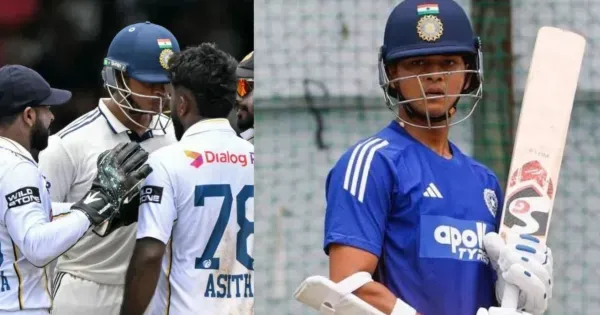
Colombo: India opener Yashasvi Jaiswal and Sri Lanka pacer We hate Fernando have faced criticism after an ugly on-field confrontation during the opening day of the second Test at the Sinhalese Sports Club in Colombo. Former India cricketers Cheteshwar Pujara and Saba Karim condemned the incident, with both insisting that competitive aggression should not cross the line into physical contact.
The confrontation occurred after Fernando dismissed Jaiswal during India’s innings. The Sri Lankan fast bowler gave the Indian opener a send-off, prompting Jaiswal to turn back and confront him. The exchange quickly became heated, with the two players arguing before their heads appeared to make contact. Other players intervened and separated the pair.
The incident attracted considerable attention because both players are important members of their respective Test teams. It also came during a closely contested series, with India entering the second Test after winning the opening match in Galle by 165 runs.
What happened between Jaiswal and Fernando
Jaiswal’s dismissal triggered the confrontation during the first day in Colombo. Fernando celebrated the wicket with a send-off, and Jaiswal reacted by turning towards the bowler rather than immediately walking away.
The two exchanged words as the situation escalated. The confrontation then moved beyond a verbal exchange, with the players making physical contact before teammates stepped in to prevent the incident from becoming more serious.
Such confrontations are not unusual in Test cricket, where players frequently attempt to unsettle opponents through verbal exchanges and aggressive celebrations. However, the involvement of physical contact made this particular incident more serious.
Former India batter Cheteshwar Pujara acknowledged that emotions can run high during a Test match but said players must maintain control.
“It’s not an ideal visual. As a player, you need to control your emotions,” Pujara said while speaking on Sony Sports, as quoted by The Indian Express. He added that being angry or disappointed is understandable, but the situation becomes unacceptable once it results in body contact.
Pujara says body contact crossed the line
Pujara’s criticism was directed at the nature of the confrontation rather than the competitive intensity itself.
The former India Test batter said players can argue or express frustration during a match, but there needs to be a boundary.
He accepted that emotions are part of professional sport and that players can become angry in the heat of competition. However, according to Pujara, the confrontation between Jaiswal and Fernando went beyond what should be tolerated on a cricket field once physical contact occurred.
The comments are particularly notable because Pujara himself spent years playing Test cricket for India and was regularly involved in intense battles with opposition bowlers.
His message was therefore not against aggression itself. Instead, it was a reminder that players need to distinguish between competitive intensity and behaviour that can damage the image of the sport.
Saba Karim also criticises both players
Former India wicketkeeper Saba Karim was equally critical of the confrontation.
Karim said cricket is not a contact sport and questioned why either player allowed the situation to escalate to such a level.
He argued that bowlers are entitled to be aggressive and attempt to get under a batter’s skin, but that aggression should remain within the boundaries of cricket.
Karim also highlighted the responsibility players have towards younger audiences.
According to him, international cricketers are effectively ambassadors of the game, and their conduct is watched by youngsters around the world.
His criticism therefore extended beyond the individual incident. He suggested that players need to consider the example they set whenever they represent their countries at the highest level.
Both players punished by ICC
The International Cricket Council took disciplinary action against both Jaiswal and Fernando following the incident.
Both players were fined 25 per cent of their match fees and received one ICC demerit point each for their involvement in the confrontation.
The punishment reflects the ICC’s view that the incident crossed the acceptable limits of on-field conduct.
A demerit point can become significant if a player accumulates multiple points over a specified period, potentially leading to further disciplinary consequences. For Jaiswal and Fernando, however, the immediate punishment was limited to the fine and one point each.
The fact that both players were penalised also indicates that the authorities did not place responsibility entirely on one individual.
India entered second Test with 1-0 lead
The incident occurred during an important phase of India’s tour of Sri Lanka.
India had already taken a 1-0 lead in the two-Test series after defeating Sri Lanka by 165 runs in the opening Test at Galle.
India posted 462 in their first innings and then declared at 193/4 in the second innings. Sri Lanka were dismissed for 284 in their first innings before being bowled out for 206 while chasing a target of 372.
Manav Suthar was one of India’s major contributors in the Galle victory, taking 10 wickets in the match. The result gave the Shubman Gill-led side a strong start to the series.
The second Test in Colombo is therefore crucial for India as the visitors look to complete a 2-0 series sweep.
Jaiswal remains a key part of India’s batting
Despite the controversy, Jaiswal remains one of India’s most important young Test batters.
The left-handed opener has established himself as an aggressive top-order player and is expected to play a major role in India’s long-term Test plans.
His attacking approach is an important part of his game, but the incident in Colombo has highlighted the need for him to balance aggression with discipline.
For an opener, confrontations with fast bowlers can become particularly intense because the batter spends considerable time facing the same bowler. Send-offs and verbal exchanges are common features of such battles.
However, the criticism from Pujara and Karim underlines that maintaining emotional control is equally important.
Fernando’s role in Sri Lanka’s attack
Fernando is also an important component of Sri Lanka’s pace attack.
As a fast bowler, he operates in a role where aggression and intimidation are often central to the contest. A successful dismissal can naturally bring an emotional celebration, particularly when the wicket involves an important opposition batter.
But the Colombo incident demonstrated how quickly such moments can escalate.
The ICC’s decision to penalise both players provides a formal conclusion to the disciplinary aspect of the confrontation, although the comments from former India players have kept the debate around player conduct alive.
Aggression has always been part of Test cricket
Test cricket has traditionally involved a significant amount of verbal and psychological competition.
Bowlers often celebrate wickets passionately, while batters sometimes respond to sledging or send-offs. The intensity is particularly visible when two teams are closely matched.
There is a difference, however, between verbal aggression and physical confrontation.
Players are expected to compete fiercely while respecting the laws and spirit of the game. That balance has become increasingly important as international cricket reaches a global audience through television, streaming platforms and social media.
A brief confrontation can quickly become a major talking point because videos are shared widely online.
That is one reason former players such as Pujara and Karim have stressed the responsibility of current cricketers to maintain discipline.
Incident overshadows an important Test
The confrontation also briefly shifted attention away from the cricket itself.
India’s second Test against Sri Lanka is being played with significant implications for the teams’ World Test Championship campaigns. India are looking to build on their Galle victory, while Sri Lanka are attempting to level the series in Colombo.
The match has also provided opportunities for players to establish themselves in India’s evolving Test side under captain Shubman Gill.
Against that backdrop, the Jaiswal-Fernando incident became an unwanted distraction.
For both teams, the focus will now be on completing the Test without further disciplinary controversies and producing a result on the field.
Why Pujara’s comments matter
Pujara’s remarks carry additional weight because of his reputation as one of India’s most disciplined Test batters.
Throughout his career, he was involved in numerous intense contests with opposition bowlers but was generally known for his composed approach.
His criticism of the incident is therefore a reminder that aggression does not necessarily require confrontation.
A player can compete intensely, respond to pressure and challenge an opponent without allowing emotions to result in physical contact.
That distinction is particularly important for younger players such as Jaiswal, who are expected to become central figures in Indian cricket over the coming years.
Conclusion
The heated confrontation between Yashasvi Jaiswal and Asitha Fernando during the second Test in Colombo has sparked criticism from former India players Cheteshwar Pujara and Saba Karim. Both former cricketers agreed that while emotion and aggression are natural parts of Test cricket, physical contact is unacceptable.
The ICC also acted against both players, handing each a 25 per cent match-fee fine and one demerit point for their involvement.
The incident serves as a reminder that international cricketers are expected to maintain discipline even during the most intense moments. With India already leading the series 1-0 following their 165-run win in Galle, the focus now needs to return to the contest between bat and ball.
For Jaiswal and Fernando, the best response will be to let their performances on the field do the talking. The Colombo Test is an important match for both sides, and neither team will want another disciplinary episode to overshadow the cricket.
-
Breastfeeding: Breastfeeding after C Section, Easy Tips to Get Started

-
Even if the phone falls, don't stress! Realme's cheap 4G phone with a strong body enters the market; Know everything from features to price

-
EFL Cup 2026-27 — Savio nets on debut as Tottenham cruises past Charlton

-
Asian Games 2026 Cricket: ‘Tented Dressing Rooms, Washrooms 500m Away’ — Jasprit Bumrah, Shreyas Iyer May Miss as BCCI Consider ‘B’ Team India
-
Genome Sequencing to Create World Champions; 5 Year Master Plan of Gujarat Govt