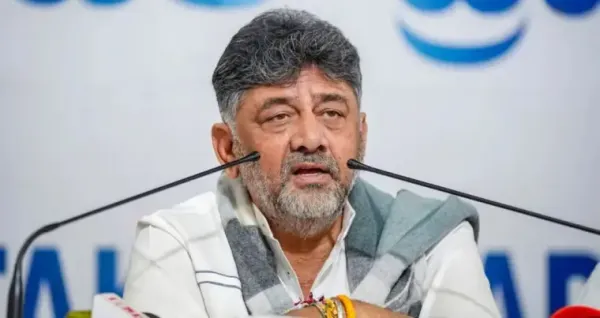
Karnataka Chief Minister DK Shivakumar said that only the first two stanzas of Vande Mataram will be sung in government and public functions. Supporting the decision of the Congress, he said that the government stands firmly with the ideology and fixed stand of the party.
Bengaluru: The political controversy over full singing of Vande Mataram in Karnataka has reached a new stage. Chief Minister DK Shivakumar has clarified that only the first two stanzas of the national song Vande Mataram will be sung in government and public programs in the state. He said that his government stands with the decision of the Congress and the ideology of the party in this matter. Shivkumar gave this statement in a program of India Today on 26 August 2026.
What did DK Shivakumar say?
DK Shivakumar said that he believes in the ideology of his party and whatever decision the party has taken, he stands by it. He told that in an Independence Day program the full version of Vande Mataram was sung without his knowledge. According to him, in future only the first two antras will be sung in government programs in Karnataka as per the Congress's stand.
The Chief Minister also said that Karnataka is a diverse state and India is a country with diverse communities. He accused BJP of doing appeasement politics and said that Congress believes in taking all sections along. This statement has come at a time when the political conflict between Congress and BJP over the singing of Vande Mataram is intensifying.
What is the decision of Congress Working Committee?
In the background of the controversy, the decision of Congress Working Committee i.e. CWC on August 19 is important. The top decision-making body of the Congress clarified that only the first two stanzas of Vande Mataram will be sung in the party programs. Linking its decision to the decision of the Congress taken in 1937, the party said that it is following the historical tradition.
Congress leaders argue that during the freedom movement, a special arrangement was made for public singing of Vande Mataram among the then top leaders including Mahatma Gandhi, Jawaharlal Nehru, Rabindranath Tagore, Subhash Chandra Bose and Sardar Vallabhbhai Patel. Congress says that the tradition of singing the first two anthems in its programs is linked to the same historical decision.
Controversy started after the program of August 15
The current political controversy over Vande Mataram intensified after the Independence Day programs of 15 August. BJP accused Congress of insulting the national anthem. BJP leaders raised questions over the video of the event held at the Congress headquarters and alleged that the party leadership was uncomfortable with the singing of the entire song.
Congress rejected these allegations. The party said that Vande Mataram was sung in full at the Congress headquarters and no attempt was made to stop it. Congress General Secretary Jairam Ramesh had refuted BJP's allegations and said that Sonia Gandhi's gesture was not to stop the song, but to arrange a chair for long-standing Congress President Mallikarjun Kharge.
After this, the controversy moved beyond party programs to the nature of the national song in government programs and the new guidelines of the Central Government.
What guidelines did the Central Government give for Vande Mataram?
The Central Government issued new guidelines regarding the official singing of Vande Mataram in 2026. The Home Ministry's guideline dated January 28, 2026 laid down the protocol regarding the official version of the national anthem with six differences. The duration of the official full version is reported to be approximately 3 minutes 10 seconds.
After this, All India Radio also started broadcasting the full six-interlude version of Vande Mataram from 26 March 2026. Prior to this, All India Radio's morning broadcasts generally used a version of approximately 65 seconds with two initial intervals. The full version was included in the official broadcast following the new directive from the government.
As per government protocol, when both Vande Mataram and the national anthem are presented at an official function, the national anthem is presented first and then the national anthem. In government programmes, emphasis has been laid on adherence to set protocols and the official version.
Vande Mataram also got legal protection
Amid the controversy to Vande Mataram, Parliament passed the Prevention of Insults to National Honor (Amendment) Bill, 2026. The bill was passed by the Rajya Sabha on 29 July and the Lok Sabha on 30 July. Later this amendment became law and the national song was also brought under the same legal protection as the national anthem.
The law provides that a person who knowingly prevents the singing of the national anthem or causes disruption in an assembly engaged in such singing shall be punished with imprisonment of either description for a term which may extend to three years, or with fine, or with both. The focus of the law is to intentionally stop singing or disrupt a gathering.
Importantly, the law does not make it clear that merely not singing all six stanzas of Vande Mataram will make a person guilty of an offence. The legal provision mainly makes the act of stopping singing or obstructing singing punishable. Therefore, it is important to understand the legal difference between singing two interludes and intentionally stopping singing.
Political tussle increased between BJP and Congress
After Congress's decision to sing two anthems, BJP has accused the party of political appeasement and compromising on issues to national sentiment. Union Home Minister Amit Shah also criticized Congress's decision and linked it to appeasement politics.
Congress, on the other hand, is linking it to its historical decision and party's ideology. The party says that the singing of the first two intervals is not the result of any new decision, but is in line with the tradition decided in 1937.
What will be the impact of Karnataka's decision?
After the statement of DK Shivakumar, Karnataka has become an important state in this controversy. The gap between the central government's official protocol and the two-pronged approach set by the Congress for its political programs has now become a major topic of public debate.
At present, Shivakumar has made it clear that the Karnataka government is in favor of singing only the first two stanzas of Vande Mataram in government and public programs as per the decision of the Congress. This is likely to further intensify the debate between the Center and Congress-ruled states over protocols, national symbols and political jurisdiction in the coming days.
Vande Mataram is a song deeply associated with India's freedom movement and national history. Therefore, the nature of its singing is no longer just a cultural or administrative matter, but has now also become a part of political and legal debate. Karnataka's latest decision is being considered as the sequel to this wider national controversy.
-
National Sports Day: The most defining moments of 2026
-
Daily reality: India saw 63 anti-minority hate attacks in July
-
Watch: Javed Miandad Breaks Down In Tears After Imran Khan's Sons' Interview
-
'Toxic' Day 3 Box Office Collection: Yash's Film Mints Rs 26.60 Cr On Raksha Bandhan, Earnings Drop 29.3%
-
Ollie Watkins apologises to Aston Villa squad after missing Brighton game ahead of Saudi move