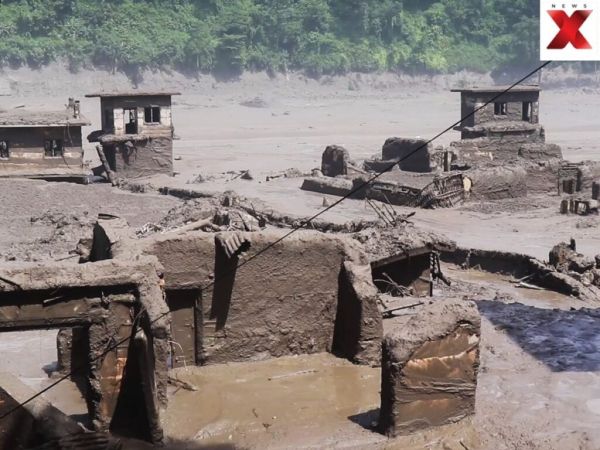
At least 160 people have been killed and hundreds remain missing after flash floods and mudslides tore through areas along the Nepal-Tibet border. Authorities are still searching for 579 tourists, including 466 foreigners from 28 countries. The disaster also swept away 19 bridges, destroyed 40 km of roads, damaged 13 hydroelectric projects and carried away more than 200 trucks. But what caused such powerful torrents of water and debris to suddenly carve through towns, roads and bridges remains unclear. Scientists are examining whether a massive glacier collapse triggered the tragedy.
Nepal disaster explained: why a glacier-landslide is the leading theory
One leading theory is that a huge section of glacier broke away from a mountain and crashed into the Lhende Khola River, a tributary of the Bhote Koshi River that flows from China into Nepal through deep gorges. The event happened around 8:37 a.m. local time.
The US Geological Survey initially reported a 4.4-magnitude earthquake along the Nepal-China border, north of Kathmandu. It later clarified that the shaking was not an earthquake. Instead, the exceptionally powerful landslide itself produced seismic shaking equivalent to a magnitude 5.2 earthquake. In simple terms, an earthquake did not trigger the landslide; the landslide caused the earthquake-like shaking.
A team of international scientists believes rapidly moving ice and rock cascaded down the mountainside, gathering already waterlogged sediment during the monsoon. As per CNN, Geologist Daniel Shugar of the University of Calgary said, “What is hard to reconcile is the the gargantuan volumes of water that we see in these these absolutely horrific videos.” He said it could take weeks or even months to establish exactly what happened.
Nepal glaciers: how they form and why they can collapse
Glaciers begin when layers of snow build up year after year in cold mountain or polar regions. The weight of newer snow compresses older layers, squeezing out air and gradually transforming the snow into dense, blue glacial ice over decades or centuries. Once massive enough, the ice slowly moves downhill under gravity, behaving like a very slow frozen river.
Rising temperatures can make unstable glaciers and mountain slopes more vulnerable. Melting surface snow and ice can send water into cracks. That water may reach the glacier’s base, reduce friction and allow large sections to slip, shear off or collapse. Seismic activity can also fracture unstable ice and trigger avalanches.
Scientists say climate change may have contributed to the Nepal disaster. The Himalayas are warming rapidly, while thousands of glaciers are melting and becoming less stable. Shugar said warmer temperatures may have hastened the collapse, with melting snow seeping into cracks and weakening glacier and mountain rock.
Nepal flood risk: what is a glacial lake outburst flood?
Another possible explanation is a glacial lake outburst flood, or GLOF. These happen when lakes formed by melting glaciers become so full that the ice or land holding them back fails, sending enormous volumes of water and debris down steep valleys.
As per CNN, Tom Robinson, a senior lecturer at the University of Canterbury in New Zealand, previously compared glacial dams with constructed dams. “These glacial dams are no different to constructed dams,” he said, explaining that if a massive lake behind a dam is suddenly released, the water can rush down a valley in huge flood waves.
Research shows ice-loss rates across the Hindu Kush Himalaya, including Nepal, have doubled since 2000, putting nearly 2 million people living downstream at enormous risk. However, experts say a GLOF appears less likely in this case.
Nepal tragedy: why heavy rain is considered less likely
Professor Wolfgang Schwanghart of Freie Universität Berlin said satellite imagery so far shows no major lakes upstream of the flood path, meaning a glacial lake outburst can potentially be excluded. A similar flood in the region last year was linked to a GLOF in neighbouring Tibet, but experts have not established whether an outburst played any role this time.
Heavy rain is also considered unlikely to have been the main trigger. CNN Weather analysis of satellite and weather-station data found no widespread intense rainfall near the disaster zone during the previous week. However, it is monsoon season, the wettest period of the year, and seasonal rain combined with recent snowmelt would have left rivers carrying more water.
Scientists are still investigating the exact chain of events. For now, a landslide involving ice and rock remains the leading explanation, while climate-driven glacier instability could have made the mountains more vulnerable.
Khalid Lateef is a Sub-Editor at NewsX Digital, specializing in Indian politics and global affairs. He also covers viral trending stories and major crime developments.
The post Nepal Disaster Explained: Was A Glacier Collapse Behind The Massive Tragedy? How They Form, Burst And Trigger GLOFs appeared first on NewsX.
-
US Open 2026 Takes A Strange Turn As Players Complain Of Marijuana Smell During Matches

-
NMC Releases List Of 52,690 PG Medical Students Admitted In 2025-26; Check MD/MS/Diploma Names At nmc.org.in

-
AIAPGET 2026: NTA Releases Admit Cards For 49 Candidates At aiapget.nta.nic.in; Re-Exam To Be Held On September 1 In Jaipur

-
Forest forward ends long Premier League goal drought with strike at Anfield

-
Manchester United winger with 24 senior international caps completes move to Premier League rivals Arsenal as special clause comes to light