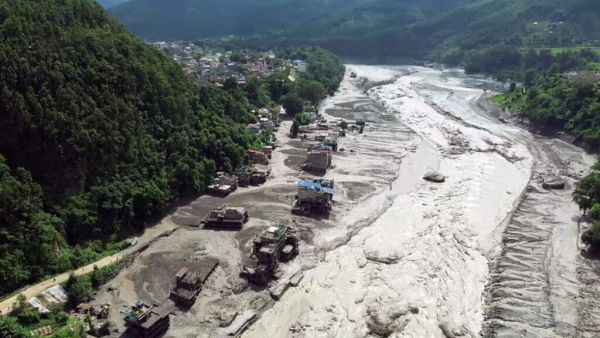
After the sudden and extremely strong flood that occurred in Nepal’s Rasuwa district on August 26, now the danger of another major disaster is looming. According to scientists, a barrier preventing the flow of water may still exist in the upper area near the Nepal-China border. If this barrier suddenly breaks, the downstream areas may be hit again by severe flooding and inundation of debris. The International Center for Integrated Mountain Development (ICIMOD) has issued a warning regarding this possible danger.
Know why warning was given in 7 points
1. According to ICIMOD, the possible blockage in the upper region is the cause of greatest concern. If a large amount of water has accumulated behind it and suddenly this natural barrier breaks, the water can rush downwards at extremely high speed. In view of this apprehension, the authorities have instructed the people around Jilong Port to go to safe places. Scientists are currently trying to find out how big the blockage is and what are the chances of it breaking.
2. ICIMOD said that on August 26, there was a sudden flood and along with the water, silt, large stones and heavy debris started flowing into the Bhote Koshi and Trishuli river systems. Within a few minutes the water level of the river rose rapidly. This sudden change raised two important questions before the officials and scientists that what was the real reason for the flood and is there still a danger of a second wave after this?
3. Qianggong Zhang, head of ICIMOD’s climate and environmental risks department, has expressed serious concern about the situation. Zhang said, ‘The area where flood caused devastation in Rasuwa last year is once again in danger. It is suspected that this happened due to avalanche in Lende Khola, but the reason has not been confirmed yet.
4. He further warned, ‘There is still obstruction in the upper areas on the Nepal-China border, so the authorities have warned that there is a danger of flood for the second time and evacuation orders have been issued for Jilong Port.’
5. The catastrophic speed of floods can be estimated from hydrological data. According to reports, the water level of Trishuli river in Galchi rose by about 9 meters within just 30 minutes. At the same time, in Malekhu also the river level rose by about 7 meters in about half an hour. Such a large rise in water level in such a short period indicates that a large amount of water, debris and sediment suddenly moved downwards from the upper area.
6. A major possibility in the scientists’ investigation is a large avalanche of snow and rocks in high altitude areas. Based on the video and other information emerging from the affected area, initial estimates are that a huge pile of snow and rocks may have fallen into Lendhe Khola, a tributary of the Bhote Koshi river. If this happened, large amounts of water would have been suddenly displaced. This can generate a powerful wave and carry rocks, sediment and debris downstream.
7. Another important aspect of the investigation is the possibility of a temporary dam formed by landslide or avalanche debris. According to experts, heavy debris can accumulate at a narrow place in the upper part of the river and block the path of water. In such a situation, water accumulates behind the blockage and a temporary natural reservoir can form.
-
Indian teen in UAE turns AI ideas into award-winning projects

-
Passenger Ferry Carrying 267 Capsizes Off Northern Cyprus; 100 Evacuated

-
Japan unveils 220-meter bridge with views of its largest lake
-
Inside Rajkummar Rao’s Rs 44 Crore Mumbai Home: Spiral Staircase, Buddha Statue, And A Puja Area

-
Freshly dried lemons brought from the market? Bajimat will be easy trick