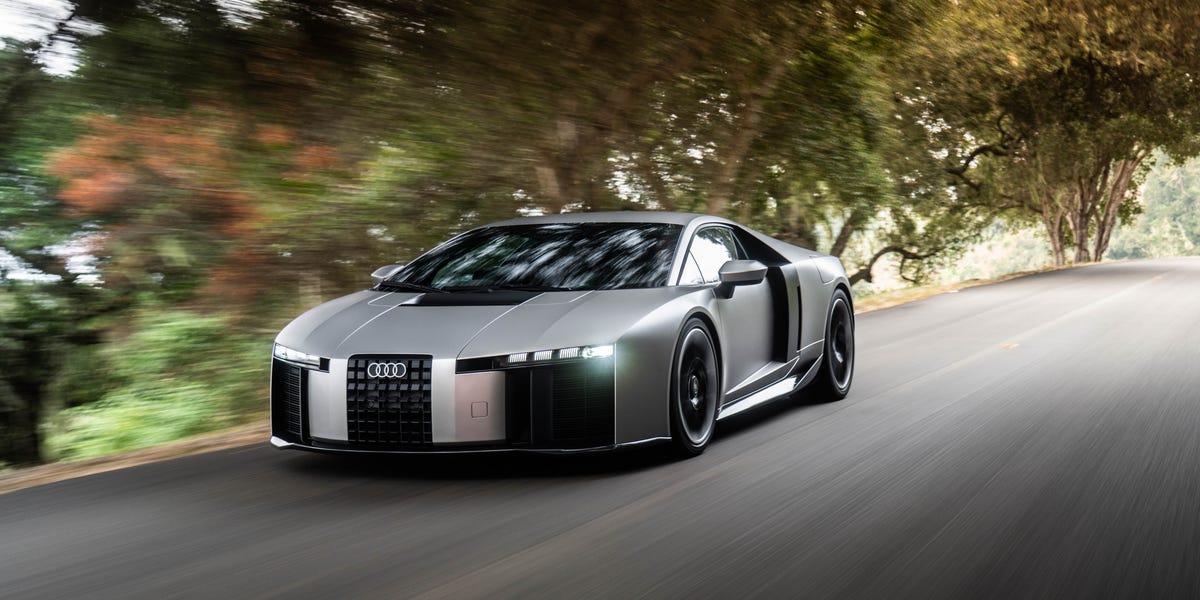
My reaction was probably a bit too immediate. It was certainly not especially restrained. I was in the passenger seat beside Audi CEO Gernot Döllner as he carefully guided the company’s Nuvolari prototype supercar along a narrow, twisting private road near Carmel, California.
I had around 15 minutes with the seemingly affable Döllner, and roughly halfway through the drive, I simply blurted out, “I’m very happy to hear that. I love this!” We were discussing how the Nuvolari’s clean, pared-back design theme would spread across the Audi range in the years ahead.
The first step is the limited-run Nuvolari itself, priced at roughly $700,000. Audi plans to deliver about 200 cars to customers in Europe starting in the first half of 2027. Then around 200 buyers in the U.S. will receive their cars from the beginning of 2028. The remaining roughly 100 units will be allocated to the Middle East and Asia, though not China.
After that, the next model to adopt the new design language, which Audi calls Radical Next, will be the production version of the Concept C. That road-going EV sports coupe is due next year. Then in 2028, Radical Next will reach the first high-volume vehicle in Audi’s line-up, although the company has not yet revealed what that model will be.
Having walked the lawn only days earlier at The Quail: A Motorsports Gathering, the world’s leading supercar and hypercar event, I can say with confidence that the Nuvolari is an exceptional design. It will not be confused with anything else on the road. It avoids the elongated, sharp-nosed look of most supercars. Instead, it appears like a solid block of material. Its proportions are well judged, and nothing distracts the eye from them. In photographs, the Nuvolari’s minimal ornamentation and uninterrupted body panels make it look almost digitally rendered. In person, however, what stood out to me was not just its presence, but also the extraordinary precision of its detailing.
The aluminium four-rings logo set into the top of the Nuvolari’s active rear wing is beautiful. The rear of the car, which is almost entirely devoted to a heat-extracting grille, is finished in high-quality anodised aluminium. It looks cleanly functional rather than merely industrial. And the small billet aluminium front grille is among the most fascinating examples of industrial design on any current car. Each row of its horizontal louvers is set at a different pitch or angle of attack, fully “open” at the bottom and “closed” on the top row. Audi says this is functional, channelling air neatly into the S-duct that generates front downforce while taking away any possible luggage space. It is absolutely stunning.
Do note, however, that the production version will share the same design but will not be made from billet aluminium. Another small production change compared with the car shown here will be the addition of front side-marker lights. Otherwise, the overall appearance will remain the same, including the carbon-fibre body panels.
The interior is another welcome return to classic Audi form. Its simplicity feels deliberate, rather than like the automatic addition of more video screens, as seen in current Audis. The parts that appear to be metal are in fact metal, as they should be at this price. These elements are also beautifully executed. The cabin air vents are made from black-anodised aluminium, with precisely cut slits that ring when you drag a fingernail across them. If I owned this car, I would never stop doing it ... “Riiiiiiing! Riiiiiiing!”
The levers used to control airflow through those vents are—don’t laugh—functional art. Without sounding completely obsessed with dashboard details, they are proper levers that move smoothly through most of their travel, requiring a steady amount of force. Then, as they near their end positions, the effort rises sharply, as though you are pushing them uphill. The resistance then peaks and suddenly drops to almost nothing as the lever clicks into place. Think of the most satisfying toggle switch you have ever used, and you are getting close.
Let us hope Audi’s fans of physical switches and knobs can restore genuinely satisfying tactility to the brand—and perhaps to the wider industry as well. Yes Audi, please, in this world of stackable moulded plastic chairs, be the Eames bent-plywood lounge.
This may sound like a minor detail, but for this car it means everything. If this flagship for Audi’s future does not offer the finest quality touchpoints, then what is the point? Especially because the Nuvolari, like the R8 before it, is based on the underpinnings of a smaller Lamborghini, in this case the Temerario. And the Lamborghini costs significantly less. The Nuvolari is not quite double the price of the Temerario, but it is not very far off.
The Audi uses the Temerario’s twin-turbo 4.0-litre V-8—the one that revs to 10,000 rpm and produces 789 hp. Audi adds a larger battery, with 7.3 kWh gross capacity, to increase the output of the three electric motors on board. It has not yet been certified for the U.S. market, so the figures could change slightly, but Audi estimates the Nuvolari will deliver a total combined 987 horsepower, compared with the Lamborghini’s completely inadequate 907 hp.
How much of that did I actually use in my very brief stint behind the wheel after we swapped seats? Very little, unfortunately. Audi had arranged a private road inside a wildlife sanctuary and ultra-wealthy enclave. It was no place to unleash nearly 1000 horsepower, and I pressed the throttle hard only once, and only for a moment. A proper verdict on the Nuvolari’s dynamics will have to wait for a longer and more suitable drive.
That said, I can report that the car is surprisingly loud even while simply idling out of a driveway, producing a deep rumble whenever it is not in EV mode. Steering response at low speed is quick and progressive, though light in your hands. Visibility is quite good, apart from directly to the rear, where there is effectively none at all. The useless rear-view mirror in the prototype I drove will be replaced in the production car by a mirror-sized screen showing the feed from the rear-view camera. The elegantly slim seats are comfortable, at least over the short distance I drove, and supportive; these carbon seats are entirely manually adjustable. No other seat will be available. One extra benefit for real human beings: getting in and out of the Nuvolari is easy, with none of the awkward contortions demanded by most supercars.
The Nuvolari feels like a breath of fresh air in this segment, even if mechanically it is so close to an existing model. As the standard-bearer for Audi’s renewed commitment to quality and purposeful design, it is spectacular. By the way, Döllner says there is room in the line-up between the Nuvolari and the Concept C-based EV, something roughly in the mould of an R8 successor. He says it is not a car the company is actively developing yet, but it is one Audi is thinking about.
-
Honda Says Manual Gearboxes Are Still Part of Its Plans Despite Civic Si Pause
-
Mate Rimac Says Top-End Sports Cars Will Continue with Petrol Engines for a Long Time
-
Allegations alone are not findings: CJI on Rajasthan Chief Justice

-
Revoke RSS chief Mohan Bhagwat’s visa: US panel to Trump

-
Bigg Boss 20 contestants list: 12 confirmed names with photos