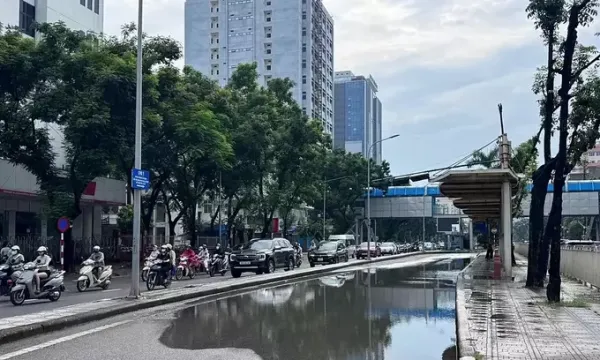
For the last three days, Ngoc Linh, 50, of Tran Phu, Ha Dong, who lives in a low-lying area has been checking how much the water has risen, trying to identify flooded spots to avoid. “However, since August 21, I have not encountered any flooded spots”, he says.
Last October, his house had been flooded twice, with water rising to over one meter and damaging much of his furniture. This time, he sees streets such as To Huu and Nguyen Chi Thanh are not flooded.
“Previously, whenever it rained, To Huu street would be flooded by 30-40 cm of water. I guess the two regulating lakes along the road have done their job,” he says.
|
The intersection of Hoang Quoc Viet and Pham Van Dong experiences only slight surface water accumulation following heavy rain on the night of Aug. 23, 2026. Photo by Read/Pham Nga |
The fear of flooding has also disappeared for Tran Duc, 37, of Cau Dien, Tu Liem Ward.
Usually, whenever there was heavy rain, he used to hurriedly find a safe parking spot for his car. But for the last few days, he has continued to park the vehicle in the alley, where there has not been standing water. “For the last two days I have been taking my child to school through notorious flooding hotspots such as My Dinh and Trieu Khuc without seeing any flooding”, he says.
Le Hang of An Khanh Commune recalls having to wheel her stalled motorbike through water last year and getting home at 10 pm. But now, she travels through the My Dinh Stadium area without any problem. There have been only a few small puddles on Thang Long Avenue, but workers are stationed there to drain even them.
At the Ecohome 3 apartment complex (Co Nhue), Thu Ha, 32, says that, in her eight years there, this is the first time she can go grocery shopping during a multi-day rainy period with the roads remaining completely clear and traffic moving as usual.
The public surprise has quickly made its way across social media. People living around the Lotte Tay Ho, Ha Dong, and My Dinh areas say they no longer have to wade through water unlike in previous years, crediting the constant presence of sanitation workers at high-risk flooding spots.
 |
|
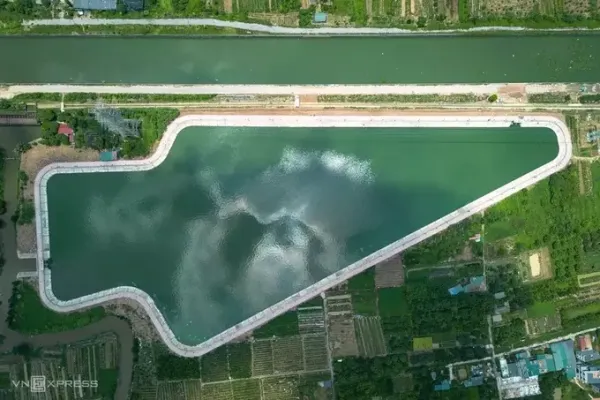
Lake Yen Nghia 2 in An Khanh Commune covers about 5 hectares. Built at a cost of US$9.5 million, the project is largely complete and began storing rainwater in May. Photo by Read/Bang Giang |
Between August 23 night and the following morning, the city experienced downpours, with heavy rainfall recorded in Hai Ba Trung (146.5 mm), Yen So (138.1 mm), Tay Mo (107.5 mm), and Phu Thuong (104.8 mm), but no flooding was reported.
Nguyen Duc Hung, director of the Hanoi Technical Infrastructure Management Center, says: “In 2025, rainfall of 70 to 100 mm typically caused 71 spots in the city to flood. However, during this prolonged rainy period, several heavier downpours have occurred without a single spot being flooded.”
He attributes this to five projects and new regulating lakes each this year. The city has added 83 hectares of water surface area at 19 regulating lakes, increasing the total water storage capacity by 3.4 million cubic meters.
Drainage capacity has been increased by 33.08 cubic meters per second, through the renovation and construction of pumping stations.
The center has instructed drainage units to activate their highest response protocols, and more than 2,500 workers and 200 pieces of equipment have been deployed 24/7. “Proactive monitoring, lowering baseline water levels, and synchronized operation of pumping stations, sluice gates, and regulating lakes have maximized the drainage system’s efficiency.”
Nevertheless, he acknowledges there is localized flooding in areas where infrastructure remains patchy, such as Thuy Khue Street, Lane 42 Giang Van Minh Street, the Co Linh – Dam Quang Trung intersection, and Nguyen Gia Bong Street.
At these places, the center is implementing temporary fixes by installing pumping stations, clearing drainage flows, and deploying personnel 24/7. In the long run, the city plans to speed up construction work of the drainage system in order to permanently stop flooding.
In the years ahead, Hanoi is planning to build a “sponge city” model by shifting from rapid drainage to retaining, absorbing, and reusing water. This will be rolled out in phases, prioritizing parks, sidewalks, and new urban developments.
The capital currently has 3,500 natural lakes and ponds, 337 more than in 2023, to ensure water retention and natural flood control.
-
Ladakh cuts VAT on natural gas from 21 pc to 5 pc to boost clean energy adoption

-
Dehradun man held for allegedly killing wife after domestic dispute

-
Unprecedented atmosphere in favour of Cong in upcoming Rajasthan local body polls, claims Gehlot

-
Complaints of harassment of women to remain confidential: Himachal CM Sukhu

-
Tottenham Hotspur still pushing for Bundesliga striker move as they look to beat familiar face: report