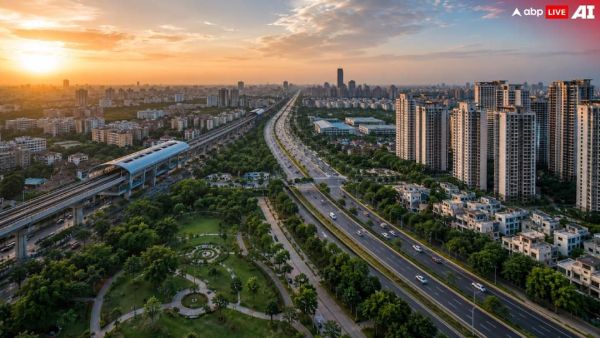
Delhi’s Master Plan 2047 (MPD-2047) comes at a defining moment for the capital. The city is expected to have a population of around 32 million by 2047, with the Master Plan estimating a requirement for nearly 40 lakh additional homes. The challenge, however, is not simply to create more housing. It is to accommodate this growth without allowing congestion, infrastructure stress and unplanned expansion to become the defining features of Delhi’s next three decades.
That makes the direction of MPD-2047 particularly important. Its emphasis on land pooling, urban regeneration, Transit-Oriented Development, green development and mixed-use development reflects a broader change in the way Delhi needs to grow. The focus has to move from adding isolated projects to creating complete urban environments where housing, employment, retail, social infrastructure and mobility are planned as parts of the same ecosystem.
Focus On Regeneration
For the real estate sector, redevelopment could become one of the most important themes of the next phase. Delhi cannot rely indefinitely on outward expansion when land within the capital is limited. Existing residential areas, older housing stock, resettlement colonies and other under-utilised urban areas offer an opportunity to increase the productivity of already-developed land while improving infrastructure and liveability. The Master Plan’s emphasis on regeneration recognises this reality.
Transit-Oriented Development (TOD) can complement this by concentrating greater development intensity around public transport. But TOD should not be viewed simply as a mechanism to increase density. Its real value lies in creating walkable, mixed-use neighbourhoods that reduce dependence on private vehicles and bring daily needs closer to where people live and work.
The impact will inevitably extend beyond Delhi. As the capital becomes more constrained, the wider NCR will increasingly function as an extension of Delhi’s housing, employment and consumption markets. Within Delhi, Dwarka is a strong example of how planned development and improving connectivity can create a new residential and commercial growth centre. Faridabad, Noida and Greater Noida are also well placed to benefit from this trend as road, metro and regional connectivity continues to improve. The same logic applies to Delhi’s relatively less-connected peripheral areas, particularly the Narela-Bawana belt and parts of western and south-western Delhi, where better connectivity can change the development equation.
Infra Is Primary
This is where infrastructure becomes central to real estate. Expressways, ring roads, metro extensions and regional transit corridors are no longer merely mobility projects; they are shaping where economic activity and new communities can develop. The future township will increasingly be defined by its relationship with these corridors, rather than simply by the size of its land parcel.
The real test of MPD-2047, therefore, will be implementation. Land-use planning must move in step with water, power, sewerage, public transport and social infrastructure. Private-sector participation will also be important, particularly in redevelopment, land pooling, TOD and mixed-use projects where execution capability can determine whether planning intent becomes a functioning neighbourhood.
Delhi has reached a stage where the question is no longer how much more the city can expand, but how intelligently it can reorganise and connect itself. If implemented with discipline, MPD-2047 can help Delhi and the wider NCR move towards a more integrated urban model, one where growth is planned around people, infrastructure and economic opportunity rather than simply around available land.
(The author is the Managing Director, Omaxe Ltd)
Disclaimer: The opinions, beliefs, and views expressed by the various authors and forum participants on this website are personal and do not reflect the opinions, beliefs, and views of ABP Network Pvt. Ltd.
-
Israeli restrictions push Gaza aid to ‘breaking point’, UN told
-
Anti-conversion law: Maharashtra churches seek prayer consent forms

-
Pilot, instructor killed in training aircraft crash in UP
-
SC to hear plea on cash donations received by political parties
-
Ex-DRDO chief among 31 Hyderabad pilgrims stranded in Nepal