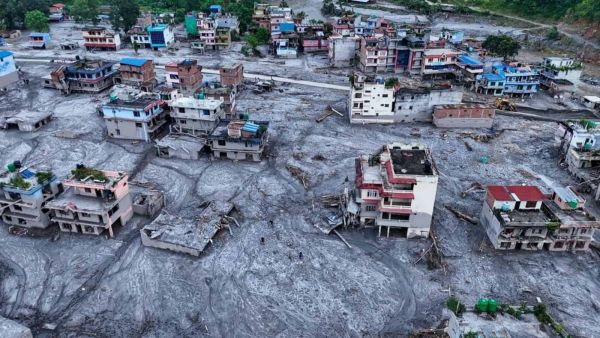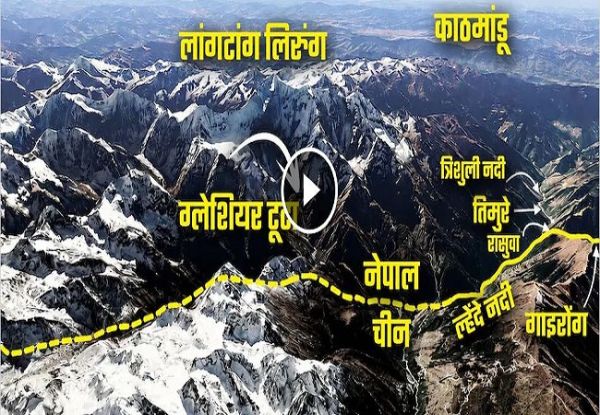
New Delhi. The scenes that emerged from the northern hilly areas of Nepal on Wednesday were not just floods or landslides. He was such a disaster that even calling it 'destructive' seems inadequate. The incident, which started from the slopes of the 7,234 meter high i.e. 23733 feet Langtang Lirung mountain, located just 45 kilometers north of Kathmandu, badly devastated the Nepal-Tibet border area.
Read :- Severe earthquake of 7.4 magnitude in Colombia, buildings falling and people running away, national emergency declared.
Satellite images and experts said that this disaster started with a huge avalanche associated with the glacier. A piece of glacier about 2,000 feet wide broke from a height of about 17,000 feet. That is, more than half a kilometer larger. Fell about 4,000 feet into the valley below. The force of this collision is said to be about 6.3 percent of the Hiroshima nuclear explosion, which produced an earthquake-like vibration of 5.2 magnitude.
A severe flash flood (Harapa Ban) that occurred after the flow of Bhotekoshi river was blocked by glacier debris completely destroyed Rasuwagadhi town and surrounding areas located on the China-Nepal border. According to data released by the Nepal government on Thursday morning, bodies of 162 people have been recovered so far, while at least 750 people are missing.
Nepal's Foreign Minister Shishir Khanal has confirmed that around 300 Indian citizens are among the missing. These include a group of 32 devotees from Kolkata and 37 tourists from Tamil Nadu who went on Kailash-Mansarovar Yatra.
Glacier burst after earthquake, area with population of 50 thousand affected
Read :- Earthquake occurred in the Bay of Bengal, its tremors were felt till Visakhapatnam.
According to Nepal Disaster Management Department (NDRRMA), an earthquake of magnitude 4.4 was recorded in Tibet region at 8:37 am on Wednesday. Soon after this, a huge iceberg broke off in the Rasuwagadhi area and fell into the Lahande Khola river. After the dam made of ice and debris broke, a massive flood of water and black mud rapidly gushed into the Bhotekoshi river. Rasuwagadhi town with a population of about 50 thousand, situated on both banks of the river, and the surrounding villages were buried under water and mud. Many bridges, houses and roads have been completely washed away. The Nepali Army and disaster relief forces are carrying out rescue operations on a war footing.
Glacier broken by earthquake… devastation after 3 minutes
The disaster in Nepal was caused by a nearly 2,000-foot-wide section of the glacier breaking off and falling into the lower river valley, The New York Times reported. After studying satellite images, geologist Daniel Sugar of the University of Calgary said that at an altitude of 17,000 feet above ground level, about 2,000 feet wide part of the glacier was completely separated. This huge iceberg fell 4,000 feet. Due to the falling of such a huge iceberg from a great height, there was a huge flood in the Lhende Khola river, which reached the Bhotekoshi river. This strong flow caused huge devastation in the low-lying areas.
'The 100 meter high wave destroyed everything in a moment'
According to the Kathmandu Post, Rajendra Dhungana, chief customs officer of Rasuwa, said that when he ran outside, he saw a huge wall of water with a plume of smoke coming from above, rushing towards Timure Bazaar. He said, 'The flood entered the market like a wave about 100 meters high and within a few moments the entire market was washed away'.
Read :- Earthquake: Earthquake of 4.7 magnitude occurred in Hingoli district of Maharashtra, no casualties
22 concrete bridges, 42 km road also washed away
Apart from Rasuwa and Dhading, 125 km from Kathmandu, Nuwakot is also badly affected. According to Nepal's newspaper Kantipur, a dozen hydroelectric projects have suffered serious damage, causing a power crisis. 22 concrete bridges and five bailey bridges were washed away in different areas of Rasuwa, Nuwakot and Dhading. 42 km of road was also washed away in the rapid floods. After the inundation, flood water spread to Nuwakot, Chitwan, Gorkha, Tanahun and Nawalparasi East districts. The government has declared Rasuwa, Nuwakot and Dhading as disaster affected areas for three months. Immediate steps will be taken from treatment to other facilities.
Crisis on Mansarovar pilgrims
In the month of August-September, a large number of devotees go on Kailash-Mansarovar Yatra via Nepal. Many pilgrims traveling through private travel agencies were hit by this sudden deluge. Due to complete breakdown of communication system, even travel agencies are not able to establish contact with their passengers.
West Bengal government issued helpline
On the instructions of Chief Minister Suvendu Adhikari, the state government has started an emergency helpline at the police headquarters at Bhawani Bhawan to assist the residents of West Bengal and their families trapped in the disaster.
Read :- BJP Mayor Vinod Aggarwal created ruckus in Moradabad due to his own government's bulldozer, appealed to the state president to save his honour.
The affected families can contact the following helpline numbers of the state government for assistance:
(033) 24793311
9147890181
-
India Vs Thailand Women's T20 Asia Cup 2026: Thipatcha Putthawong Wins Toss, India Bat First Ahead Of Pakistan Clash

-
'Inspired By Mr Munde': Twinkle Khanna & Dimple Kapadia Are Now Making Paneer At Home Amid Fake Product Scam

-
What we know about Trump’s oil reserves deal with Venezuela

-
Germany: British woman fatally stabbed at station, 1 detained

-
Death toll in Nepal floods mounts to 788, over 2,500 missing