Toronto meetings bring governments, investors, businesses and universities together around trade, technology, investment and a C$70 billion ambition
By Ayush Anand
TORONTO: India and Canada are attempting to transform their renewed diplomatic relationship into a much deeper economic partnership, with senior ministers, investors, business leaders and universities gathering in Toronto to discuss trade, technology, finance, energy and new investment opportunities.
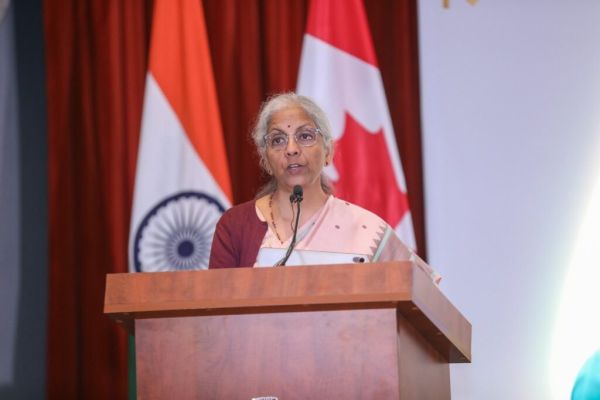
Indian Finance Minister Nirmala Sitharaman placed that effort within a much larger global challenge. Speaking in Toronto following the inaugural Canada India Finance Ministers’ Economic and Financial Dialogue, she warned that countries are confronting profound changes in the international economy.

“The world is going through a profound transformation. There’s just a lot of uncertainty everywhere,” Sitharaman said in an official video released by her office. “The geopolitical and economic realities are constantly evolving. So, in this background, closer economic cooperation has become increasingly important to build resilient, sustainable and inclusive economies, both in Canada and in India.”
Her remarks captured the central argument behind the visit. Canada is seeking to diversify its trade and investment relationships as global economic tensions increase. India, meanwhile, is looking for reliable sources of energy, food, critical minerals, capital and technology to support its rapid economic expansion. Officials from both countries believe their respective strengths could make them increasingly valuable partners.
Sitharaman and Canadian Finance and National Revenue Minister François Philippe Champagne concluded the first Canada India Finance Ministers’ Economic and Financial Dialogue on August 27. According to their official joint statementthe ministers discussed global economic developments, domestic priorities, investment, financial cooperation and the need for more resilient supply chains.
The two governments reaffirmed their shared ambition to expand bilateral trade to C$70 billion by 2030. They also repeated their intention to conclude negotiations for a Canada India Comprehensive Economic Partnership Agreement by the end of 2026. India expressed readiness to begin negotiations on a Bilateral Investment Treaty at the earliest opportunity, although no completed investment treaty was announced during the visit.
Financial cooperation emerged as one of the most significant areas of discussion. Officials agreed to support further engagement on cross border remittances and merchant payments, including potential partnerships that could broaden the use of India’s Unified Payments Interface in Canada. The statement did not announce an immediate UPI launch in Canada, but said future partnerships could help make payments faster and more affordable while supporting trade, tourism, education and small businesses.
The ministers also discussed financial technology, capital markets, financial stability, institutional investment and efforts to address financial crime. Critical minerals were identified as another strategic area where cooperation could help Canada and India create more secure and diversified international supply chains.
The government level dialogue was accompanied by a broader effort to connect businesses and investors. Earlier in Sitharaman’s Toronto visit, the Consulate General of India hosted a business reception in her honour, bringing together public representatives and leading Canadian and Indian business leaders.
According to the Consulate’s official accountSitharaman used the reception to highlight what she described as the immense potential of the India Canada economic corridor. Her address focused on using the strengths of both economies to generate business opportunities, develop investment partnerships, expand financial cooperation and facilitate greater flows of capital.
Indian High Commissioner Dinesh K. Patnaik and Consul General Mahaveer Singhvi also addressed the reception. They focused on what they described as the next phase of India Canada economic engagement, with potential opportunities in technology, innovation, infrastructure and other emerging sectors. The reception itself did not produce a publicly announced deal or investment commitment, but it provided Canadian and Indian leaders with a platform to establish relationships and explore possible projects.
A separate high level business roundtable was held with investors and senior representatives from sectors including energy, artificial intelligence, critical minerals, advanced manufacturing, infrastructure, finance and higher education. The meetings were designed to identify commercial opportunities and encourage Canadian organizations to consider expanding their investment and operations in India.
Gabriel Miller, President and CEO of Universities Canada, offered one of the most enthusiastic assessments following the roundtable. In a video published by India’s Ministry of FinanceMiller called his discussion with Sitharaman inspiring and encouraging.
Miller described the Indian finance minister as modest and calm, but said she also possessed major ideas about India’s future. He said she appeared eager to work with Canada to create jobs and opportunities in both countries.
His participation provides an important secondary signal about the direction of the relationship. Higher education is increasingly being treated as part of the broader economic partnership through research, innovation, skills development and connections between universities and industry.
Earlier in 2026, Universities Canada led a delegation of 21 Canadian university presidents to India. The mission explored academic exchanges, collaborative research, industry partnerships and models through which Canadian institutions could establish a greater presence in India.
Canada and India subsequently launched a Talent and Innovation Strategy representing more than 20 Canadian institutions and announced 13 partnerships between Canadian and Indian universities. Those initiatives include research cooperation, student and faculty exchanges, hybrid campuses and artificial intelligence centres of excellence.
The economic foundation for further cooperation is already significant. Canada’s Department of Finance estimates that direct and indirect Canadian investment in India surpassed C$110 billion in 2024. India offers Canadian businesses access to a population of approximately 1.4 billion and one of the world’s fastest growing major economies. Canada, in return, can provide resources, investment expertise, research capacity and access to advanced technology.
However, the optimism expressed in Toronto must still be converted into measurable results. The business reception did not announce a signed deal. Miller’s testimonial did not include a specific job commitment. Wider UPI availability in Canada remains a potential partnership rather than a confirmed launch. The proposed trade and investment agreements must still be negotiated.
Even with those limitations, the Toronto meetings demonstrate a significant change in the relationship. India and Canada are no longer focused only on restoring diplomatic communication. They are now discussing trade targets, capital flows, critical minerals, financial systems, research partnerships and the creation of jobs.
In an increasingly uncertain global economy, both countries appear to believe that closer cooperation could make them stronger. The next challenge will be turning that shared belief into agreements, investments and opportunities that Canadians and Indians can see in their everyday lives.
-
Alpine confirms Franco Colapinto for 2027, pointing to a quieter-than-usual Formula 1 silly season

-
Honda May Build Body-on-Frame Pick-ups and SUVs Linked to the 2029 Nissan Xterra

-
Bigg Boss 20 gets 2 more names; total 14 contestants in the list

-
Hyderabad woman techie goes missing in Nepal floods

-
Death toll from Nepal-Tibet flash flood climbs to 469