Defence tech startup Sanlayan Technologies posted a net profit of ₹7.9 Cr in FY26 as against a net loss of ₹2.9 Cr in the previous fiscal year.
The turnaround came as the startup expanded its defence electronics portfolio through acquisitions, including stakes in Dexcel Electronics and Versabyte Data Systems.
Sanlayan’s operating revenue surged 5.7X to ₹124.7 Cr, while a ₹9.5 Cr exceptional gain from the sale of immovable property boosted its profit.
Defence tech startup Sanlayan Technologies turned profitable in the financial year 2025-26 (FY26), as acquisitions helped it scale its portfolio of radar, electronic warfare, and other strategic electronic systems.
The Bengaluru-based startup posted a consolidated net profit of ₹7.9 Cr in FY26 as against a net loss of ₹2.9 Cr in the previous fiscal year, according to its financial statements accessed by Inc42.
Sanlayan’s operating revenue surged 5.7X to ₹124.7 Cr from ₹21.7 Cr in FY25. Including other income of ₹3.5 Cr, total income stood at ₹128.2 Cr during the year under review.
The startup’s profitability was also supported by a ₹9.5 Cr exceptional gain from the sale of immovable property. Consequently, its profit before tax stood at ₹33.8 Cr in FY26.
After accounting for a net tax expense of ₹8.8 Cr, the group’s profit before minority interest stood at ₹25 Cr. Of this, ₹17 Cr was attributable to minority shareholders in Sanlayan’s subsidiaries, leaving a consolidated net profit of ₹7.9 Cr attributable to Sanlayan.
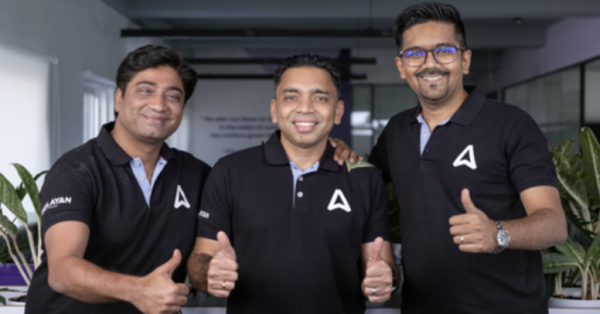
Founded in 2023 by former Zetwerk executives Rohan Gala, Abhijit Kothawale, and Rahul Vamshidhar, Sanlayan develops electronic systems spanning radar, electronic warfare, avionics, radio-frequency systems, and embedded electronics.
Its portfolio includes radar systems and their components, RF front ends, antenna array units, digital signal-processing systems, and radar data-processing systems. It is also developing electronic warfare capabilities such as jamming and spoofing, alongside counter-unmanned aerial systems designed to detect, track, and neutralise drones.

Acquisitions Power Growth
Sanlayan has combined in-house product development with acquisitions to expand its presence across the defence electronics value chain.
It acquired a majority stake in embedded systems company Dexcel Electronics in January 2025. Dexcel has more than two decades of experience across the aerospace, defence, and space sectors, including contributions to Jaguar and Sukhoi aircraft upgrades and ISRO programmes.
In October 2025, Sanlayan also acquired a strategic stake in defence power-electronics supplier Versabyte Data Systems. Versabyte posted revenue of ₹67 Cr and a net profit of ₹16.5 Cr in FY25. It had an order book of ₹210 Cr at the time of the transaction, The Economic Times reported.
The acquisition-led expansion was also visible on Sanlayan’s balance sheet. Its goodwill increased to ₹100.5 Cr at the end of FY26 from ₹16.9 Cr a year earlier. Investments in subsidiaries and acquisitions contributed to an investing cash outflow of ₹112.6 Cr during the year.
Meanwhile, Sanlayan strengthened its capital base during FY26. The issuance of shares, including securities premium, brought in ₹191.6 Cr, while its total financing cash inflow stood at ₹198.8 Cr.
The startup ended FY26 with cash and bank balances of ₹94.3 Cr, up from ₹14.9 Cr at the end of the previous fiscal year.
Expenses Rise 3.6X To ₹104 Cr
Sanlayan’s total expenses jumped 3.6X to ₹103.9 Cr in FY26 from ₹28.9 Cr in the previous fiscal year.
The startup’s cost of materials consumed increased 5X to ₹54.4 Cr from ₹10.9 Cr. Employee benefit expenses surged to ₹9.1 Cr from ₹38 Lakh, while depreciation and amortisation expenses increased to ₹24.1 Cr from ₹8.9 Cr.
Its other expenses rose to ₹14.7 Cr from ₹8 Cr, while finance costs increased to ₹2 Cr from ₹64 Lakh.
Earlier this month, the defence ministry notified its sixth Positive Indigenisation List, covering 405 strategically important items, including radars, sonars, fire-control systems, and satellite communication equipment. These items have an estimated procurement value of ₹3,070 Cr.
The government said that more than 15,700 defence items were indigenised over the five years ended March 2026, while defence PSUs placed orders worth about ₹10,000 Cr with domestic vendors during the period.
The deployment of indigenously developed systems during Operation Sindoor in 2025 also sharpened the focus on domestic drones, electronic warfare systems, and layered air-defence technologies.
In June 2025, Sanlayan raised ₹186 Cr in a Series A funding round led by Ashish Kacholia, Lashit Sanghvi, and Jungle Ventures. Gemba Capital, Singularity Ventures, and Shastra VC also participated in the round.
In December 2025, Versabyte transferred an indigenously developed high-voltage power supply for airborne self-protection jammers to the armed forces. Sanlayan was also recognised by the DRDO for developing an airborne electronic warfare payload.
Edited by Vinaykumar Rai
-
Dr. Samina Haq’s claim about female hostel residents sparks online debate

-
3 Zodiac Signs Are Exceptionally Lucky All Week From August 31 – September 6, 2026

-
Hotels in central Vietnam expected to be fully booked for National Day holidays

-
India and Canada can build strong financial partnership based on economic complementarities: Finance Minister Sitharaman
-
4 Tech Brands That Are Owned By Corsair