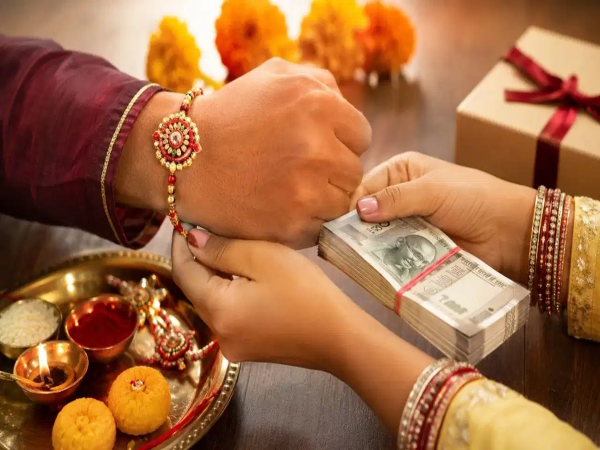
The festival of Raksha Bandhan symbolizes the bond of love between siblings. On this day, sisters tie a *rakhi* on their brothers' wrists, and in return, brothers give them gifts as a token of affection. These gifts can range from cash in an envelope to gold jewelry, shares, or even property. Amidst these celebrations, the Income Tax Department also keeps a close watch. Whether or not the gift received by the sister falls under the tax net depends entirely on income tax regulations.
**Gifts from a biological brother are completely tax-free**
Tax rules regarding gifts are determined under Section 56(2)(x) of the Income Tax Act. According to this rule, if you receive a gift from someone who does not fall under the category of a "relative," any gift exceeding ₹50,000 in a financial year becomes fully taxable. It is treated as "income from other sources," and tax is levied according to your applicable tax slab. However, there is a significant exemption: if the gift is received from a specified "relative," there is no monetary limit. A biological brother falls within this list of relatives. If a biological brother gives his sister ₹1 lakh in cash along with a gold chain worth ₹2 lakh, the sister does not have to pay a single rupee in tax.
**Tax implications for gifts from a cousin**
Many families misunderstand this rule. While Section 56(2)(x) of the Income Tax Act classifies a biological brother as a relative, a cousin is excluded from this list. If a sister receives a gift worth ₹75,000 from her biological brother, it is entirely tax-free. However, if the same gift of ₹75,000 is given by a cousin, the sister is liable to pay tax on the entire amount. The ₹50,000 limit is not an exemption but a threshold. If the total value of gifts received from friends or cousins during the year is ₹49,000, no tax is applicable. However, if the amount reaches ₹51,000, the entire sum becomes taxable. While gifts received from anyone on the occasion of a wedding are tax-free, this exemption does not apply to gifts given on occasions like Rakhi, Diwali, or birthdays.
**Rules regarding stamp duty on gifted property**
Brothers often gift flats or plots of land to their sisters. In the case of such immovable property received without any monetary consideration, the stamp duty value is treated as the value of the gift. If a brother gifts a flat with a stamp duty value of ₹40 lakh, it remains entirely tax-free; however, the gift deed must be registered. Had a friend gifted the same flat, tax would have been payable on the entire ₹40 lakh amount in that same year.
**Exercise caution when accepting cash gifts**
Out of affection, brothers sometimes give large sums of cash to their sisters. This is where a serious error can occur. Under Section 269ST, no person can accept cash of ₹2 lakh or more from a single individual in a single day or through a single transaction. If a brother gives ₹2 lakh in cash to his sister, no income tax is levied due to their relationship, but the sister would face a penalty of ₹2 lakh under Section 271DA. Therefore, large amounts should always be received via cheque, NEFT, or UPI.
**Tax liability on income generated from the gift**
If the sister invests the gifted money in a fixed deposit, she is liable to pay tax on the interest income earned from it. The 'clubbing of income' provisions under Section 64 apply to spouses or minor children, not to sisters. Consequently, the gift given by the brother becomes the sister's own asset.
Disclaimer: This content has been sourced and edited from TV9. While we have made modifications for clarity and presentation, the original content belongs to its respective authors and website. We do not claim ownership of the content.
-
Manchester United stance on £30m late move for striker Alexander Sorloth emerges as INEOS are presented with tempting option

-
Paris Saint-Germain agree verbally with Ajax for winger Mika Godts

-
What’s happening at Lulu Mall Hyderabad on August 28 and 29?

-
Man jumps from building in IS Sadan, family cries foul

-
Nepal flash flood: 4 Indians rescued, 287 still missing