Claude Cowork Gets a Built-In Browser
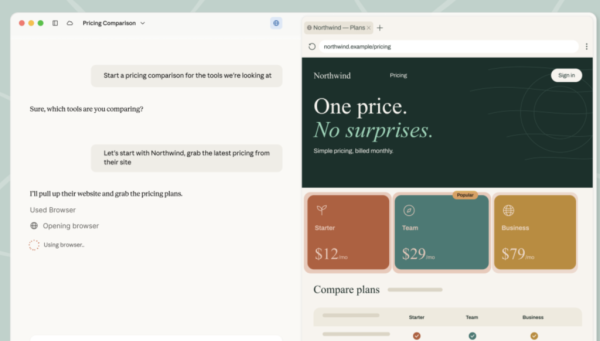
Anthropic has added a built-in browser to Claude Cowork, giving the AI assistant the ability to navigate websites and complete web-based tasks without relying on a separate Chrome extension. The browser is designed to let Claude open websites, interact with pages, fill forms and complete tasks while users can watch the process.
The update represents a significant expansion of Cowork’s capabilities. Instead of simply generating information or working with files, Claude can now take a goal and perform parts of the work directly on the web.
Claude Can Now Do More Than Browse
The new browser is designed around task completion rather than conventional web browsing.
Users can ask Claude to perform a web-based task, after which Cowork can open the required website, navigate through pages, click buttons, enter information and complete forms. Anthropic says users can see the work as it happens and redirect Claude when necessary.
This makes Cowork increasingly similar to an AI employee that can operate digital tools rather than simply answering questions about them.
For example, a user could potentially ask Claude to research information across websites, retrieve documents, complete repetitive online workflows or perform other browser-based tasks.
A Separate Browser Keeps Personal Tabs Isolated
One of the important aspects of the new system is that Claude’s built-in browser operates separately from the user’s normal browser environment.
This means Claude does not automatically gain access to the user’s existing tabs, bookmarks or browsing activity. The separation is intended to provide greater control over what the AI can access while allowing it to perform web tasks independently.
Anthropic also maintains safeguards around sensitive accounts and websites. The company warns users to exercise particular caution when giving browser agents access to sensitive information or accounts.
Claude in Chrome Is Still Available
The launch does not mean Anthropic is abandoning its Claude in Chrome extension.
The two systems are designed for different scenarios. The built-in Cowork browser is useful when Claude can perform a task independently in its own browsing environment. Claude in Chrome remains useful when the AI needs to work with a webpage that is already open in the user’s browser or interact with an existing browser session.
This gives users a choice between an isolated AI-controlled environment and a browser environment that is already part of their workflow.
Cowork Is Becoming a True Work Agent
Cowork was originally designed to allow Claude to handle tasks involving files and other work processes. Anthropic has continued expanding it into a broader agent capable of performing multi-step tasks across tools and environments.
The browser adds an important missing capability: access to websites that do not necessarily have dedicated integrations or connectors.
Instead of requiring a separate integration for every online service, Claude can potentially interact with the service through its website just as a human user would.
Anthropic’s own description says Cowork works directly with selected folders and tools, while the browser allows it to open websites and complete web tasks.
Security Becomes Even More Important
The greater capability also introduces new risks.
An AI that can navigate websites and fill forms has more power than an AI that merely generates text. If it misunderstands an instruction, encounters malicious content or takes an unintended action, the consequences can be greater.
Anthropic has therefore built permission and safety mechanisms into the browsing experience. Users can observe Claude’s actions and intervene when required, while certain high-risk websites and activities receive additional restrictions.
The underlying challenge is becoming increasingly clear: as AI agents gain the ability to act, controlling what they are allowed to do becomes just as important as improving what they can do.
A Step Toward the AI-Powered Workplace
The built-in browser could make Claude Cowork considerably more useful for businesses and professionals.
Many everyday workflows still require employees to move between websites, dashboards, forms and internal systems. An AI agent capable of navigating those interfaces could automate portions of these repetitive processes without requiring a custom software integration for every task.
That could eventually shift the role of AI assistants from answering questions to actually completing assignments.
The Bigger AI Battle Is Moving to Actions
The launch also reflects a broader shift in the AI industry.
AI companies are increasingly competing not only on how intelligently their models can respond, but on how effectively those models can operate computers, access information and execute multi-step workflows.
Claude’s built-in browser is another step in that direction. Cowork is moving closer to becoming an environment where users describe what they want accomplished and allow Claude to handle the execution.
The important question is no longer simply whether AI can understand a task. It is whether users are comfortable giving AI enough access to actually finish it.
Summary
Anthropic has introduced a built-in browser for Claude Cowork, allowing the AI to independently open websites, navigate pages, interact with online services and complete web-based tasks. The browser operates separately from users’ normal browsing environment, while Claude in Chrome remains available for tasks involving existing browser sessions. The update pushes Cowork further toward becoming an AI agent capable of completing real-world digital work.
-
Bhadrapada month has arrived, there will be many fasts and festivals, see the list

-
6 Vegetarian Restaurants In Chennai For Benne Dose, Thatte Idli And More

-
IND vs SL: Team India's first batting, Kuldeep Yadav out… Saransh Jain's debut

-
India vs Thailand: India will go to register a big win against Thailand, know who will have the upper hand

-
'How can this happen…', Suryakumar Yadav was out after winning the World Cup, broke his silence after 3 months