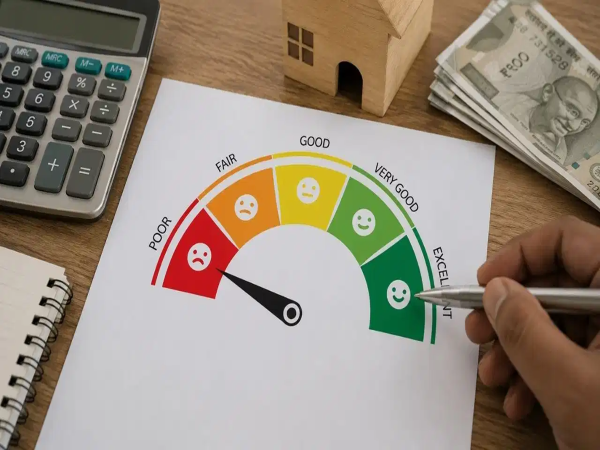
Today, millions of people are facing a peculiar problem. They pay every EMI on time—with no bounced installments—yet their credit score suddenly drops. People often fail to understand where things are going wrong. In reality, a credit score is determined by more than just timely installment payments; it reflects your overall financial habits. If you are making certain subtle mistakes, your score may quietly decline, potentially leading to loan rejections or higher interest rates down the line. Let’s look at the factors that could be damaging your credit score.
**Excessive Credit Card Usage**
If your credit limit is ₹1 lakh, it does not mean you should spend ₹80,000–₹90,000 every month. Banks view this as "over-dependence" on credit. Ideally, you should utilize only 30% to 40% of your limit. If your spending exceeds 70%, the bank's system flags you as a risk, which directly impacts your credit score.
**Applying for Loans Repeatedly**
People often apply for loans with multiple banks simultaneously, hoping to secure approval from at least one. However, every such application triggers a "hard inquiry" on your credit report. This signals to banks that you are in urgent need of funds, making your profile appear risky—a factor that directly lowers your score.
**Closing Old Credit Card Accounts**
People frequently close old credit cards they no longer use, but this can prove to be a major mistake. An old account strengthens your credit history; closing it reduces your "credit age." Since 30% of your credit score depends on payment history, losing that long-standing record weakens your profile. Similarly, your score can drop if you hold only unsecured loans, such as personal loans or credit cards. To maintain a good score, it is essential to have a balance of both secured and unsecured loans.
Errors Hidden in the Report
Sometimes, your score drops due to system glitches even when you are not at fault. For instance, a loan belonging to someone else might be recorded under your name, or a loan you closed long ago might still appear as active. Incorrect outstanding balance entries are another common cause. Therefore, make it a habit to check your credit report every 3 to 6 months. Nowadays, banks use AI-based scoring systems that instantly detect even minor oversights. Crossing the 750 mark is crucial for a good score; to achieve this, keep your spending within limits.
Disclaimer: This content has been sourced and edited from TV9. While we have made modifications for clarity and presentation, the original content belongs to its respective authors and website. We do not claim ownership of the content.
-
Ruben Amorim reportedly very keen on Manchester United defender Leny Yoro this summer

-
What’s happening at Lulu Mall Hyderabad on August 29 and 30?

-
Hyderabad: MLC Mirza Rahmath Baig clarifies on ‘deepfakes’

-
Indian fan’s love letter to Bilal Abbas Khan: My Mahadev sent you

-
Joe Root Dethrones Ricky Ponting! England Star Breaks Major Test Record