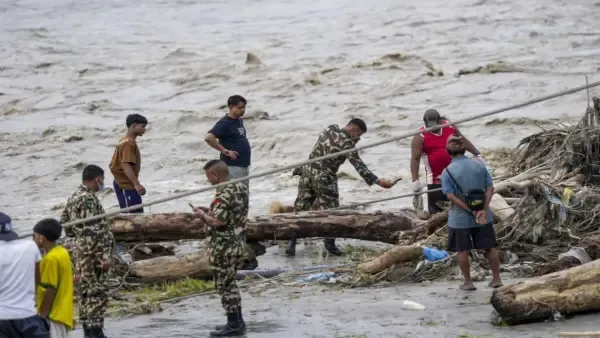
The death toll from the flash floods that swept through Nepal earlier this week has reached 626, the Nepal Police said in a statement on Saturday morning, as rescue teams push through a fourth day of gruelling search and relief operations across the devastated regions.
According to the statement, nearly 2,500 people are still missing. It also said that 17 police personnel remain out of contact at the time of publishing this story.
More than 8,700 police officers have been deployed across the flood-ravaged areas, working alongside rescue teams to locate survivors and recover bodies. Officials said 3,301 people have been injured and rescued so far, with 140 of them treated and discharged from hospitals in the Kathmandu Valley.
At a temporary morgue in the capital, authorities have taken the heartbreaking step of displaying photographs of unidentified bodies, hoping that families searching for their loved ones might find answers.
Speaking to PTI, a Nepal Police official said, "We are displaying photographs of the unidentified bodies kept here. If people recognise someone from the photographs, we show them the body for identification. If the body is identified, it will be handed over after the post-mortem. If it remains unidentified, it will be kept here for further identification. We have also uploaded the records on the website, including those from Nawalparasi, Chitwan and Nuwakot. The records available here are only of the bodies kept at this location, while the rest are available on the website."
Meanwhile, Chinese officials have warned that a temporary lake formed in the upper reaches of the Lhende river system could breach its banks at any moment.
The lake formed after debris from a glacial collapse created a natural dam near where the Chochen River on the Chinese side meets the Purepu River in Nepal. The glacial collapse is believed to have triggered the initial flash flooding that devastated communities on both sides of the border earlier this week.
In a communication to Nepal's Ministry of Foreign Affairs, Chinese authorities noted that the colour of the newly formed lake has been steadily darkening, a worrying sign that could indicate an increased risk of a breach, India Today reported.
"The colour of the lake that began forming the day before yesterday is continuously becoming darker. This means that it could burst," the Chinese message stated.
Beijing, however, sought to temper fears, suggesting that the consequences of any breach would likely remain contained. Chinese authorities estimated that even if part of the natural dam gives way, the maximum flow entering the river system would be around 500 cubic metres per second, which could possibly stay within the river's banks.
Chinese water resources officials said the lake had accumulated approximately 2.5 million cubic metres of water by Friday, with an additional 3 million cubic metres expected to flow in over the following days. Drones and satellites have been deployed to monitor the situation, while flood modelling has been conducted to assess potential impacts.
By Friday afternoon, the lake had already begun spilling into the Lhende Khola and Trishuli rivers. China's state broadcaster CCTV assessed the resulting risk as manageable, but authorities on both sides of the border remain on high alert.
-
Hindutva groups allege religious conversion at Hyderabad firm

-
UAE grants Musk’s Starlink 10-year satellite internet licence

-
Eviction threat: Slum dwellers near PM’s home meet Rahul

-
‘Not Rejected Foreign Aid’ Including India: Nepal Seeks Targeted Help Amid Floods

-
Manchester United enquire about Europa League-winning defender as they aim to solve left-back issue