The number of first-year international students applying to U.S. universities fell to 148,780 in the 2025-26 admissions cycle, a decline of roughly 16,000 from the previous year, according to the Common Application, better known as Common App, a centralized online platform that allows undergraduate students to apply to 1,146 colleges and universities across all 50 U.S. states and several other countries.
The Common App 2025-26 End-of-Season Report indicates the decline was broad-based across much of the world, with applicants from Asia falling 11% and those from Africa dropping 17%.
The downturn follows years of strong growth for U.S. higher education. Common App data showed first-year international applicants increased steadily from 80,312 in the 2014-2015 academic year to 96,320 in 2018-2019.
Following a brief pandemic-driven dip in 2019-2020, the number rebounded to 107,112 in 2020-2021 and continued to grow until slightly dropping in 2024-2025.
This international downturn, however, runs counter to domestic trends, as the number of U.S. first-year applicants increased by 4%.
|
Applications from first-year international students to U.S. universities over the years. Graphics by CommonApp |
The figures highlight the impact of the Trump administration’s restrictive immigration policies.
During the 2025-26 admissions cycle, prospective students faced heightened scrutiny over visas and immigration rules.
These U.S. policies have created greater uncertainty by imposing entry restrictions affecting nationals of 39 countries, disrupting visa processing during the peak season, and enforcing a new four-year maximum stay starting Sept. 15.
The administration has also signaled plans to reform the Optional Practical Training program, a crucial pathway for international STEM graduates to gain temporary work experience in the U.S.
Rodney Hughes, a senior data scientist at Common App, said: “We have thought about what’s been going on over the past season and it’s interesting to differentiate the applicants, which is what we see here, from enrollments and just the thought process of applying.”
“If you think, ‘OK, it might be hard for me to get a visa,’ that may make students more hesitant to apply,” he said, as quoted by Inside Higher Ed.
|
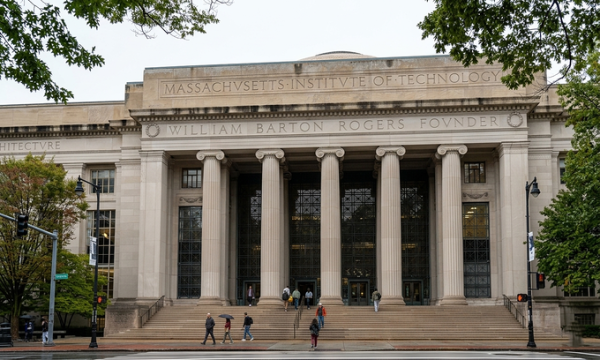
People walk outside Building 7, the main entrance to the Massachusetts Institute of Technology (MIT), on an overcast autumn day in Cambridge, Massachusetts in October 2025. Photo from the university’s Facebook page |
According to a joint analysis by NAFSA: Association of International Educators and JB International, the U.S. could lose up to $3.4 billion in economic activity and nearly 40,000 jobs next academic year as international student enrollment declines.
The analysis draws on the Institute of International Education’s (IIE) Spring 2026 Snapshot, which surveyed 585 U.S. higher education institutions.
IIE projects a 9.5% decline in overall international student enrollment for the 2026-27 academic year, attributing the expected drop to “visa delays, policy uncertainties, and growing global competition.”
Based on the projection, about 111,000 fewer international students are expected to enroll at U.S. colleges and universities next year. Total enrollment is projected to fall to 1.057 million, from an estimated 1.169 million in 2025-26.
-
PM Modi receives warm reception from Indian diaspora in Uzbekistan

-
Flash floods in Nepal: 275 Indians missing

-
Prepare for draught-like situation in Rajasthan with timely measures amid weak rainfall: Gehlot

-
Judiciary proactively responded to emerging fraudulent schemes like digital arrest: CJI

-
Gas pipeline leak prompts traffic diversion on Samruddhi Expressway in Chhatrapati Sambhajinagar