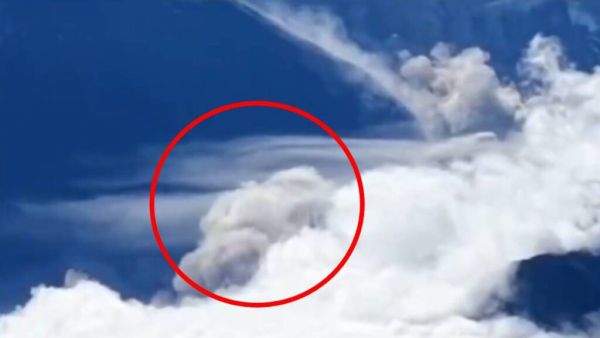
The breakage of the high-altitude glacier is suspected to be behind the massive flood and debris that occurred on the Nepal-China border on August 26. The camera of a tourist making a video of the mountainous area in Gyirong County of Tibet Autonomous Region of China recorded such a scene, which experts are linking to the breaking of the glacier. It is believed that after the breaking of this glacier, a huge amount of ice, rocks and debris came down from the mountain valleys and later turned into a powerful debris flow.
According to Kang Shichang, director of the Institute of Mountain Hazards and Environment under the Chinese Academy of Sciences, the area seen in the video matches the location identified as the source of the disaster in remote-sensing images. According to Xinhua report, the scene of glacier breaking towards Nepal is likely to be seen in the video. After this incident, a strong stream of debris moved towards China and caused massive destruction in the Guirong Port area.
How did the devastation happen on 26th August?
On August 26, an incident of breakage of ice and rocks occurred in the high altitude area of Nepal. After this, a large amount of snow, rocks and debris came down rapidly towards the mountain valleys. As it descended, this material turned into a powerful debris stream. This stream moved towards China and badly affected the Gyirong Port area of Tibet.
According to Chinese media, the glacier breaking incident took place at an altitude of about 5,140 meters. The area where this incident took place is said to be around 6,20,000 square meters.
The debris came down about 20 kilometers in 7 minutes.
According to the report, the stream of debris formed after the breaking of the glacier came down for about 20 kilometers. During this time it covered a height difference of about 3,300 meters. It is reported that this stream of debris reached Gyirong Port in about seven minutes. Due to its rapid descent, there was huge damage to the areas and infrastructure in its path.
The impact of this disaster was seen in both Nepal and China. Many villages, roads, bridges and other infrastructure were damaged or swept away in the debris flow. Relief and rescue operations are going on in difficult hilly areas. A barrier lake, i.e. a temporary lake formed due to a natural obstruction, has also been formed in the affected area. Due to this, there is a possibility of further floods.
China warns of another flood?
Nepal is already on alert regarding the threat of another possible flood. Just four days after devastating flash floods in many parts of the country, China has issued a warning regarding a temporary lake. According to the report of ‘India Today’, China has warned that this temporary lake built above can break at any time. Seeing the changes taking place in the lake, China has informed the Foreign Ministry of Nepal about this danger. These also include the gradual deepening or blackening of the lake water.
Danger may increase if the natural wall of the lake is broken.
China has also said that according to its modelling, if some part of the natural wall blocking the lake is broken, a strong flow of water could occur. According to the model, in such a situation, water can reach the river system at a maximum speed of about 500 cubic meters per second. For this reason, the danger in the low-lying areas has increased and officials are keeping an eye on the water level of the temporary lake as well as the strength of the natural wall that prevents it.
623 people died in Nepal
Relief and rescue work is going on continuously in Nepal. So far, at least 623 people have been confirmed dead in Nepal. At the same time, the death of seven people has been confirmed in Tibet. The rescue and relief operation is going on amidst difficult geographical conditions. Along with this, the officials are also continuously monitoring the situation of the temporary lake built on the upper side.
-
Anthony Hopkins scores UK chart-topping debut with classical album

-
Things Finally Fall Into Place For 3 Zodiac Signs On Sunday, August 30, 2026

-
Finance Minister Sitharaman meets Mondelez COO Luca, discusses company's expansion plans in India

-
12 Of The Best Speakers To Take On A Camping Trip

-
Google changed rules for Android apps: Apps that consume too much RAM will be banned